Tag: storytelling

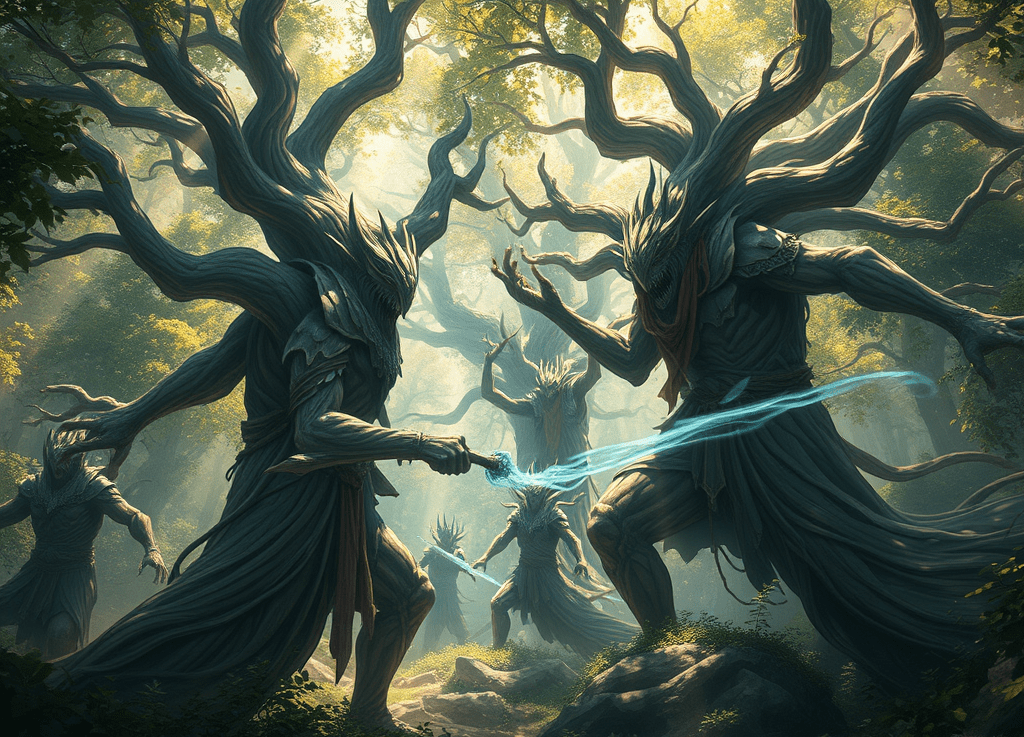
The Battle of the Trees

The Battle of the Trees


I have been in many shapes,
Before I attained a congenial form.
I have been a narrow blade of a sword.
(I will believe it when it appears.)
I have been a drop in the air.
I have been a shining Star.
I have been a word in a book.
I have been a book originally.
I have been a light in a lantern.
A year and a half.
I have been a bridge for passing over
Three-score rivers.
I have journeyed as an eagle.
I have been a boat on the sea.
I have been a director in battle.
I have been the string of a child’s swaddling clout.
I have been a sword in the hand.
I have been a shield in the fight.
I have been the string of a harp,
Enchanted for a year
In the foam of water.
I have been a poker in the fire.
I have been a tree in a covert.
There is nothing in which I have not been.
I have fought, though small,
In the Battle of Goddeu Brig,
Before the Ruler of Britain,
Abounding in fleets.
Indifferent bards pretend,
They pretend a monstrous beast,
With a hundred heads,
And a grievous combat
At the root of the tongue.
And another fight there is
At the back of the head.
A toad having on his thighs
A hundred claws,
A spotted crested snake,
For punishing in their flesh
A hundred souls on account of their sins.
I was in Caer efynedd,
Thither were hastening grasses and trees.
Wayfarers perceive them,
Warriors are astonished
At a renewal of the conflicts
Such as Gwydion made.
There is calling on Heaven,
And on Christ that he would effect
Their deliverance,
The all-powerful Lord.
If the Lord had answered,
Through charms and magic skill,
Assume the forms of the principal trees,
With you in array
Restrain the people
Inexperienced in battle.
When the trees were enchanted
There was hope for the trees,
That they should frustrate the intention
Of the surrounding fires….
Better are three in unison,
And enjoying themselves in, a circle,
And one of them relating
The story of the deluge,
And of the cross of Christ,
And of the Day of judgement near at hand.
The alder-trees in the first line,
They made the commencement.
Willow and quicken tree,
They were slow in their array.
The plum is a tree
Not beloved of men;
The medlar of a like nature,
Over coming severe toil.
The bean bearing in its shade
And army of phantoms.
The raspberry makes
Not the best of food.
In shelter live,
The privet and the woodbine,
And the ivy in its season.
Great is the gorse in battle.
The cherry-tree had been reproached.
The birch, though very magnanimous,
Was late in arraying himself;
It was not through cowardice,
But on account of his great size.
The appearance of the …
Is that of a foreigner and a savage.
The pine-tree in the court,
Strong in battle,
By me greatly exalted
In the presence of kings,
The elm-trees are his subjects.
He turns not aside the measure of a foot,
But strikes right in the middle,
And at the farthest end.
The hazel is the judge,
His berries are thy dowry.
The privet is blessed.
Strong chiefs in war
And the … and the mulberry.
Prosperous the beech-tree.
The holly dark green,
He was very courageous:
Defended with spikes on every side,
Wounding the hands.
The long-enduring poplars
Very much broken in fight.
The plundered fern;
The brooms with their offspring:
The furze was not well behaved
Until he was tamed
The heath was giving consolation,
Comforting the people –
The black cherry-tree was pursuing.
The oak-tree swiftly moving,
Before him tremble heaven and earth,
Stout doorkeeper against the foe
Is his name in all lands.
The corn-cockle bound together,
Was given to be burnt.
Others were rejected
On account of the holes made
By great violence
In the field of battle.
Very wrathful the …
Cruel the gloomy ash.
Bashful the chestnut-tree,
Retreating from happiness.
There shall be a black darkness,
There shall be a shaking of the mountain,
There shall be a purifying furnace,
There shall first be a great wave,
And when the shout shall be heard,
Putting forth new leaves are the tops of the beech,
Changing form and being renewed from a withered state;
Entangled are the tops of the oak.
From the Gorchan of Maelderw.
Smiling at the side of the rock
(Was) the pear-tree not of an ardent nature.
Neither of mother or father,
When I was made,
Was my blood or body;
Of nine kinds of faculties,
Of fruit of fruits,
Of fruit God made me,
Of the blossom of the mountain primrose,
Of the buds of trees and shrubs,
Of earth of earthly kind.
When I was made
Of the blossoms of the nettle,
Of the water of the ninth wave,
I was spell-bound by Math
Before I became immortal.
I was spell-bound by Gwydion,
Great enchanter of the Britons,
Of Eurys, of Eurwn,
Of Euron, of Medron,
In myriads of secrets,
I am as learned as Math….
I know about the Emperor
When he was half burnt.
I know the star-knowledge
Of stars before the earth (was made),
Whence I was born,
How many worlds there are.
It is the custom of accomplished bards
To recite the praise of their country.
I have played in Lloughor,
I have slept in purple.
Was I not in the enclosure
With Dylan Ail Mor,
On a couch in the centre
Between the two knees of the prince
Upon two blunt spears?
When from heaven came
The torrents into the deep,
Rushing with violent impulse.
(I know) four-score songs,
For administering to their pleasure.
There is neither old nor young,
Except me as to their poems,
Any other singer who knows the whole of the nine hundred
Which are known to me,
Concerning the blood-spotted sword.
Honour is my guide.
Profitable learning is from the Lord.
(I know) of the slaying of the boar,
Its appearing, its disappearing,
Its knowledge of languages.
(I know) the light whose name is Splendour,
And the number of the ruling lights
That scatter rays of fire
High above the deep.
I have been a spotted snake upon a hill;
I have been a viper in a lake;
I have been an evil star formerly.
I have been a weight in a mill.
My cassock is red all over.
I prophesy no evil.
Four score puffs of smoke
To every one l who will carry them away:
And a million of angels,
On the point of my knife.
Handsome is the yellow horse,
But a hundred times better
Is my cream-coloured one,
Swift as the sea-mew,
Which cannot pass me
Between the sea and the shore.
Am I not pre-eminent in the field of blood?
I have a hundred shares of the spoil.
My wreath is of red jewels,
Of gold is the border of my shield.
There has not been born one so good as I,
Or ever known,
Except Goronwy,
From the dales of Edrywy.
Long and white are my fingers,
It is long since I was a herdsman.
I travelled over the earth
Before I became a learned person.
I have travelled, I have made a circuit,
I have slept in a hundred islands;
I have dwelt in a hundred cities.
Learned Druids,
Prophesy ye of Arthur?
Or is it me they celebrate,
And the Crucfixion of Christ,
And the Day of Judgement near at hand,
And one relating
The history of the Deluge ?
With a golden jewel set in gold
I am enriched;
And I am indulging in pleasure
Out of the oppressive toil of the goldsmith.


Dating fraud

Dating fraud


Remember colour ,language and distance dons’t matter,but LOVE matters a lot in life.

Bovenstaande spreuk kom ik vaak tegen als reactie op mijn advertentie in dating-sites, tot nog toe kwamen die reacties ergens uit Ghana, meestal vergezeld met een lang verhaal over een meisje dat familie was van een belangrijk ex-regeringslid die vermoord werd tijdens een opstand, waardoor een erfenis vrijkomt. Klinkt leuk, maar het geld zit vast en er zijn nog advocatenkosten te voldoen.

Klinkt dit bekend?

Flessentrekkerij!

Atlantis

Atlantis


De Griekse filosoof Plato (427-347 voor Christus) was de eerste die over Atlantis schreef in zijn dialogen Timaeos en Kritias.
Hij leek ervan overtuigd dat dit land werkelijk heeft bestaan, omdat de grootvader van zijn oom Kritias hierover verhalen had gehoord van Solon, die het weer van een Egyptische priester had gehoord.
Hoe het land eruit zag, is door Plato in detail beschreven.
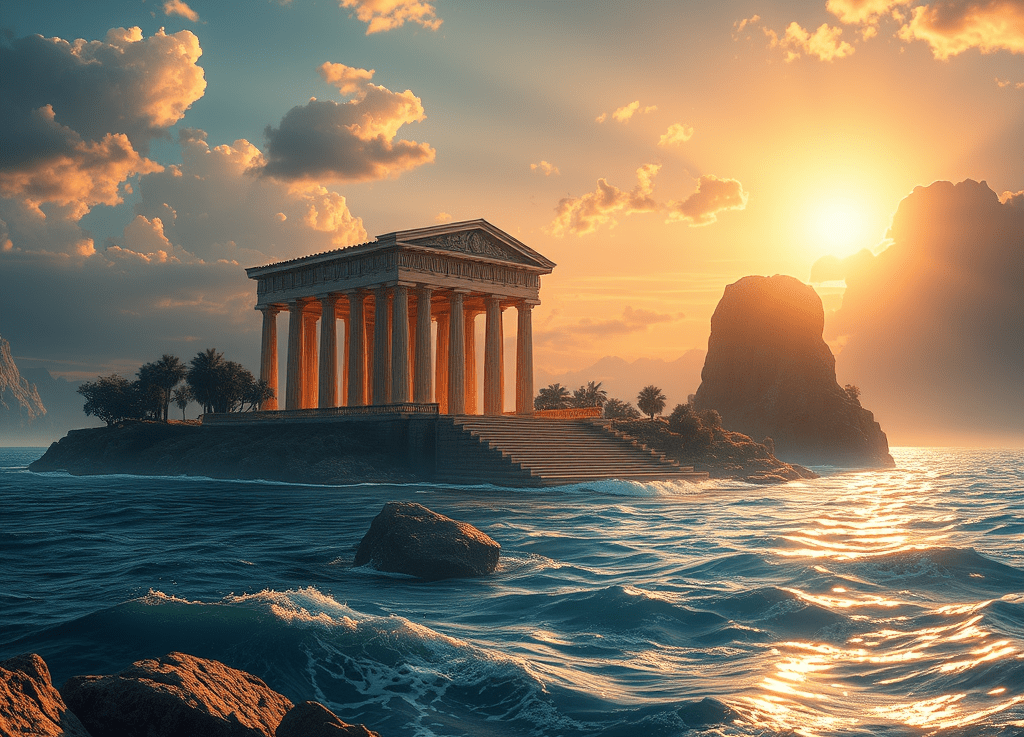
Onder andere was er op het eiland een tempel gewijd aan Poseidon, de god van de zee, dit is omdat het eiland door de Goden aan Poseidon werd toebedeeld.

Het eiland Atlantis zou buiten de Middellandse Zee moeten hebben gelegen, dus nog verder dan de Zuilen van Hercules (de straat van Gibraltar).

Volgens Plato verdween het rijk ongeveer 9500 voor Christus door een wereldwijde catastrofe, een soort zondvloed, waardoor ieder spoor van het land werd weggewist.
Atlantis zou volgens de Griekse mythologie wegens hoogmoed van de bewoners uit straf door de god Kronos (de vader van Zeus) zijn vernietigd.

Hoewel ik sceptisch ben mbt diverse Atlantis-theorietjes die na Plato zijn beschreven, heeft dit verhaal een enorme emotionele impact op mij.
Ooit had ik een trance-reis met bepaalde beelden over de laatste tempel van Poseidon, die beelden heb ik verwerkt in mijn gedicht.

Misschien heeft dit te maken met een leven in een andere tijdruimte, of is het een sterke imprint van een ervaring in de Droomtijd.

Non, je ne regrette rien

Non, je ne regrette rien


Non, rien de rien, non, je ne regrette rien! Ni le bien qu’on m’a fait, ni le mal; tout ça m’est bien egal! Non, rien de rien, non, je ne regrette rien! C’est payé, balayé, oublié. Je me fous du passé! Avec mes souvenirs j’ai allumé le feu! Mes chagrins, mes plaisirs, je n’ai plus besoin d’eux! Balayés les amours avec leurs trémolos, balayer pour toujours! Je repars à zéro. Non, rien de rien, non, je ne regrette rien! Ni le bien qu’on m’a fait, ni le mal; tout ça m’est bien egal! Non, rien de rien, non, je ne regrette rien! Car ma vie, car me joies aujourd’hui ça commence avec toi! Charles Dumont / Michel Vaucaire / Edith Piaf

Nathalie

Nathalie


La Place Rouge tait vide Devant moi marchait Nathalie Elle avait un joli nom, mon guide Nathalie La Place Rouge tait blanche La neige faisait un tapis Et je suivait par ce froid dimanche Nathalie Elle parlait en phrases sobres De la Rvolution d’Octobre Je pensais dj Qu’aprs le tombeau de Lnine On irait au Caf Pouchkine Boire un chocolat La Place Rouge tait vide Je lui pris son bras, elle a souri Il avait des cheveux blonds, mon guide Nathalie, Nathalie Dans sa chambre, a l’universit Une bande d’tudiants L’attendait impatiemment On a ri, on a beaucoup parl Ils voulaient tout savoir Nathalie traduisait Moscou, les plaines de Krim Et les Champs-Elyses On a tout mlang et on a chant Et puis, ils ont dbouch En riant l’avance Du champagne de France Et on a dans Et quand la chambre fut vide Tous les amis taient partis Je suis rest seul avec mon guide Nathalie Plus d’questions de phrases sobres Ni d’au Rvolution d’Octobre On n’en tait plus l Fini le tombeau de Lnine Le chocolat de chez Pouchkine C’est, c’tait loin dj Que ma vie me semble vide Mais je sais qu’un jour Paris C’est moi qui lui servirai de guide Nathalie Nathalie Bcaud Gilbert –

Paris

Paris


Je suis l’dauphin d’la place Dauphine
Et la place Blanche a mauvaise mine
Les camions sont pleins de lait
Les balayeurs sont pleins d’balais

Il est cinq heures
Paris s’éveille
Paris s’éveille

Les travestis vont se raser
Les stripteaseuses sont rhabillées
Les traversins sont écrasés
Les amoureux sont fatigués

Il est cinq heures
Paris s’éveille
Paris s’éveille

Le café est dans les tasses
Les cafés nettoient leurs glaces
Et sur le boulevard Montparnasse
La gare n’est plus qu’une carcasse

Il est cinq heures
Paris s’éveille
Paris s’éveille

La tour Eiffel a froid aux pieds
L’Arc de Triomphe est ranimé
Et l’Obélisque est bien dressé
Entre la nuit et la journée

Il est cinq heures
Paris s’éveille
Paris s’éveille

Les banlieusards sont dans les gares
A la Villette on tranche le lard
Paris by night, regagne les cars
Les boulangers font des bâtards

Il est cinq heures
Paris s’éveille
Paris s’éveille

Les journaux sont imprimés
Les ouvriers sont déprimés
Les gens se lèvent, ils sont brimés
C’est l’heure où je vais me coucher

Il est cinq heures
Paris se lève
Il est cinq heures
Je n’ai pas sommeil

Jacques Dutronc

Le Moribond

Le Moribond


Adieu Chirac je t’aimais bien Adieu Chirac je t’aimais bien tu sais On a chanté les mêmes vins On a chanté les mêmes filles On a chanté les mêmes chagrins Adieu Chirac je vais mourir C’est dur de mourir au printemps tu sais Mais je pars aux fleurs la paix dans l’âme Car vu que tu es bon comme du pain blanc Je suppose que tu prendras soin de la France Je veux qu’on rie Je veux qu’on danse Je veux qu’on s’amuse comme des fous Je veux qu’on rie Je veux qu’on danse Quand c’est qu’on me mettra dans le trou Adieu Royal je t’aimais bien Adieu Royal je t’aimais bien tu sais On n’était pas du même bord On n’était pas du même chemin Mais on cherchait le même port Adieu Royal je vais mourir C’est dur de mourir au printemps tu sais Mais je pars aux fleurs la paix dans l’âme Car vu que tu étais sa confidente Je sais que tu prendras soin de la France Je veux qu’on rie Je veux qu’on danse Je veux qu’on s’amuse comme des fous Je veux qu’on rie Je veux qu’on danse Quand c’est qu’on me mettra dans le trou Adieu Sarko je t’aimais pas bien Adieu Sarko je t’aimais pas bien tu sais J’en crève de crever aujourd’hui Alors que toi tu es bien vivant Et même plus solide que l’ennui Adieu Sarko je vais mourir C’est dur de mourir au printemps tu sais Mais je pars aux fleurs la paix dans l’âme Car vu que tu étais son amant Je sais que tu prendras soin de la France Je veux qu’on rie Je veux qu’on danse Je veux qu’on s’amuse comme des fous Je veux qu’on rie Je veux qu’on danse Quand c’est qu’on me mettra dans le trou Adieu la France je t’aimais bien Adieu la France je t’aimais bien tu sais Mais je prends le train pour le Bon Dieu Je prends le train qui est avant le tien Mais on prend tous le train qu’on peut Adieu la France je vais mourir C’est dur de mourir au printemps tu sais Mais je pars aux fleurs les yeux fermés la France Car vu que je les ai fermés souvent Je sais que tu prendras soin de mon âme Je veux qu’on rie Je veux qu’on danse Je veux qu’on s’amuse comme des fous Je veux qu’on rie Je veux qu’on danse Quand c’est qu’on me mettra dans le trou Jacques Brel –

Die Lorelei

Die Lorelei


Ich weiß nicht, was soll es bedeuten, Daß ich so traurig bin, Ein Märchen aus uralten Zeiten, Das kommt mir nicht aus dem Sinn. Die Luft ist kühl und es dunkelt, Und ruhig fließt der Rhein; Der Gipfel des Berges funkelt, Im Abendsonnenschein. Die schönste Jungfrau sitzet Dort oben wunderbar, Ihr gold’nes Geschmeide blitzet, Sie kämmt ihr goldenes Haar, Sie kämmt es mit goldenem Kamme, Und singt ein Lied dabei; Das hat eine wundersame, Gewalt’ge Melodei. Den Schiffer im kleinen Schiffe, Ergreift es mit wildem Weh; Er schaut nicht die Felsenriffe, Er schaut nur hinauf in die Höh’. Ich glaube, die Wellen verschlingen Am Ende Schiffer und Kahn, Und das hat mit ihrem Singen, Die Loreley getan. Heinrich Heine, 1823

Zu Bacharach am Rheine

Zu Bacharach am Rheine


Zu Bacharach am Rheine Wohnt eine Zauberin, Sie war so schön und feine Und riß viel Herzen hin. Und brachte viel zu schanden Der Männer rings umher, Aus ihren Liebesbanden War keine Rettung mehr. Der Bischof ließ sie laden Vor geistliche Gewalt – Und mußte sie begnaden, So schön war ihr’ Gestalt. Er sprach zu ihr gerühret: "Du arme Lore Lay! Wer hat dich denn verführet Zu böser Zauberei?" "Herr Bischof laßt mich sterben, Ich bin des Lebens müd, Weil jeder muß verderben, Der meine Augen sieht. Die Augen sind zwei Flammen, Mein Arm ein Zauberstab – O legt mich in die Flammen! O brechet mir den Stab!" "Ich kann dich nicht verdammen, Bis du mir erst bekennt, Warum in diesen Flammen Mein eigen Herz schon brennt. Den Stab kann ich nicht brechen, Du schöne Lore Lay! Ich müßte dann zerbrechen Mein eigen Herz entzwei." "Herr Bischof mit mir Armen Treibt nicht so bösen Spott, Und bittet um Erbarmen, Für mich den lieben Gott. Ich darf nicht länger leben, Ich liebe keinen mehr – Den Tod sollt Ihr mir geben, Drum kam ich zu Euch her. – Mein Schatz hat mich betrogen, Hat sich von mir gewandt, Ist fort von hier gezogen, Fort in ein fremdes Land. Die Augen sanft und wilde, Die Wangen rot und weiß, Die Worte still und milde Das ist mein Zauberkreis. Ich selbst muß drin verderben, Das Herz tut mir so weh, Vor Schmerzen möcht’ ich sterben, Wenn ich mein Bildnis seh’. Drum laßt mein Recht mich finden, Mich sterben, wie ein Christ, Denn alles muß verschwinden, Weil er nicht bei mir ist." Drei Ritter läßt er holen: "Bringt sie ins Kloster hin, Geh Lore! – Gott befohlen Sei dein berückter Sinn. Du sollst ein Nönnchen werden, Ein Nönnchen schwarz und weiß, Bereite dich auf Erden Zu deines Todes Reis’." Zum Kloster sie nun ritten, Die Ritter alle drei, Und traurig in der Mitten Die schöne Lore Lay. "O Ritter laßt mich gehen, Auf diesen Felsen groß, Ich will noch einmal sehen Nach meines Lieben Schloß. Ich will noch einmal sehen Wohl in den tiefen Rhein, Und dann ins Kloster gehen Und Gottes Jungfrau sein." Der Felsen ist so jähe, So steil ist seine Wand, Doch klimmt sie in die Höhe, Bis daß sie oben stand. Es binden die drei Ritter, Die Rosse unten an, Und klettern immer weiter, Zum Felsen auch hinan. Die Jungfrau sprach: "da gehet Ein Schifflein auf dem Rhein, Der in dem Schifflein stehet, Der soll mein Liebster sein. Mein Herz wird mir so munter, Er muß mein Liebster sein!-" Da lehnt sie sich hinunter Und stürzet in den Rhein. Die Ritter mußten sterben, Sie konnten nicht hinab, Sie mußten all verderben, Ohn’ Priester und ohn’ Grab. Wer hat dies Lied gesungen? Ein Schiffer auf dem Rhein, Und immer hat’s geklungen Von dem drei Ritterstein: Lore Lay Lore Lay Lore Lay Als wären es meiner drei. (Clemens Brentano, 1800)