Tag: death

De droom van Onze Lieve Vrouwe

De droom van Onze Lieve Vrouwe


Ik was in het Onze Lieve Vrouwe Gasthuis voor een scan en lag in de MRI cabine:

Het lijkt wel een glazen kist uit een sprookje.
Via de koptelefoon klinkt klassieke muziek: Solveig’s lied!

Mijn ogen sluiten zich, ik droom weg…

Het bed verandert in een sloep dat wegdrijft over de rivier naar de droomtijd en brengt me naar het Regenboog Eiland. 

In de mist zie ik een stille vage gestalte, gehuld in een mantel die het gezicht bedekt met een kap.

Naderbij komend zie ik meer:
De mantel tonen de contouren van een magere gestalte.
Het gelaat onder de kap wordt langzaam duidelijk:
De linkerhelft toont de kale schedel van een geraamte, de rechterhelft toont het gezicht van een beeldschone vrouw.

Ze wenkt en neemt me mee over een smal pad.
We lopen over rotsige stenen die verderop veranderen in doornstruiken.
Het pad wordt smaller en komt uit op een brug dat zo smal is als een vlijmscherp zwaard.
Op de achtergrond hoor ik gezang: ..This ae nighte…
Over de dunne brug lopend kijk ik naar beneden en zie de knekels van degenen die eerder hier waren geweest.

Uiteindelijk komen we bij een ijzeren poort in een donkere berg.
Iemand roept: ‘wie hier binnentreedt verliest alle hoop!’

Ik loop achter mijn gids aan door de poort.
Gaandeweg verlies ik alles wat ik bij me heb: rugzak, kleren…
Ik verlies mijn huid, mijn vlees, mijn botten, mijn gedachten…
Ik los op in de donkerte en kom tot rust in een droomloze slaap…


Er klinkt weer gezang: ‘Wake Again”

Het wordt lichter om me heen.
Langzamerhand kom ik terug in de dagelijkse werkelijkheid.

In mijn hand vind ik een steen die ik kennelijk heb meegenomen uit de andere wereld.
Het is een kleine, platte, ronde steen met een gat in het midden.

Ik kijk door het gat in de steen en zie de andere werkelijkheid achter de dagelijkse, als een gedimd licht onder een mantel.


Even death may die in Mythago World

Even death may die in Mythago World


Beneath Gotham, something moved.
At first it was mistaken for settling stone: a faint grinding, a tremor beneath the broken foundations.
Then came a sound no human throat could have produced—a wet metallic groan rising from somewhere below the oldest streets.
The remnants of the dragon had not died.
Its enormous body lay crushed beneath the Clockwork Golem, but the creature’s blackened heart still pulsed.
Each beat sent a dull crimson light through the cracks in its scales.
Worse still, the Golem’s broken mechanisms had begun turning again, driven by that alien rhythm.
Dragon and machine were becoming one.

Engineer Leonardo understood before anyone else.
“We must bury them deeper.”

But Lady Blackbird shook her head.
“You cannot bury something that wants to dig upward.”

Meanwhile, the revolution had reached its decisive hour.
Macdonald’s mercenaries, exhausted and surrounded, abandoned their barricades.
The citizens poured into the streets.
Yet victory proved less glorious than the revolutionaries had imagined.
There was no perfect republic waiting beneath the rubble, only arguments, hunger, fear, and men suddenly discovering that power was easier to destroy than to govern.

For several bitter weeks, Gotham existed without a master.
Then the rebuilding began.
Not with towers.
With sewers.
With bridges.
With hospitals and kitchens and workshops.

Stone by stone, the citizens reclaimed their city.
The South Tower remained a jagged monument.
The North Tower was left untouched, because every mason who approached it reported hearing gears turning beneath the earth.
Gotham rebuilt itself, though never completely.
New streets crossed the old foundations.
New towers rose where ancient blood had soaked the soil.
Children played in markets whose stones still bore the scars of dragon fire.
And beneath them all, far below the city, two hearts continued their impossible rhythm.
One organic.
One mechanical.
Together.
Waiting.

Gotham had survived.
But something beneath Gotham had survived with it.


ping:

Lessons from a Dream: Navigating Loss

Lessons from a Dream: Navigating Loss


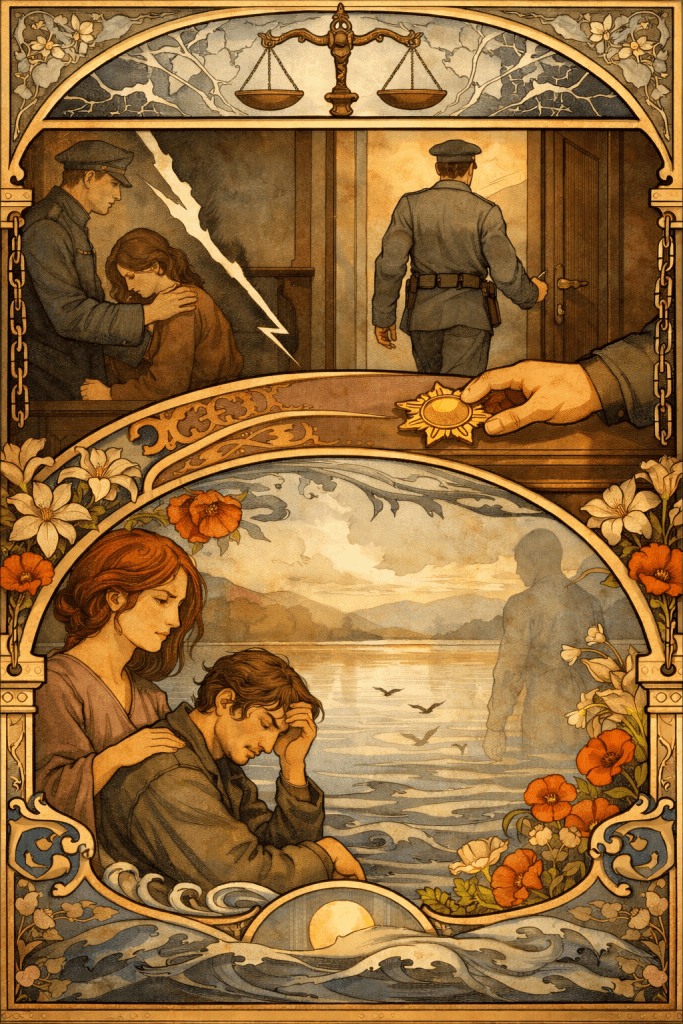
I belonged to a unit that called itself orderly, though order there was a brittle thing, like frost on a window that vanishes at a breath.
We wore the same colors, spoke the same clipped phrases, and trusted—so we said—the same chain of command.
But one morning our leader turned his gaze upon a colleague of mine, a quiet woman who kept her counsel and did her work with a steady hand.
He judged her in haste, and his words were a blade without temper.
I felt the cut as if it had found my own skin.

In that moment I understood how a structure may stand and yet be hollow.
Justice, we had been taught, was the spine of our work.
Without it, we were only shadows moving in formation.
I placed my badge upon the desk, a small sun gone cold, and stepped out of that narrow world.
No one stopped me.
The door closed with a sound like a verdict, though I could not say upon whom it fell.

…

The dream shifted, as dreams do, into a softer country.
I was among friends—no uniforms, no ranks—only the fragile, luminous ties we make of laughter and shared hours.
We walked beside water that held the sky like a second, deeper truth.
There was someone there who mattered to me in ways I had never named, as one does not name the air until it is gone.

Then a friend approached, her face already carrying the news before her lips shaped it.
The words were simple, and because they were simple they were absolute: he was gone.
The world did not break; it thinned.
Sound grew distant, as if I stood beneath the surface of the water we had walked beside.

Grief came not as a storm but as a tide—inevitable, patient.
It filled the spaces where certainty had been.
I learned then that leaving and losing are kin, each a doorway we do not choose, each remaking the shape of the self that passes through.

← Back

Thank you for your response. ✨

Healing Ancestral Grief

Healing Ancestral Grief


The child, in mourning, weeps for those long gone,
For ancestors whose voices fade away,
Whose stories die upon a dying tongue,
And wisdom buried deep in shadowed clay.
A broken mosaic scattered on the earth,
And in the soul a hollow, aching space.
I gaze upon this sorrowed child in pain,
And feel the weight of helplessness upon me.
What can I do? How can the wound be healed,
That time and grief have carved so deep within?
I call upon the spirits of the past,
And they, like winds, come swift to ease my mind.
The creatures of the strength and ancient wild,
The dog and hare, bring warmth to frozen heart,
And still the aching cry that rends the night.

Ping:

A Child’s Perspective on grief

A Child’s Perspective on grief


The child curls inward
at the edge of the room,
breath rocking the dark,
learning silence.

Where is Father, where is Mother?
Working, the walls say.
They will come with night.

Father, Mother—
where have you gone?
Hush now.
Time is only waiting.
All will be well.

—

For a month we drift
toward a warmer latitude.
The air sticks to the skin.
Sleep splits open—
a giant leans through plaster,
coffins loosen their teeth,
goblins gather where lamps fail.

Where is Father, where is Mother?
Father is always in motion.
Mother bends the day into bread.

—

For days we rise
into cold air,
crossing white distances.
My room draws closer,
tightens its grip.

Where are you now?
Father burns beneath a spotlight.
Mother works the hours thin.

—

Where is Father, where is Mother?
They return to the sunlit place.
You remain.
This will be called
a future.

—

My life unwinds
along a crooked thread.

—

Where is Father, where is Mother?
They come back through the cold.
Each of us learns
the grammar of separation.

—

Where is Father, where is Mother?
Father keeps moving,
a body harnessed to applause.
Mother holds the household
together with her hands.

—

Father was meant to stop,
to stand beside Mother—
but Santa Muerte steps forward,
quiet and exact.

Questions scatter.
None return.

His mourners shape the farewell;
we stand inside the brightness,
unvoiced.

Mother waits
in the antechamber of bones and prayer.
I sit with her there
until the door opens.

—

Mother—
I spoke my leaving.

Father—
with you,
the words stayed behind.

—

Father,
even now
my mouth is full
of what I never said.


Wandering in an Alien Land: A Poem of Loss

Wandering in an Alien Land: A Poem of Loss


The Elders assembled beneath the frozen Sun,
When the Wheel of the Year stood still in shadow.
They brake the Bread of Mystery,
They lifted the Wine of Vision,
And their voices rose like smoke from the altar of Time.

Lo! At every Feast the Young grow fewer,
And the Hoary Head multiplies upon the earth.
The Songs of Old no longer kindle the inward Eye,
For the Children of this Age hear them not.

The Heavens are shut; no Thunder answers prayer.
The Firmament is brass, and gives no sign.
Thus the Powers Below are forgotten,
And the Deep is emptied of its dread.

Behold! Our People waste away.
We are scattered sparks upon cold ground,
Strangers walking in an alien Land.
We wander the Waste; we tread the scorched Field;
We sleep beneath a Sun that does not know us.

One by one we pass through the Gate unseen,
Descending softly into the Kingdom of Shades,
Where names are unspoken
And memory fades into silence.

(A.I. poem inspired by William Blake)


Gotham Mystery Tale: mask on/off

Gotham Mystery Tale: mask on/off


Midwinter bal masque in Gotham during martial law lockdown: Only Highlords like Vladimir are able to bribe the Administration to look the other way.
While the Authority is dancing, the Underground organises the ongoing Revolution:
some members of the resistance group “Gotham Angels'” went undercover to the masque ball of Highlord Vladimir, scouting opportunities for the resistance.
…
Using fake invitation letters, Marquisio the Hunter and Fieldy the automaton Scarecrow disguised themselves with the obligatory  Commedia dell’Arte masks and costumes.

Vladimirs large ballroom was very crowded, at least hundred guests were already dancing and flirting.
Large tables with food and drinks were set up, more than enough to feed the multitude during the weeklong festival.

Marquisio was unable to resist his hunger and started to feed!

A Columbina in red approached and started flirting with Marquisio…
Enticing him to follow her to ‘a more private place’ in the mansion, it became apparent that she was part of another faction that wished the downfall of the Authority.
“Take this secret letter with magic symbols to the Tribe”
…
Meeting the tribal shaman went quite well: after receiving the secret letter, he brew some “strong medicine” to use at the bal masque.
…
Returning to the festival, Marquisio created some distraction by throwing stones at the chandeliers.
While the guards were chasing the culprit, Feeldy scattered the ” strong medicine ” through the ballroom.
…
Our heroes were able to escape during the chaos and went to their hideout to wait till the heat blew over.
…
Escalating alarming words on the street:
“Many people, who joined the festival, are very ill now”
“The Authority is tightening lockdown: curfew between sundown and sunup, mandatory wearing face covering, limiting gathering of groups”
…
Marquisio and Feeldy realised that the ” strong medicine ” was getting out of control!
…
They looked for the tribal shaman, but he already left the city.
…
Following the trails, they saw four riders on a hill having a palaver.
…
Approaching the four riders, they recognised the tribal shaman in white,  carrying bow and arrow.
When asked for a cure, the shaman demanded a life sacrifice.
…
Feeldy stepped forward and opened his chest and a small boy jumped out!
As soon as the shaman performed the sacrifice, the essence of the small boy became a cloudy ball that entered Feedly’s chest again!
Satisfied with the sacrifice, the shaman let our heroes go home:
“It is done! Innocents will be spared!”

Ping:

Gotham Blades in the Dark Revolt

A.I. reviews “The Relics of Nature”

A.I. reviews “The Relics of Nature”


A.I., review this!

This collage creates an eerie and mysterious atmosphere with its combination of organic and decayed elements.
The focal point appears to be a combination of bones and what looks like moss or lichen growing on a weathered surface, perhaps representing life and death in a cyclical, intertwined way.

The use of the torn paper edges adds a raw, fragmented texture, creating a sense of disintegration or transformation.
The contrast between the green mossy surface and the darker tones of the skulls gives the impression of a nature reclaiming what was once alive—suggesting a theme of decay or the passage of time.
The mix of vibrant and muted colors creates tension between life (the green, moss-like areas) and death (the skeletal remains), adding depth to the composition.

The background also includes some metallic elements, perhaps representing a link between nature and something more industrial or alien.
The overall effect is a haunting visual that feels both unsettling and beautiful, with layers of meaning that could be interpreted in various ways, from the ravages of time to the cycles of nature.

A potential theme for this artwork could be “The Relics of Nature,” exploring the relationship between life, death, and the ongoing transformation of the natural world.

ORACLE

The central jagged form rising upward looks like a spire or a flame.
That often represents transformation, ambition, or a push toward something higher.
Around it, the green, almost moss-like texture suggests growth, healing, or something slowly reclaiming space.

The darker edges and tangled elements at the bottom give a sense of old structures, past struggles, or things breaking down.
They aren’t gone—but they’re being overtaken.

Oracle message:
You’re in a phase where something within you is rising despite chaos or decay around it.
Growth may feel messy, uneven, or even destructive—but it’s still growth.
Let go of what’s crumbling; it’s making space for something stronger and more aligned.


Ping: A.I. reviews “Embers of Rebellion” – Dreamquest

A.I. maakt een pantoum: Ik ben op reis en ik neem mee…

A.I. maakt een pantoum: Ik ben op reis en ik neem mee…


A.I., maak een pantoum!

Ik ben op reis en ik neem mee…
Waarom ga ik op reis?
Op de vlucht voor de vier ruiters van de Apocalyps:
Ziekte, honger, oorlog, dood…

Waarom ga ik op reis?
Wat is urgent:
Ziekte, honger, oorlog, dood…
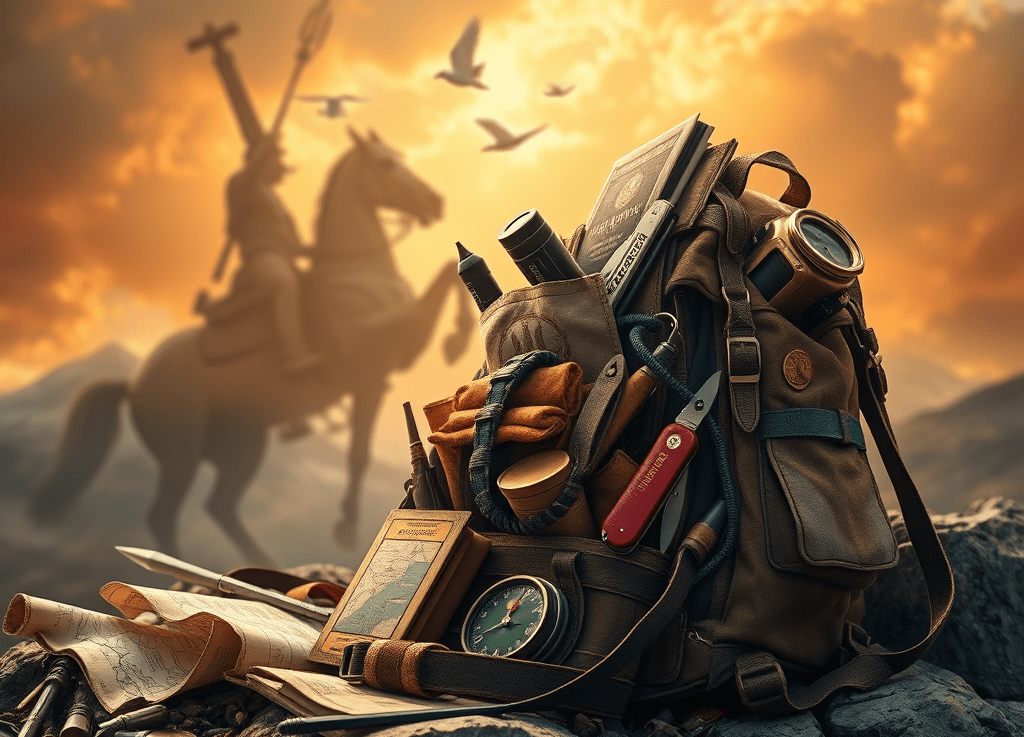
Zwitsers zakmes, vuursteen, veldfles, rugzak…

Wat is urgent:
Poncho, handboek survival, potlood, dagboek, kompas…
Zwitsers zakmes, vuursteen, veldfles, rugzak…
Knijpkat, EHBO-kist, powerbank met zonnepaneel…

Poncho, handboek survival, potlood, dagboek, kompas…
Mobiel, miniradio, kleren, I Ching, speelkaarten…
Knijpkat, EHBO-kist, powerbank met zonnepaneel…
Gedroogd voedsel, landkaart,is alles wat ik neem.

Mobiel, miniradio, kleren, I Ching, speelkaarten…
Gedroogd voedsel, landkaart, is alles wat ik neem.
Gedroogd voedsel, landkaart, is alles wat ik neem…
Ik ben op reis en ik neem mee…

Ping:

A.I.  reviews “Echoes of Nature: Ruin and Renewal”

A.I. reviews “Echoes of Nature: Ruin and Renewal”


A.I. , review this!

This collage presents an evocative blend of natural and man-made environments, intertwining themes of growth, decay, and nostalgia.

– The **top section** includes a painterly landscape reminiscent of Impressionist works, possibly alluding to an idealized vision of nature.
– The **middle portion** contrasts this with photographs of overgrown ruins and abandoned structures, suggesting themes of time’s passage, abandonment, and nature reclaiming human-made spaces.
– The **bottom segment** shows a reflective body of water, reinforcing a sense of depth, tranquility, or possibly the unknown.

The combination of images tells a compelling story about the relationship between civilization and the natural world. It invites reflection on themes like memory, the resilience of nature, and the impermanence of human structures.


ping: