Tag: politic

Gotham and other city states

Gotham and other city states


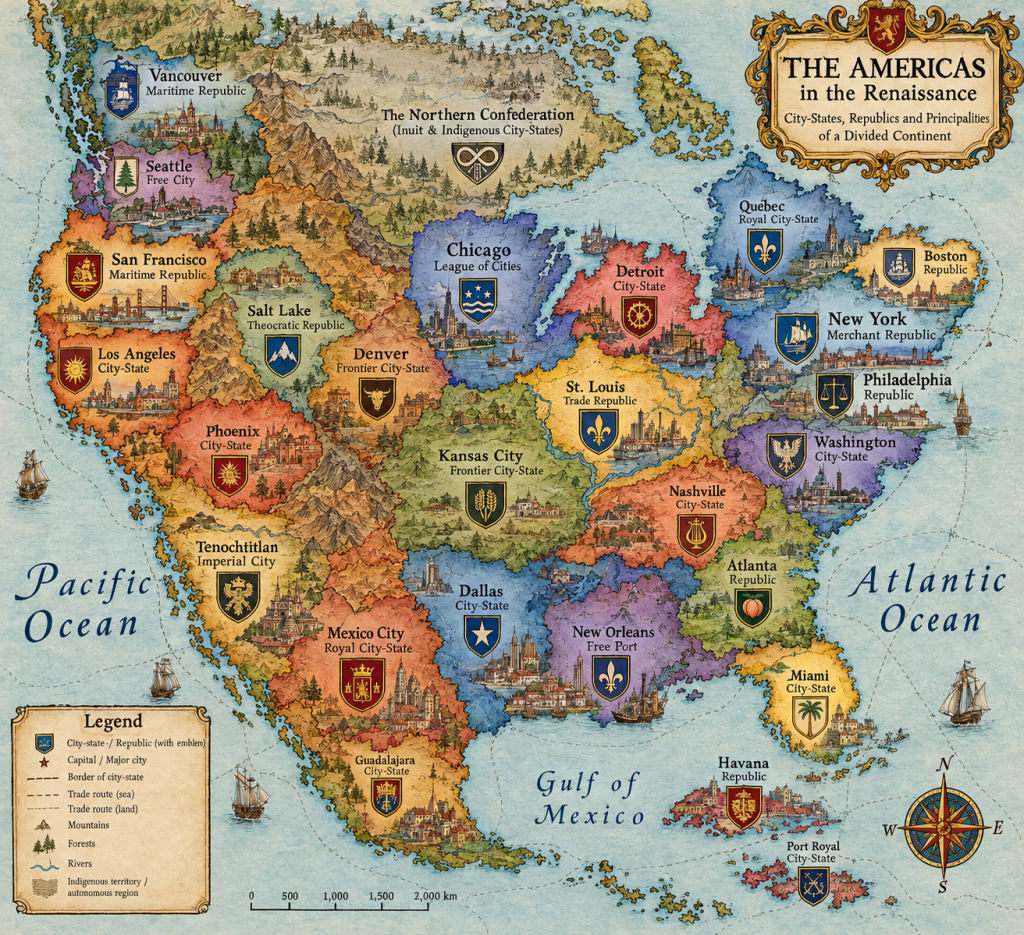
Imagine that America had never become united, but instead had developed like Renaissance Italy: a continent filled with rival city-states, powerful trading republics, principalities, and alliances.

New York, for example, becomes a powerful trading republic on the Atlantic coast, Chicago controls trade across the Great Lakes, and San Francisco emerges as a wealthy maritime city-state on the Pacific coast.

The political landscape might look something like this:

  • New York — a North American Venice, wealthy thanks to maritime trade, bankers, and diplomacy.
  • Boston — a republic of merchants, shipbuilders, and scholars.
  • Chicago — a strategic trading power controlling the connections between the Great Lakes and the interior.
  • San Francisco — a maritime republic with trade routes across the Pacific.
  • New Orleans — an important river city-state controlling access to the Mississippi.
  • Mexico City — a powerful southern empire with its own political and cultural traditions.

Just as in Renaissance Italy, these states would constantly form alliances, wage wars, hire mercenaries, and compete for control of trade routes.
Smaller cities might sometimes become particularly powerful by controlling a mountain pass, a river mouth, or an important harbor.

The fascinating consequence: the United States would not exist as a single country.
Instead, the continent would resemble an American patchwork of Florence, Venice, Genoa, and Milan, alongside larger kingdoms and Indigenous states pursuing their own struggles for power.

Dromen van West

Dromen van West


Het is het jaar 2126.
Ik loop door de Staatsliedenbuurt en herken tegelijk veel en weinig.
De straten zijn groener geworden.
Tussen de huizen groeien bomen, geveltuinen en kleine moestuinen.
Kinderen spelen waar vroeger auto’s stonden.
Op pleinen ontmoeten mensen elkaar, zitten ouderen in de zon en is ruimte voor stilte, beweging en gesprek.

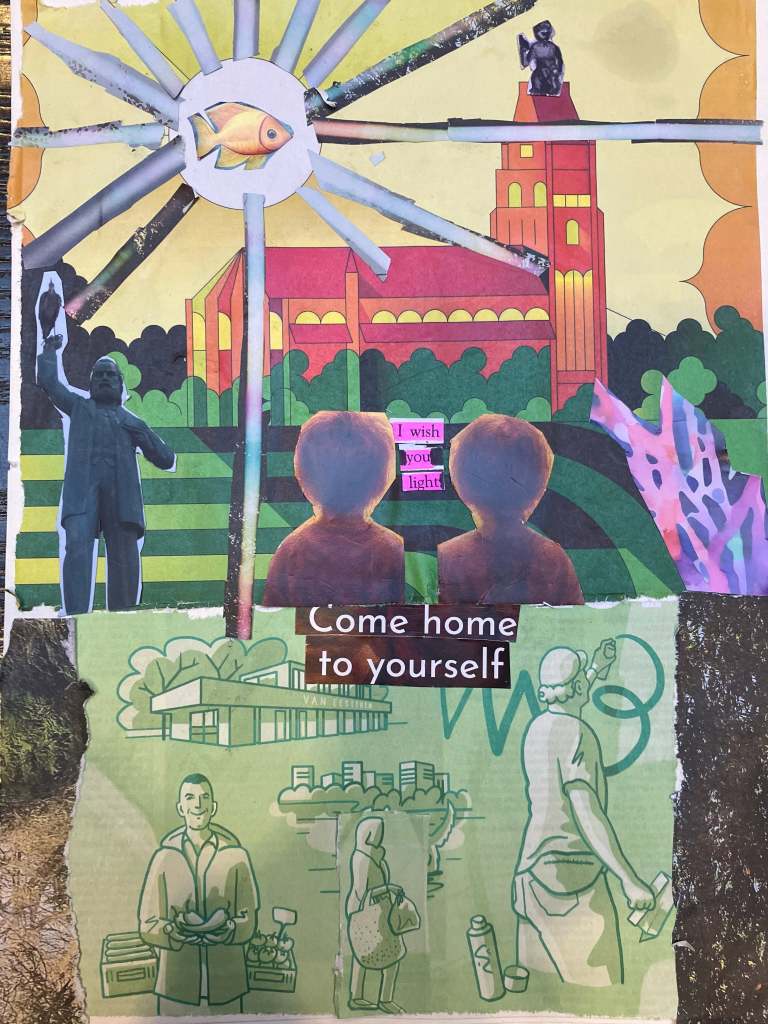
Boven alles rijst de Nassaukerk.
Tweehonderd jaar oud, maar nog altijd levend.
De toren is vertrouwd herkenningspunt en de kerk is opnieuw een hoopgevend ankerpunt voor de buurt.
De deuren staan open.
Hier komen mensen samen die van verschillende werelden afkomstig zijn: geboren in Amsterdam of elders, met uiteenlopende culturele tradities, spiritualiteiten, overtuigingen en levensverhalen.
Ook verschillen in inkomen of sociale positie vormen geen reden om elkaar buiten te sluiten.

In de kerk is plaats voor een buurtmaaltijd, een stiltekring, muziek, lezingen en gesprekken over wat mensen bezighoudt.
Er worden taallessen gegeven, kinderen maken er kunst en jongeren ontmoeten ouderen.
Soms is er een viering, soms een debat, soms gewoon koffie aan een lange tafel.
Niemand hoeft hetzelfde te geloven om zich hier thuis te voelen.

Buiten gaat het verhaal verder.
De markt brengt geuren en smaken uit vele landen samen.
Mensen delen kennis over koken, tuinieren, zorg en duurzaamheid.
Een buur helpt een andere buur met een boodschap; een kind leert van een oudere hoe je planten verzorgt.
De wijk ademt samen.

En ergens tussen al die ontmoetingen zwemt een kleine vis in een zon van licht.
Een eenvoudig beeld, maar ook een herinnering: blijf kijken, blijf dromen.

Want een wijk wordt niet alleen gebouwd met stenen.
Zij wordt gemaakt door mensen die naar elkaar omzien.

Zo hoop ik dat West over honderd jaar voelt: als een plek waar je kunt thuiskomen, bij jezelf én bij elkaar.

Ping:

The enemy within Gotham

The enemy within Gotham


The stone beneath City Hall burst apart.

From the darkness below came a roar like a thousand iron gates dragged across the earth. 

Dust poured from the ceiling. 

Men stumbled. 

Lamps went out one by one, and in that sudden darkness every faction drew steel.
“Hold!” cried Wayne.

But fear had already loosed the arrows.
A Scurlock guard struck a Triad captain across the face. 

The captain answered with a dagger-thrust. 

Three men fell before either lord could speak.

“Traitors!” shouted Scurlock.
His guards formed a shield wall.

Wang’s captains answered with curved blades, darting between the benches like wolves among sheep.

Steel rang against steel. 

One Scurlock man fell beneath a shower of short blades, while another seized a chair and broke it across a Triad soldier’s shoulders.

Lionel’s men stood apart for a heartbeat.
Then Lionel smiled grimly.
“If everyone is fighting,” he said, “we may as well choose a side.”
His guards charged.
The council chamber became a battlefield.
Scurlock’s men fought in tight ranks, their shields locked together. 

Wang’s warriors moved like water, striking from gaps and retreating before the counterstroke. 

Lionel’s mobsters attacked both sides, hoping to break the balance and seize City Hall for themselves.

Wayne drew his sword.
He met the first attacker at the foot of the council table.

Their blades crossed once, twice, three times.
Wayne turned the fourth stroke aside and struck the man’s wrist, sending his sword spinning across the floor.
“Enough!” Wayne thundered.
No one heard him.

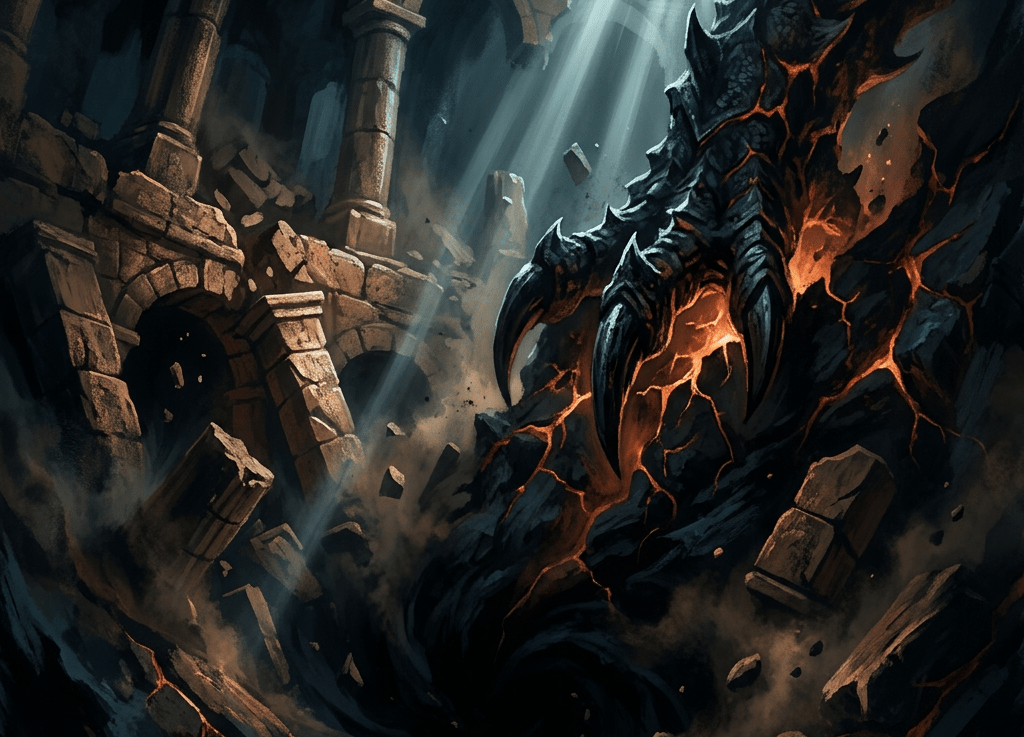
Then the floor split.
A black claw rose through the broken stone.
Every warrior froze.
It was larger than a carriage wheel, plated in ancient metal, its fingers ending in hooked talons.
Steam hissed from the joints.
Behind it came another claw.
Then another.

Grandmother Bright raised her staff.
“The Dragonheart does not serve Gotham,” she whispered.
The creature below roared.
“It rules it.”

For the first time that morning, the factions lowered their weapons.
Outside, bells began ringing throughout the city.
From the South Quarter came the sound of marching feet.
From the markets came horns.
And beneath Gotham, the Dragonheart awakened fully.

Ping:

Gotham sound of War

Gotham sound of War


Before the great houses had learned to call themselves allies, Grandmother Bright heard the ominous sound:

Three turns.
A pause.
Three turns.

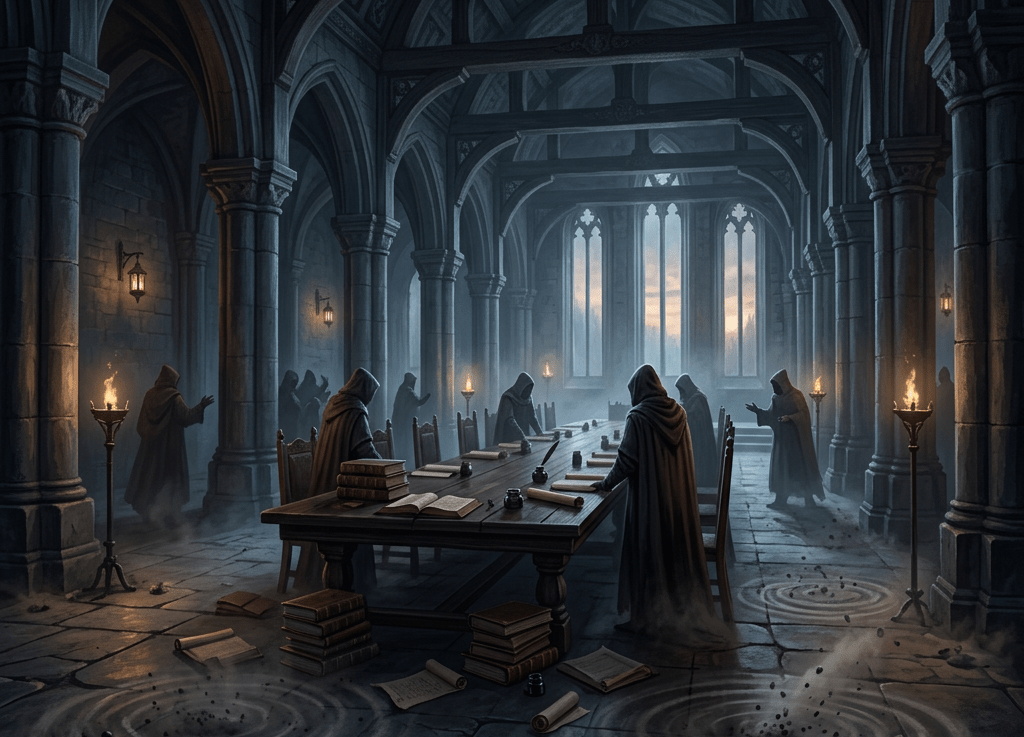
She rose before dawn and went to City Hall.

There she found Lord Wayne already awake, standing over a map of Gotham. Red markers surrounded the South Quarter. Blue marked the markets. Black marked the tunnels.

“You heard it,” Bright said.

Wayne did not turn.
“I heard something.”

“No,” she replied. “You heard war approaching.”

Before Wayne could answer, the doors opened.
Lord Scurlock entered with twelve guards.
Behind him came Wang, surrounded by Triad captains.
Lionel arrived last.
For the first time, every faction had brought armed men into the council chamber.

Scurlock placed a ledger upon the table.
“Three hundred workers have disappeared.”

Wang’s eyes narrowed. “And you accuse me?”

“I accuse everyone.”

Lionel laughed bitterly. “At last, something honest.”

Wayne struck the table.
“Enough.”

But no one listened.

Wang accused Scurlock of preparing a coup. 
Scurlock accused Wang of arming the workers. 
Lionel declared that Wayne had secretly ordered soldiers into the South Quarter.

Then a messenger burst through the doors.
“Milord!”

Everyone turned.
“The South Quarter is burning.”

Silence followed.

Wayne reached for his sword.
Wang’s hand went to his dagger.
Lionel’s guards raised their weapons.
Scurlock stepped backward.

And for one terrible moment, Gotham stood upon the edge of civil war.

Then the ground beneath City Hall moved.
Stone cracked.
The chandeliers swung wildly.

From below came three enormous turns of gears.
Everyone froze.
Three.
A pause.
Three.

Grandmother Bright closed her eyes.
“The Dragonheart has awakened.”

Beneath them, something vast began climbing toward the surface.
And the council, divided against itself, suddenly understood the cruelest truth:
They had spent so long preparing to fight one another that none of them had prepared to fight what was coming.

ping:

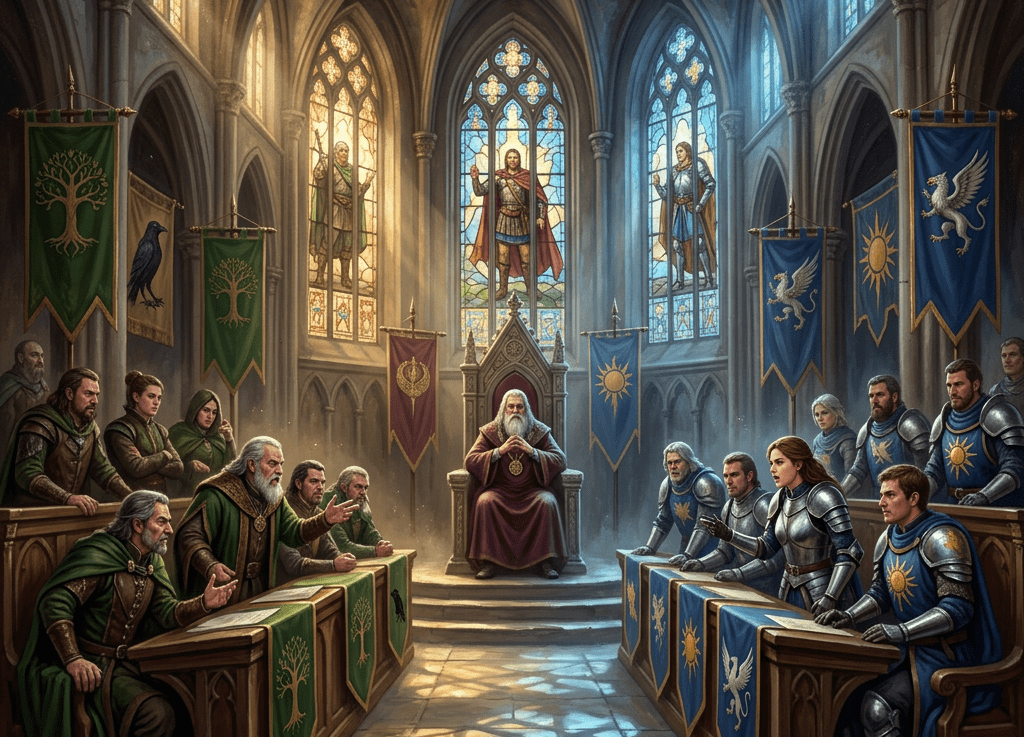
Gotham Patchwork Council

Gotham Patchwork Council


The council held together for exactly as long as Gotham remained in ruins.

Lord Wayne brought order to the meetings.
Lord Scurlock brought ledgers, contracts, and an unsettling knowledge of where every surviving coin had gone.
Triad Elder Wang kept the markets moving when no one else could.
Godfather Lionel made certain that food reached the districts that had once belonged to his enemies.
Grandmother Bright listened to everyone, spoke little, and somehow knew which promises would be broken before they were made.
Together, they were almost a government.

Then City Hall reopened.
The first argument concerned taxes.
The second concerned who had the authority to collect them.

By the third, Lord Wayne and Lord Scurlock were no longer speaking directly to one another.

Wang accused the nobles of rebuilding Gotham for themselves.
Lionel accused Wang of using the shortages to strengthen the Triad.
Scurlock produced figures proving that everyone was stealing from everyone else.
Grandmother Bright merely sighed.

Outside, the citizens watched.
They had fought a tyrant and discovered that tyranny was not the only thing that could make a city miserable.
The council’s greatest weakness was also its greatest strength: none of its members trusted the others enough to surrender power.

And so they watched one another.
Wayne watched Scurlock.
Scurlock watched Wang.
Wang watched Lionel.
Lionel watched Wayne.
Grandmother Bright watched them all.

For a time, this was enough.

Gotham recovered.
The bridges reopened.
Workshops filled with smoke.
The hospitals gained roofs.
Children returned to schools where teachers had begun replacing portraits of Highlord Macdonald with maps of the new republic.

Yet beneath the streets, something was changing.
Workers repairing a sewer beneath the old South Quarter discovered that their tools were vibrating.

Then came the sound.
Three slow turns of enormous gears.
A pause.
Three more.
The foreman ordered the men out.

That night, beneath Gotham, the Dragonheart and Clockwork body moved.

And somewhere inside City Hall, Grandmother Bright suddenly woke from sleep.
She had heard the same rhythm before.


Ping:

Books, music and oracles

Books, music and oracles


Book Club with Live Music:

“Many books inspire us to think about the future, and this has been happening since ancient times.
Neighbor and director Miranda Lakerveld and oud player Haytham Safia will take you on a journey: from centuries-old prophecies to mystical poems that may offer us guidance, and on to inspiring visions for the future of our neighborhood. Bring along a passage from a book that has inspired you to think about the future!”

Question: How can I support community building?

ORACLE:

ANALECTS 12.5
Si Ma Niu, full of anxiety, said, “Other men all have their brothers, I only have not.”
Zi Xia said to him, “There is the following saying which I have heard – ‘Death and life have their determined appointment; riches and honors depend upon Heaven.’
Let the superior man never fail reverentially to order his own conduct, and let him be respectful to others and observant of propriety -then all within the four seas will be his brothers.
What has the superior man to do with being distressed because he has no brothers?”

Comment:
Do not despair about having no relatives.
Keep the straight road, approach others with respect, do the right thing.
Then everybody is related.


ORACLE:

MENCIUS 7.14
Mencius said:
‘Qiu acted as chief officer to the head of the Ji family, whose evil ways he was unable to change, while he exacted from the people double the grain formerly paid.
Confucius said:
“He is no disciple of mine.
Little children, beat the drum and assail him.” …

Comment:
‘Do the right thing’ means to stand up against oppression!

Vrijheid en Verzet: Reflecties op een Buurthuisbijeenkomst

Vrijheid en Verzet: Reflecties op een Buurthuisbijeenkomst


Eerste indruk van vrijheidslunch in een buurthuis: grote ruimte, goede bezetting van tafels, expo vakantiefotos Turkije, Bella Ciao in Farsi op de achtergrond, een goede binnenkomst.
We krijgen een plek aan een tafel voor vier personen helemaal vooraan de zaal, na de inleiding komt de voorzitter als gespreksleider aan onze tafel.
…
Gespreksthema:
Wat betekent verzet voor je?
Door getuige te zijn geweest van een coup die gepaard ging met politieke en etnische ‘zuiveringen’ , werd ik vanaf het einde van vorig millenium steeds bezorgder bij de opkomst van xenofobisch populisme. Ik heb destijds ervaren, dat een etnische/culturele minderheid ook na honderden jaren assimilatie kwetsbaar blijft als zondebok.
Als een fascistische partij aan de macht zou kunnen komen, moet ik voorbereid zijn op mentaal en fysiek gebied. Daar heb ik training voor nodig, want je weet nooit hoe je reageert als het er op aankomt: bevriezen/vluchten/vechten?
Dit kan ik niet in mijn eentje, dan moet ik verbinding hebben met gelijkgezinde groepen, maar wie durf ik te vertrouwen, wetende dat een van de vier stemmers gekozen heeft voor een fascist?
…
De microfoon komt langs alle tafels, onze tafel kwam aan de beurt, ik was als spreker aangewezen.
…
Er was heftig protest van vrouwen aan een andere tafel ‘omdat er al zoveel mannen aan de beurt waren geweest’, een vrouw van de tafel naast ons zei nog tegen mij ‘geef die microfoon maar aan mij’ terwijl ik het bleef vasthouden.
Het duurde even voordat de voorzitter het rumoer tot bedaren wist te brengen, waarna ik mijn woord kon doen.
…
Aan onze tafel vertelde de voorzitter dat hij het protesterende groepje had aangesproken, hij sprak zijn waardering uit over mijn toespraak maar had ook waargenomen dat er geen applaus kwam voor mij, in tegenstelling tot overige sprekers.
…
Het incident ervaar ik als een smet op de bijeenkomst:
Als enige persoon van kleur ben ik door een specifieke groep gehinderd om mijn stem te laten horen.
…
Voor mij was dit ook een test van mijn weerbaarheid en verzet in de praktijk:
Ik heb mijn stem niet laten afpakken, ik heb me niet de mond laten snoeren, ik heb rustig mijn verhaal kunnen doen.
…
Maar terugkijkend heb ik wel een vieze nasmaak van de vrijheidslunch, de vraag blijft:
Wie kan ik vertrouwen in deze groep als de razzia’s uitgevoerd worden?

Nooit meer is nu!


Ping:

Lessons from a Dream: Navigating Loss

Lessons from a Dream: Navigating Loss


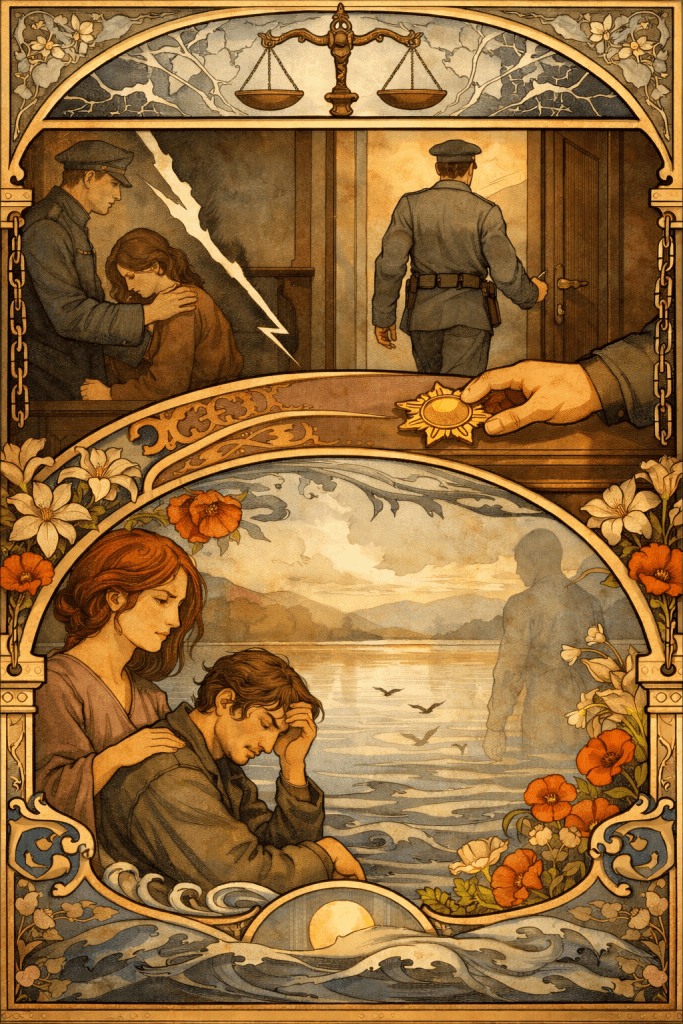
I belonged to a unit that called itself orderly, though order there was a brittle thing, like frost on a window that vanishes at a breath.
We wore the same colors, spoke the same clipped phrases, and trusted—so we said—the same chain of command.
But one morning our leader turned his gaze upon a colleague of mine, a quiet woman who kept her counsel and did her work with a steady hand.
He judged her in haste, and his words were a blade without temper.
I felt the cut as if it had found my own skin.

In that moment I understood how a structure may stand and yet be hollow.
Justice, we had been taught, was the spine of our work.
Without it, we were only shadows moving in formation.
I placed my badge upon the desk, a small sun gone cold, and stepped out of that narrow world.
No one stopped me.
The door closed with a sound like a verdict, though I could not say upon whom it fell.

…

The dream shifted, as dreams do, into a softer country.
I was among friends—no uniforms, no ranks—only the fragile, luminous ties we make of laughter and shared hours.
We walked beside water that held the sky like a second, deeper truth.
There was someone there who mattered to me in ways I had never named, as one does not name the air until it is gone.

Then a friend approached, her face already carrying the news before her lips shaped it.
The words were simple, and because they were simple they were absolute: he was gone.
The world did not break; it thinned.
Sound grew distant, as if I stood beneath the surface of the water we had walked beside.

Grief came not as a storm but as a tide—inevitable, patient.
It filled the spaces where certainty had been.
I learned then that leaving and losing are kin, each a doorway we do not choose, each remaking the shape of the self that passes through.

← Back

Thank you for your response. ✨

Vrijwilligerswerk: wat mag je van elkaar verwachten?

Vrijwilligerswerk: wat mag je van elkaar verwachten?


Samen maken we de wijk: afspraken in vrijwilligerswerk

In onze wijk gebeurt ontzettend veel.
Van activiteiten in het buurthuis tot buurtfeesten en het omkijken naar elkaar — het draait allemaal op de inzet van vrijwilligers.
Zonder hen zou een groot deel van deze initiatieven simpelweg niet bestaan.

Maar naast enthousiasme en betrokkenheid is er ook iets anders belangrijk: duidelijke afspraken.
Want hoe zit dat eigenlijk als je vrijwilligerswerk doet?

Vrijwillig, maar niet vrijblijvend

Vrijwilligerswerk is geen betaald werk.
Meestal is er geen arbeidsovereenkomst zoals bedoeld in Burgerlijk Wetboek Boek 7.

Toch betekent dat niet dat alles zomaar kan.
Afspraken tussen vrijwilligers en organisaties vallen onder het algemene overeenkomstenrecht van Burgerlijk Wetboek Boek 6. Simpel gezegd: je mag van elkaar verwachten dat afspraken worden nagekomen.

Wat betekent dat in de praktijk?

Voor organisaties in de wijk — zoals het buurthuis of een bewonersinitiatief — betekent dit dat zij goed moeten zorgen voor hun vrijwilligers. Denk aan:

  • een veilige en prettige omgeving
  • duidelijke uitleg over wat er verwacht wordt
  • begeleiding waar nodig
  • respectvolle omgang

Vaak zijn er ook praktische zaken geregeld, zoals een verzekering of een vergoeding voor gemaakte kosten.

Meer hierover is te vinden via de Rijksoverheid en de NOV (Nederlandse Organisaties Vrijwilligerswerk).

Wat mag je verwachten van elkaar?

Aan de andere kant mogen organisaties ook iets verwachten van vrijwilligers.
Bijvoorbeeld dat je:

  • je afspraken nakomt
  • op tijd bent
  • zorgvuldig omgaat met mensen en spullen
  • je afmeldt als je verhinderd bent

Werk je met persoonlijke gegevens, bijvoorbeeld bij een bewonersadministratie of activiteitenlijst?
Dan geldt ook de privacywetgeving van de Algemene verordening gegevensbescherming.
Dat betekent dat je vertrouwelijk met informatie omgaat.

Voorkom misverstanden

In een wijk waar mensen elkaar vaak kennen, worden afspraken soms mondeling gemaakt.
Dat gaat meestal goed — maar niet altijd.

Daarom is het slim om belangrijke afspraken toch even vast te leggen, bijvoorbeeld in een eenvoudige vrijwilligersovereenkomst. Dat hoeft niet ingewikkeld te zijn, maar zorgt wel voor duidelijkheid.

Samen sterk

Vrijwilligerswerk draait om vertrouwen, betrokkenheid en samen iets moois neerzetten in de wijk. Met een beetje duidelijkheid vooraf blijft het voor iedereen leuk en prettig.

Zo zorgen we er samen voor dat onze wijk blijft bruisen.


Bronnen en meer informatie

Gotham diaspora: A Tale of Courage and Community

Gotham diaspora: A Tale of Courage and Community


Xiao AoQi was known in the village for two things: a brave heart and a kindness that lingered like spring sunlight.
When the first warm winds arrived, carrying the scent of damp soil and new blossoms, he began his traditional spring cleaning ritual.
It was not just sweeping floors and washing windows—it was a quiet promise to begin again.

Outside, the muddy trail from his small garden to the front door told the story of the past season.
The harvest had failed, and the earth had given little in return for his labor.
Near the edge of the field stood the ruined old tree, its hollow trunk split by last winter’s storms. AoQi often paused there, remembering better years when its branches bloomed wide and generous.

That morning, he carried his spade over one shoulder and his flute tucked into his belt.
The nearby tower cast a long shadow across the garden, as if watching over him. He worked slowly, turning the soil, though doubt weighed heavier than the dirt.

At last, he sat beside the broken tree and played his flute.
The melody was soft, carrying both sorrow and hope across the fields.
A neighbor passing by stopped, then another. Soon, a few villagers gathered, drawn not just by the music, but by the quiet courage it held.

AoQi lowered the flute and, for the first time, asked for help.

No one hesitated.

Together, they cleared debris, mended the soil, and shared seeds saved from better seasons.
By dusk, laughter replaced silence, and the muddy trail filled with many footprints.

That night, AoQi finished his spring cleaning with a lighter heart.
The ruined tree still stood—but now, it no longer felt alone.

That night Aoqi had a strange dream:

In a quiet riverside village, there lived a curious boy named Xiǎo Àoqí (小奥奇).
No one knew exactly where he came from, only that he had been found as a baby wrapped in a blue cloth embroidered with swirling waves.

Xiǎo Àoqí loved the river.
While other children chased kites, he would sit for hours by the water, whispering to it as if it could answer.
One evening, during a heavy storm, the river rose higher than ever before.
The villagers panicked, fearing a flood.

But Xiǎo Àoqí stepped forward.

“I’ll ask it to calm down,” he said.

The adults dismissed him—until he walked straight into the raging water.
The storm suddenly softened, as though listening.
Beneath the surface, Xiǎo Àoqí saw a vast palace of light.
There, a great dragon stirred—ancient and powerful, with eyes like the deep sea.

It was Ao Guang.

“You carry the name of my kin,” the dragon rumbled. “Why do you call me?”

Xiǎo Àoqí bowed, though he trembled. “The village is afraid. Please, let the waters rest.”

Ao Guang studied him, then laughed softly, like distant thunder. “You are small, yet your heart is steady. Very well.”

With a flick of his tail, the storm dissolved.

When Xiǎo Àoqí returned to shore, the river was calm, as if nothing had happened.
From that day on, the villagers looked at him differently—not as a strange child, but as a quiet guardian.

And sometimes, when the wind brushed the river just right, they swore they could hear a dragon’s laughter echoing… and a boy whispering back.

notes:
小奥奇 (Xiǎo Àoqí) : “splendid wanderer.”
敖 = “to roam freely” “proud” or “aloof”
奇 = “strange,” “wonderful,” “extraordinary”

Thanks to Tiny Oji!