dhritirashtra:
Ranged thus for battle on the sacred plain on kurukshetra – say, sanjaya!
Say what wrought my people, and the pandavas?
sanjaya:
When he beheld the host of pandavas raja duryodhana to drona drew, and spake these words:
“ah, guru! See this line, how vast it is of pandu fighting-men, embattled by the son of drupada, thy scholar in the war!
Therein stand ranked chiefs like arjuna, like to bhima chiefs, benders of bows; virata, yuyudhan, drupada, eminent upon his car, dhrishtaket, chekitan, kasi’s stout lord, purujit, kuntibhoj, and saivya, with yudhamanyu, and uttamauj subhadra’s child; and drupadi’s; – all famed!
All mounted on their shining chariots!
On our side, too, – thou best of brahmans!
See excellent chiefs, commanders of my line, whose names i joy to count: thyself the first, then bhishma, karna, kripa fierce in fight, vikarna, aswatthaman; next to these strong saumadatti, with full many more valiant and tried, ready this day to die for me their king, each with his weapon grasped, each skilful in the field.
Weakest – meseems our battle shows where bhishma holds command, and bhima, fronting him, something too strong!
Have care our captains nigh to bhishma’s ranks prepare what help they may!
Now, blow my shell!”
Then, at the signal of the aged king, with blare to wake the blood, rolling around like to a lion’s roar, the trumpeter blew the great conch; and, at the noise of it, trumpets and drums, cymbals and gongs and horns burst into sudden clamor; as the blasts of loosened tempest, such the tumult seemed!
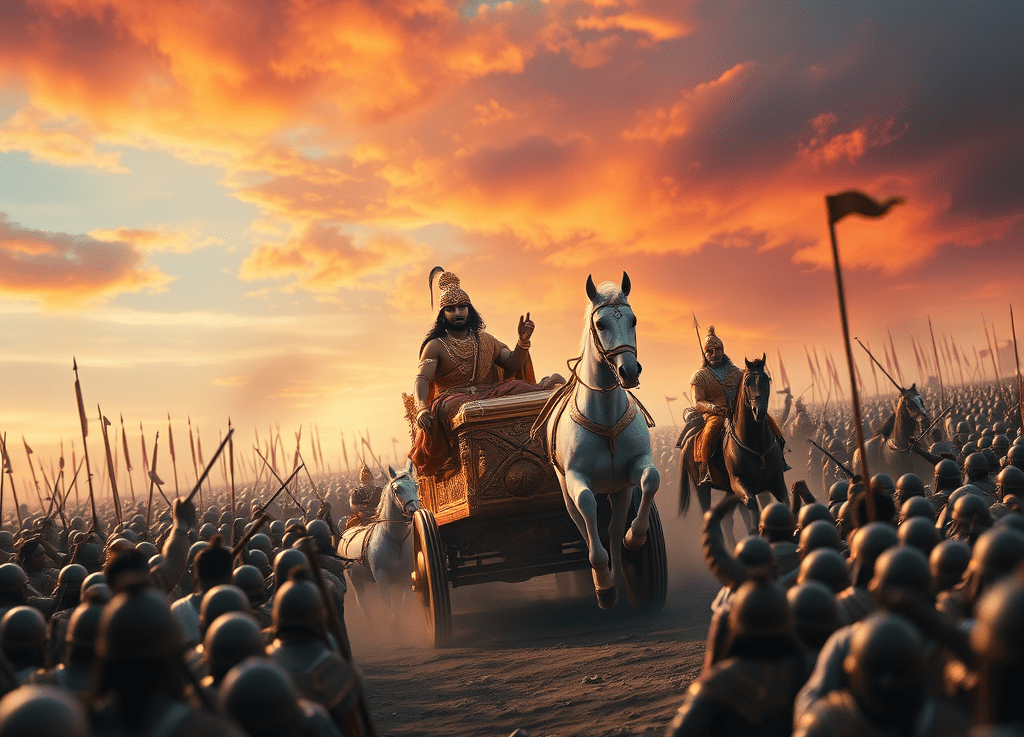
Then might be seen, upon their car of gold yoked with white steeds, blowing their battle-shells, krishna the god, arjuna at his side: krishna, with knotted locks, blew his great conch carved of the “giant’s bone;” arjuna blew indra’s loud gift; bhima the terrible wolf-bellied bhima – blew a long reed-conch; and yudhisthira, kunti’s blameless son, winded a mighty shell, “victory’s voice;” and nakula blew shrill upon his conch named the “sweet-sounding,” sahadev on his called “gem-bedecked,” and kasi’s prince on his. Sikhandi on his car, dhrishtadyumn, virata, satyaki the unsubdued, drupada, with his sons, (o lord of earth!) Long-armed subhadra’s children, all blew loud, so that the clangor shook their foemen’s hearts, with quaking earth and thundering heav’n.
Then ’twas beholding dhritirashtra’s battle set, weapons unsheathing, bows drawn forth, the war instant to break – arjun, whose ensign-badge was hanuman the monkey, spake this thing to krishna the divine, his charioteer:
“drive, dauntless one!
To yonder open ground betwixt the armies; i would see more nigh these who will fight with us, those we must slay to-day, in war’s arbitrament; for, sure, on bloodshed all are bent who throng this plain, obeying dhritirashtra’s sinful son.”
Thus, by arjuna prayed (o bharata!) Between the hosts that heavenly charioteer drove the bright car, reining its milk-white steeds where bhishma led, and drona, and their lords.
“see!” spake he to arjuna, “where they stand, thy kindred of the kurus:”
And the prince marked on each hand the kinsmen of his house, grandsires and sires, uncles and brothers and sons, cousins and sons-in-law and nephews, mixed with friends and honored elders; some this side, some that side ranged: and, seeing those opposed, such kith grown enemies – arjuna’s heart melted with pity, while he uttered this:
arjuna:
Krishna!
As i behold, come here to shed their common blood, yon concourse of our kin, my members fail, my tongue dries in my mouth, a shudder thrills my body, and my hair bristles with horror; from my weak hand slips gandiv, the goodly bow; a fever burns my skin to parching; hardly may i stand; the life within me seems to swim and faint; nothing do i foresee save woe and wail! It is not good, o keshav!
Nought of good can spring from mutual slaughter!
Lo, i hate triumph and domination, wealth and ease, thus sadly won!
Aho!
What victory can bring delight, govinda! What rich spoils could profit; what rule recompense; what span of life itself seem sweet, bought with such blood?
Seeing that these stand here, ready to die, for whose sake life was fair, and pleasure pleased, and power grew precious: – grandsires, sires, and sons.
Brothers, and fathers-in-law, and sons-in-law, elders and friends!
Shall i deal death on these even though they seek to slay us?
Not one blow, o madhusudan! Will i strike to gain the rule of all three worlds; then, how much less to seize an earthly kingdom!
Killing these must breed but anguish, krishna!
If they be guilty, we shall grow guilty by their deaths; their sins will light on us, if we shall slay those sons of dhritirashtra, and our kin; what peace could come of that, o madhava?
For if indeed, blinded by lust and wrath, these cannot see, or will not see, the sin of kingly lines o’erthrown and kinsmen slain, how should not we, who see, shun such a crime we who perceive the guilt and feel the shame oh, thou delight of men, janardana?
By overthrow of houses perisheth their sweet continuous household piety, and – rites neglected, piety extinct enters impiety upon that home; its women grow unwomaned, whence there spring mad passions, and the mingling-up of castes, sending a hell-ward road that family, and whoso wrought its doom by wicked wrath.
Nay, and the souls of honored ancestors fall from their place of peace, being bereft of funeral-cakes and the wan death-water.
So teach our holy hymns.
Thus, if we slay kinsfolk and friends for love of earthly power, ahovat!
What an evil fault it were!
Better i deem it, if my kinsmen strike, to face them weaponless, and bare my breast to shaft and spear, than answer blow with blow.
So speaking, in the face of those two hosts, arjuna sank upon his chariot-seat, and let fall bow and arrows, sick at heart.
Ping: https://sacred-texts.com/hin/gita/bg01.htm









 Dreamquest