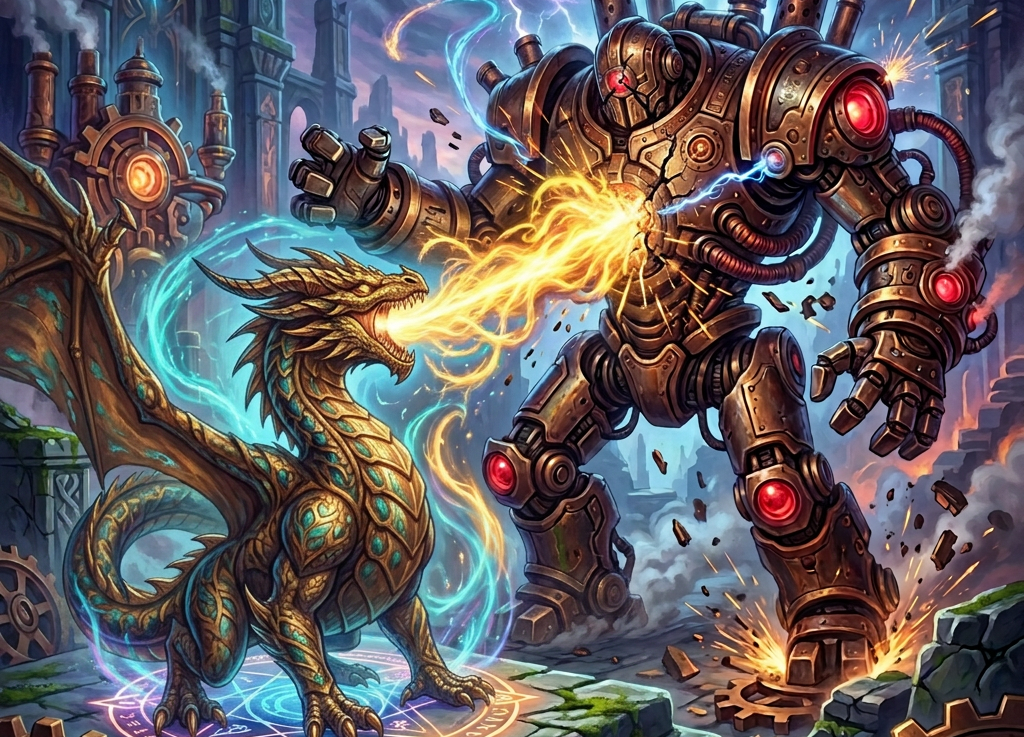
The palace shook. Dust poured from the ceiling. Then came a sound like a thousand iron teeth grinding together. The floor split open. Something enormous climbed out. It was a man. Or had once been one. Bronze plates covered its body. Pistons hammered beneath its chest. Its eyes burned with blue fire, and a great brass gear turned slowly behind its skull. The clockwork golem raised one iron fist. The dragon stared at it. The golem stared back.
The golem punched the dragon. The impact sounded like a cannon firing inside a cathedral. The dragon flew backward through three pillars. The dragon rose from the rubble. Its brass helmet was bent. Its pride was considerably more damaged. It spread its wings. Fire filled its throat.
“Everyone down!”
The dragon breathed. Flame swept across the hall.
The golem did not move. Its chest opened. Inside was a spinning furnace. The fire struck it. The machine glowed red. Then the golem laughed. It was not a pleasant sound. It seized the dragon by the throat.
The dragon clawed at its arms. The golem lifted it from the floor.
The entire palace groaned. Somewhere, a gear the size of a carriage began turning.
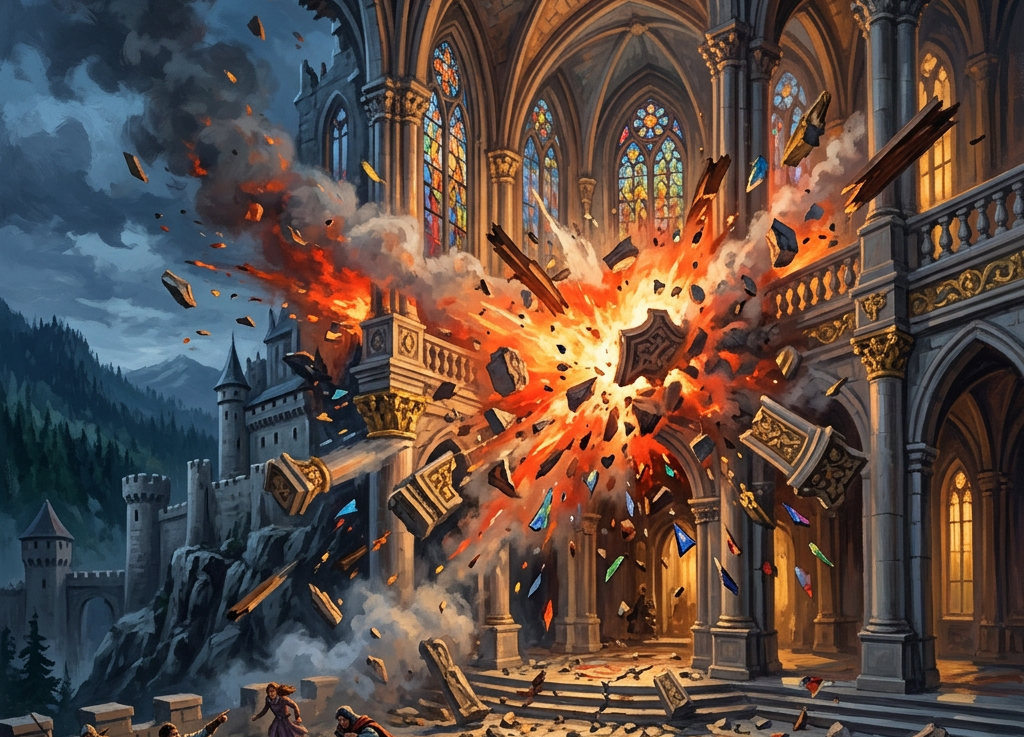
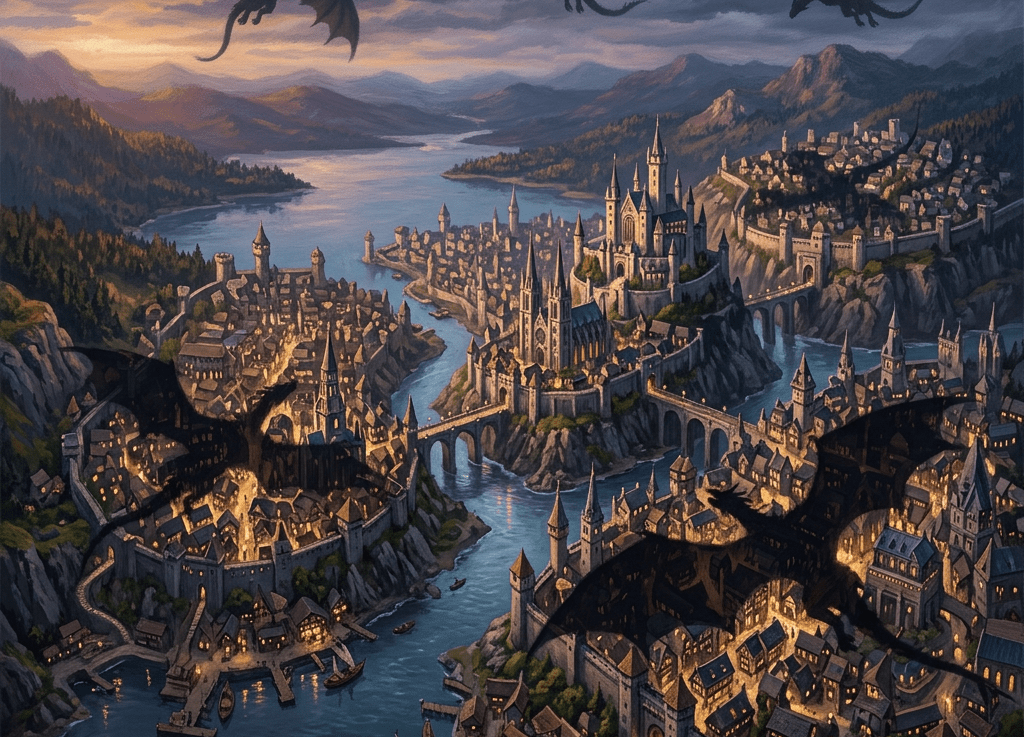
The ceiling exploded. Stone and dust thundered into the hall. Something vast crashed through the roof. It had claws. It had wings. It had far too many teeth. And it was wearing what appeared to be a brass helmet.
The creature roared. The windows shattered.
Scurlock drew his sword. Unlike Blackbird’s elegant rapier, his weapon was a long, wicked blade, black as midnight and twice as unpleasant.
“Right,” said Avery. “Who attacks first?”
Lady Blackbird grinned. “I do.”
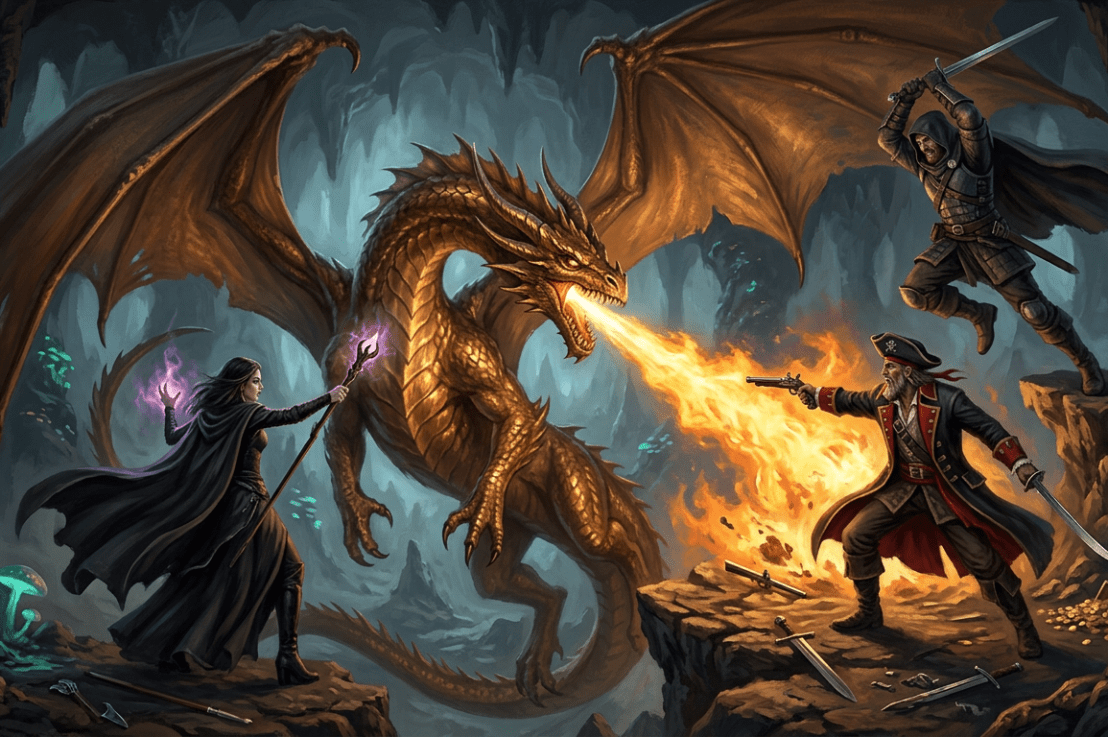
She sprang onto the back of a fallen statue, ran up its shoulder, and launched herself at the creature. Her sword flashed. She struck one of its horns. Sparks flew. The creature bellowed and swatted her aside. Avery caught her.
Scurlock leapt onto the creature’s claw. He drove his sword between two scales. The beast shrieked and shook its limb violently. Scurlock held on with one hand.
“Guardian!”
“Yes?”
“The lever!”
The Guardian went pale. “Which one?”
“All of them!”
“That seems unsafe!”
“Precisely!”
The Guardian hurled himself toward the machinery. Leonardo followed. “Wait for me!”
“You’re an engineer!”
“Exactly! I understand levers!”
Behind them, Lady Blackbird and Avery attacked together. Steel rang against brass. The creature snapped at Avery. He ducked.
Blackbird thrust. The blade vanished between its teeth. She stared. “Oh.”
Avery grabbed her by the collar. “Run!”
They fled as the beast bit down. The sword snapped.
Blackbird looked at the broken hilt in disbelief. “My sword!”
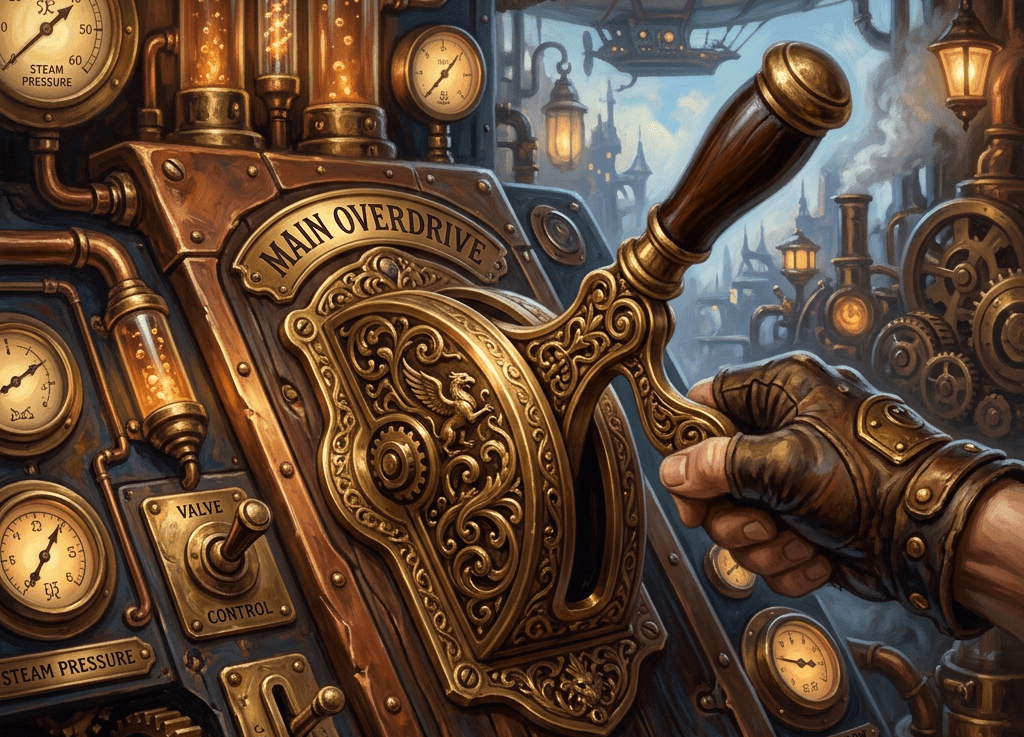
The Guardian pulled three levers. Somewhere beneath the palace, a machine awakened.
Lady Blackbird drew her sword and advanced to attack her advesary. “En garde, Lord Scurlock!”
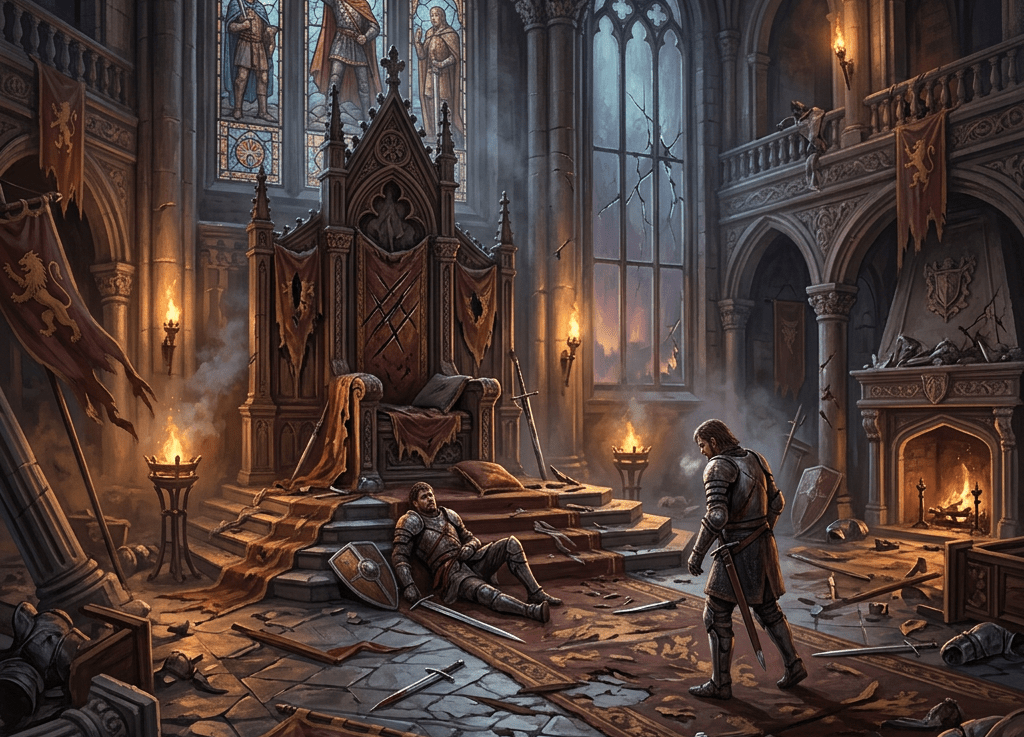
Lord Scurlock sighed. It was the kind of sigh a man makes when the evening has gone badly and somebody has just spilled gin on the carpet. He rose from the throne. He was tall, thin, and dressed in a black coat that looked as though it had been tailored by a funeral director with a grudge. A silver chain hung from his waist. At the end of it was a watch. The watch was ticking backward.
“Must we?” Scurlock asked.
Lady Blackbird lunged. Scurlock stepped aside.
She struck the throne. The throne screamed.
Lady Blackbird spun and attacked again. Scurlock parried with one finger. The blade stopped an inch from his chest. “Good sword,” he said.
“Good finger,” she replied.
He smiled. Then he flicked her sword across the hall.
It landed beside Captain Avery.
Avery picked it up. “I dislike him,” he said.
“You’re not alone,” said the Guardian. The Guardian was hiding behind engineer Leonardo.
Scurlock looked at him. The room became colder. “You,” he said.
The Guardian swallowed.
“Me?”
“You pulled the lever.”
“That was her.”
Scurlock walked toward them. Behind him, the golden throne folded itself into the shape of a chair.
“Lord Scurlock,” said Avery, raising the sword, “what exactly are you planning?”
Scurlock stopped. Through the enormous windows came the sound of something moving across the sky. Not flying. Dragging itself.
Scurlock glanced upward. “For once,” he said, “I’m not planning anything.”
The marble floor trembled.
“Then what is that?”
Scurlock looked at them. “That,” he said, “is the reason I built the door.”
Avery frowned. “The door exploded.”
“Yes.”
“Was that part of the plan?”
Scurlock considered this. “No.”
The ceiling cracked. Something enormous looked down through it.
Scurlock smiled without humor. “Now,” he said, “we may all attack together.”
Lady Blackbird peered through the window. “Atlantis is very different in this spacetime-frame!”
Captain Avery followed her gaze. Below them, the sea had acquired several additional directions. A mountain was currently sliding sideways across the horizon with the embarrassed determination of a cupboard being moved through a narrow doorway.
Leonardo frowned. “Atlantis?”
“Yes,” said the guardsman at the gate.
“But Atlantis sank.”
“In your spacetime.”
Avery looked at him. “And in this one?”
“It was promoted.”
Nobody asked what that meant. This was partly because the question seemed dangerous, and partly because a second bronze beacon had just begun emitting a noise rather like a giant clearing its throat.
The masked guardian turned. “Lighthouse Forty-Nine is unstable.”
“What does it prevent?” asked Lady Blackbird.
“Time.”
“From doing what?”
“Arriving in the wrong order.”
There was a pause. Leonardo looked deeply unhappy. “That sounds important.”
“It is.”
“What happens if it fails?”
The custodian considered this. “Yesterday may occur tomorrow.”
Avery sighed. “That already happens.”
“Not with consequences.”
The beacon flashed.
Leonardo stared at Avery. “You look pale.”
“I’ve just remembered something.”
“What?”
“I don’t know yet.”
Lady Blackbird, meanwhile, had opened the chest. “Ah,” she said.
Everyone turned. Inside, beside the lightning rod, was a small brass lever labelled: GEOGRAPHY — RESET
Underneath, in smaller letters: DO NOT USE UNLESS MAP IS ON FIRE
Leonardo swallowed. “Is the map on fire?”
Lady Blackbird glanced toward the horizon. A river had begun flowing uphill.
Avery reached for the lever.
The custodian caught his wrist. “Captain.”
“Yes?”
“Maintenance is not complete yet.”
Behind them, something enormous knocked politely on the door. Three times. Then it waited.
Captain Avery had always believed that the universe, if approached with sufficient skepticism, would eventually admit it was making a mistake. The universe, regrettably, had developed a contrary disposition.
“Maintenance,” he repeated. “For the record, whenever an ancient civilization says maintenance, ordinary people usually end up fleeing something with entirely unreasonable numbers of legs.”
A masked figure inclined its head. “Statement statistically supported.”
Engineer Leonardo brightened with the unmistakable enthusiasm of a man discovering his worst fears had been peer-reviewed. “Oh dear.”
Lady Blackbird stepped toward the chest, where the lightning rod lay with the innocent composure peculiar to artifacts that had previously ended empires. It looked almost respectable now, which was deeply suspicious. espectability, she had long observed, was often merely catastrophe wearing polished boots.
“What,” she asked, “requires maintenance after a thousand years?”
All the masked custodians answered together. “Reality.”
Nobody spoke for several seconds. Even silence appeared uncertain whether it wished to continue.
Leonardo eventually cleared his throat with the care of a gentleman attempting not to offend the laws of existence. “I should like,” he said, “to hear the longer explanation.”
“There is no longer explanation.”
“I was afraid of that.”
The bronze beacon turned once, almost thoughtfully. Far below, another blue column flickered. Then another vanished.
The nearest custodian regarded the distant light without visible concern, which somehow made matters considerably worse. “Lighthouse Forty-Eight has failed.”
“What does it illuminate?” Avery asked.
The masked face turned toward him. “It prevents geography.”
There are professions that prepare one for alarming statements. Accounting occasionally brushes against them. Diplomacy rents them by the afternoon. Sailors become acquainted through prolonged exposure. None, however, adequately equip a person for learning that mountains, oceans and respectable peninsulas apparently required supervision lest they wander off like absent-minded sheep.
Somewhere beneath the clouds came a noise resembling continents reconsidering their arrangements.
Leonardo removed his spectacles, polished them carefully, replaced them, and sighed.
It simply continues existing, each note suspended in the air as though sound itself has forgotten how to fade. The clouds beneath the Chain Spires ripple in slow circles, not from wind but from pressure, as if the heavens have become the surface of a pond disturbed by an invisible stone.
Captain Avery instinctively reaches for the helm. “Tell me someone else hears that.”
Everyone aboard the Swift Skyship Owl nods. Even the ship seems to respond. The brass compass mounted beside the wheel rotates lazily through every direction before settling somewhere impossible—straight upward.
Engineer Leonardo studies it with narrowed eyes. “I distinctly designed that to disagree only with magnets.”
A second bell joins the first. Then a third.
None of them originate from the bronze lantern suspended between the towers. Instead they seem to emerge from different distances at once, as though enormous invisible churches have been hidden throughout the sky.
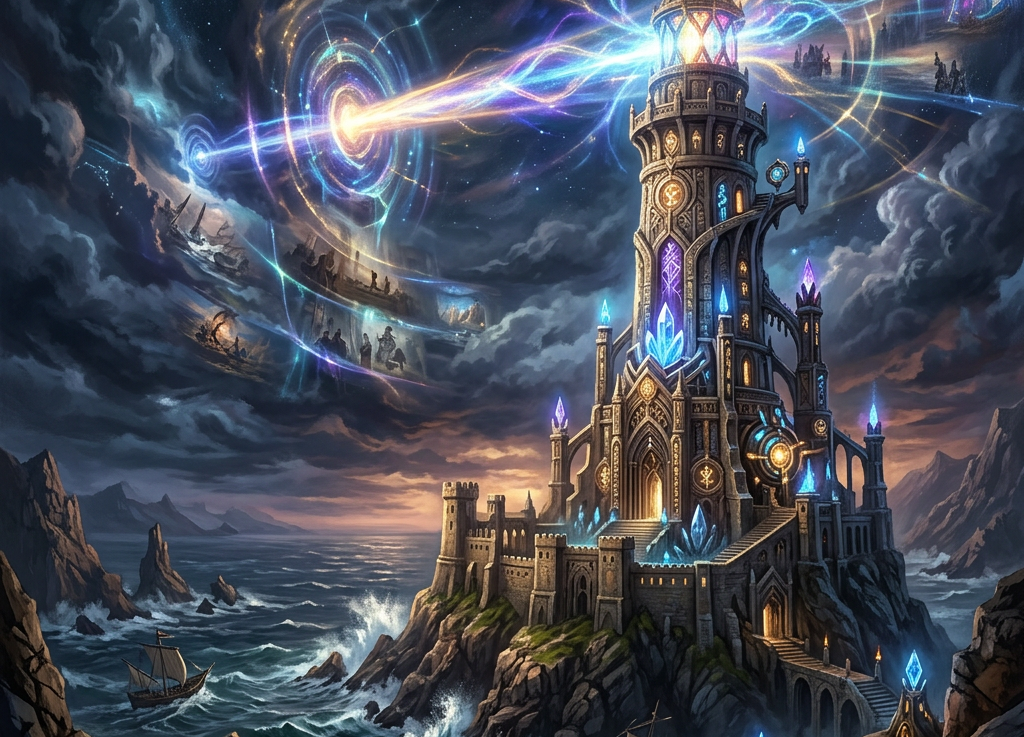
The beacon brightens. Its crystal heart rotates within its bronze cage. Blue light pours through engraved symbols circling the lantern’s frame. The runes are unlike any alphabet recorded in royal libraries. They resemble diagrams pretending to be letters, geometric thoughts carved into metal by minds that considered mathematics a native language.
The lightning rod, recovered by Lady Blackbird from the forgotten ruins, answers. It begins humming inside its storage chest. The lid rattles.
“Perhaps,” says Leonardo carefully, “we should not open that.”
The chest unlatches itself. The rod rises into the air with serene confidence, floating upright like a compass needle that has suddenly remembered true north. Thin threads of azure electricity stretch from its tip toward the distant beacon. No one aboard touches it.
No one wishes to volunteer for whatever conversation two ancient machines have decided to resume.
The Swift Skyship Owl lurches gently. Not from turbulence. From being pulled. The invisible force is subtle but undeniable, like the tide persuading a drifting boat that resistance is an unnecessary hobby.
Avery eases the helm against it. The ship answers for exactly three seconds before politely ignoring him. “I don’t appreciate vessels developing opinions,” he mutters.
Leonardo folds his arms. “I have built many remarkable devices.”
He watches the wheel turn of its own accord. “I do not recall constructing one with ambition.”
Ahead, the Chain Spires grow larger. Each tower is carved from a single pillar of dark stone streaked with veins of silver that shimmer beneath the bronze beacon’s glow. Iron chains disappear into the clouds below, so vast that entire villages could have stood upon a single link. The copper vanes atop every tower spin faster.
Still there is no wind. As the Owl drifts closer, figures appear upon the nearest platform. Not statues. People. Or something close enough to invite dangerous assumptions.
They wear long coats woven with threads of tarnished copper, their faces hidden behind polished masks shaped like expressionless owls. None carry weapons. Instead each holds a staff crowned with a crystal that burns with the same pale blue fire as the beacon. They watch the approaching skyship without waving. Without moving.
One raises a gloved hand. The bronze lantern answers.
A circle of light blossoms beneath the Swift Skyship Owl, spreading wider until it surrounds the entire vessel. The humming rod descends gently back into its chest, as though satisfied it has introduced two old acquaintances.
The bells cease.
Silence returns with such completeness that the creak of a single rope sounds startlingly loud. Then the nearest masked figure speaks. Its voice arrives from every direction equally. “Identification acknowledged.”
The pause that follows feels less like hesitation than the turning of a page in a very old book. “Courier Vessel Designation: Owl.”
Another pause. “Custodian Key recognized.”
Every masked head turns toward the chest containing the lightning rod. “Protocol Seven has resumed.”
Leonardo blinks. “I was unaware there were six previous protocols.”
The masked figure continues as though no interruption has occurred. “The Lighthouse Network requests maintenance.”
The words hang in the still air. Not a plea. Not an order. Simply the recitation of a duty left unfinished for centuries.
Far below, hidden beneath the endless blanket of cloud, something immense answers. One by one, faint columns of blue light begin rising through the overcast in distant parts of the world. There are dozens. Then hundreds. Ancient beacons—silent since kingdoms were young—are awakening.
And somewhere beyond every known chart, where forgotten seas concealed cities that memory itself struggled to locate, one final light burns brighter than all the others before disappearing beneath the horizon once more.
Atlantis, it seems, had never stopped listening. It had merely been waiting for someone to ring the bell.
The memory settles like dust in an old observatory, refusing to stay buried.
The Swift Skyship Owl glides between ribbons of pale cloud, her new sun sail drinking light with almost suspicious enthusiasm. Leonardo’s workmanship remains unmistakable: every polished brass fitting looks as though it expects applause. The reinforced ballista rests along the foredeck with the patient confidence of something designed to make pirates reconsider their career choices.
Atlantis remains absent from every horizon. Some kingdoms vanish beneath waves. Others disappear because everyone who remembers the way grows old at inconvenient moments.
The tale of the kraken corpse already acquires the untidy shape of legend. Sailors repeat that a beast older than empires dies beside forgotten ruins. Scholars insist the account is impossible. Scholars frequently mistake “impossible” for “inconvenient.”
Far ahead, a procession of narrow stone towers rises from the clouds. They are linked by iron chains thicker than ancient oaks, each tower carrying copper vanes that turn despite the still air. Blue sparks crawl between them in silent arcs.
An elderly navigator aboard a passing merchant skyship removes his hat.
“The Chain Spires,” he says. “Nobody anchors there willingly.”
His first mate snorts. “That’s because everyone who does comes back arguing with maps.”
The navigator nods solemnly.
“Maps are proud creatures. They dislike being proven wrong.”
Between the towers hangs a single object—a bronze beacon shaped like an enormous lantern. Its crystal heart pulses with the same peculiar azure glow as the lightning rod once recovered from the forgotten ruins.
The beacon awakens.
A clear bell rings across the empty sky.
Somewhere within the Chain Spires, ancient machinery begins turning for the first time in generations.
This collage is a vibrant and eclectic mix of imagery, patterns, and textures, creating a visually dynamic composition. Here are some key elements that stand out:
– **Central Framed Image:** A striking photograph of a person standing in front of a vivid, intricate mural featuring a multicolored, stylized tiger or jaguar face. The use of a blue and white ornate frame around it enhances its presence. – **Layered Frames & Circular Cutout:** The layering of the blue geometric patterns with the cutout circle creates depth and movement, leading the eye through the piece. – **Symbolism & Dark Aesthetic:** Elements like the “Black Moon Botanica” card with a crescent moon and snake, as well as the Halloween-themed scarecrow, raven, and eerie illustrations, contribute to a mystical, gothic, and possibly occult-inspired theme. – **Variety of Mediums:** The collage includes printed materials, hand-drawn elements, and textured pieces like the blue-outlined figure holding an object (possibly a drum or open book). The inclusion of different styles and textures makes the composition feel rich and layered.
Overall, this piece conveys an artistic, almost ritualistic or magical energy, blending urban street art aesthetics with folklore and symbolism.
You must be logged in to post a comment.