Month: October 2026

Gotham Tales: The Black Mirror

Gotham Tales: The Black Mirror


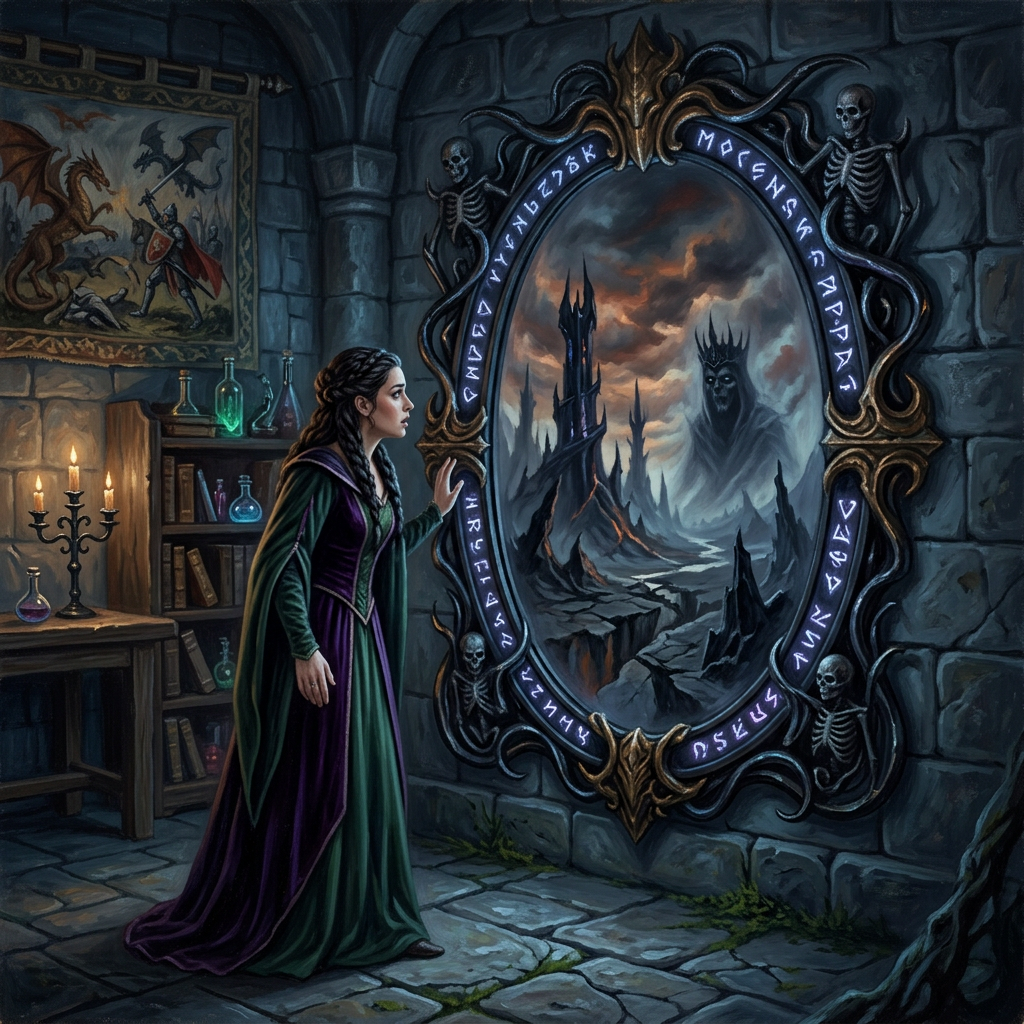
Sorceress standing before a skull-framed portal to a dark fantasy realm

The boy in blue had spoken before, though never quite where one expected him.
In Gotham, where the old stones remembered kings and the river carried secrets beneath its bridges, he had been seen on rooftops, in ruined chapels, and once reflected in a window that had no building behind it.
Those who met him afterwards remembered his blue coat, but seldom his face.
Tonight, he watched from the bathhouse rafters.

AoJi worked patiently at the river spirit’s tangled reeds.
With every knot released, the water grew clearer, and something ancient stirred beneath the bathhouse floor.

“Gotham,” murmured the spirit, tasting the word as though it were a fishbone. “That is where forgotten things gather.”

The bath-mistress looked sharply upwards. The soot sprites fell silent.

“You know the city?”

“I knew its river before men built their walls.
I knew its wells before they gave them numbers.
And I remember a bell that rang beneath the streets, calling things by their true names.”

The boy in blue swung down from the rafters and landed without a sound.

“The bell has been silent for years/
Someone stole its clapper.
Since then, Gotham has been growing stranger.
Doors open onto rooms that never existed.
Portraits forget their sitters.
And in the oldest quarter, a man has begun selling mirrors in which nobody has a name.”

AoJi felt the charm beneath his coat grow cold.
“The Black Mirror .”

The boy nodded.
“Its maker has come to Gotham, looking for something buried beneath the city.

The bath-mistress placed a hand upon AoJi’s shoulder.
“Then your well and our river are bound by the same wound.”

Outside, the tide turned.
Far away, beyond the mist, a bell sounded once beneath the earth.

The river spirit rose, taller than the bathhouse doors, water pouring from its ancient shoulders.
“Go, name-walker.
Find what Gotham has forgotten.
But remember this: a name is not a label to pin upon the world. It is a promise to pay attention.”

The boy in blue smiled without amusement.
“Come, then. Gotham has been expecting you.”

Ping:

Gotham’s Guardian of the Gate

Gotham’s Guardian of the Gate


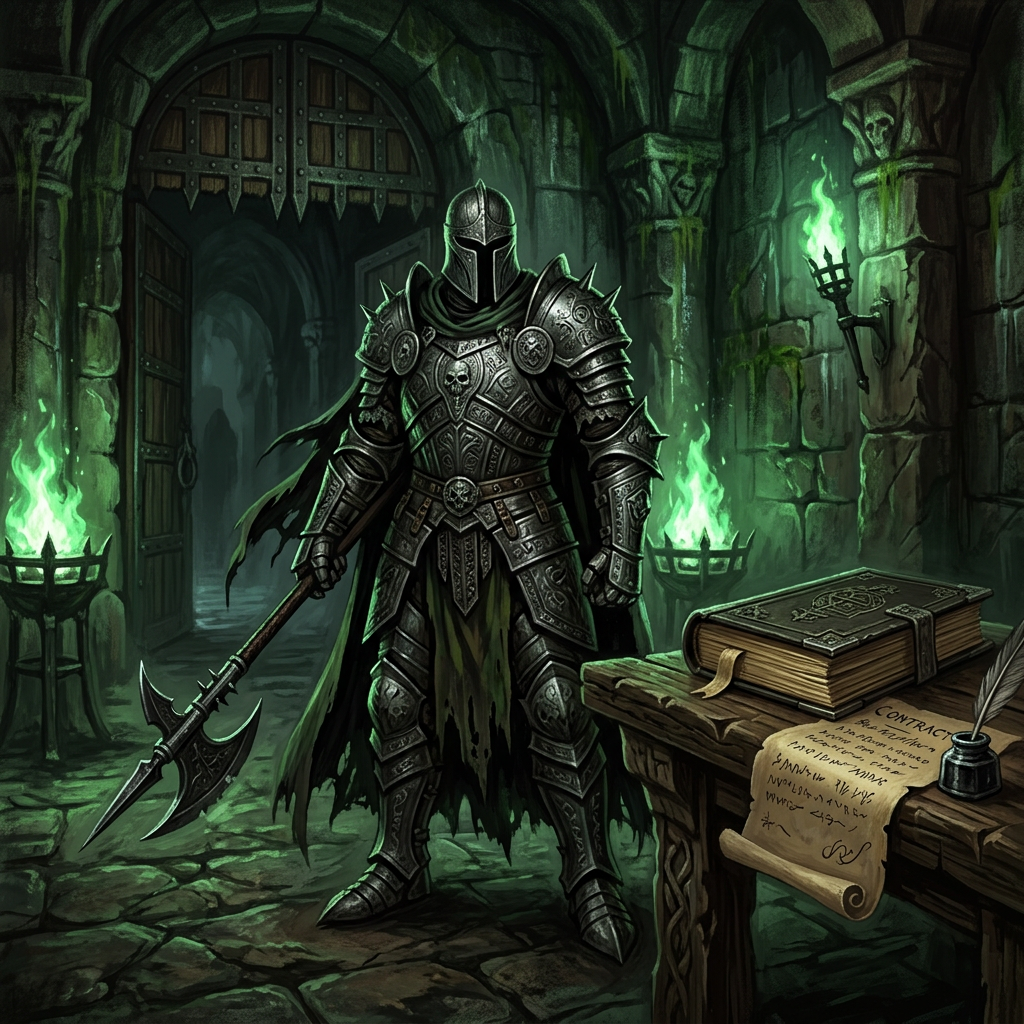
Armored knight holding a battle-axe beside a contract labeled CONTRACT

Laughter came through the door in three distinct stages: first as a chuckle, then as the grinding of stones deep underground, and finally as a small, polite cough.
A Voice said: “THE GATEKEEPER OF THE BLACK DOOR REQUESTS ADMISSION”

The door opened inward, though there was no space behind it in which it could possibly open.
The Gatekeeper entered.

He was tall enough to require the room to make certain adjustments.
His armour was black, his face hidden behind a visor without eyeholes, and from his shoulders hung a cloak that appeared to have been woven from extinguished stars.
In one gauntleted hand he carried a key.
In the other, a ledger whose pages turned of their own accord.
“I have come,to remind you that the Compact remains in force.”

“Splendid,” said Demon. “Then we agree on something already.”

The Gatekeeper tilted his helmet.
“Agreement is not required. Obedience is.”
The Gatekeeper placed his ledger upon the table.
It landed with a sound like a coffin being lowered into a grave.
“Under the original Compact, you owe me seven years of service, the surrender of one unspoken secret, and the right to claim the first shadow cast by any child born within your jurisdiction.”

Coil produced a scrap of parchment, damp at the edges and singed in one corner.
Demon recognised it immediately: the document they had stolen from the kingdom of promises, where every word spoken in earnest acquired a physical existence.
“We found this, In the archive beneath the sea of memories.
It records the original terms, including the amendments you made when the Ninth Gate was sealed.”

For the first time, the Gatekeeper became entirely still.

Vixen leaned forward. “You accepted our ancestors’ service in exchange for guarding the passage between worlds.
But the Ninth Gate is sealed.
You no longer perform that duty.”

They negotiated until the green fire burned blue.
At last, our heroes proposed a revised Compact.

The shadowrunners would retain the right to travel through the Black Door, provided they neither broke its seals nor carried an uninvited soul across the threshold.
In return, they would answer three summons from the Gatekeeper, each summons limited to a single day’s labour.
The Gatekeeper would abandon his claim upon their shadows, secrets and years.

The Gatekeeper opened his ledger to a blank page. The parchment shivered beneath his pen.

Demon signed first. Then Vixen, Grip, Hull and Coil.

Finally, the Gatekeeper pressed his gauntlet against the page.

A narrow line of silver fire travelled through the signatures and vanished into the walls.
THE COMPACT HAS BEEN AMENDED.

The Gatekeeper closed his ledger.
“You have obtained favourable terms, do not mistake that for friendship.”
He stepped ards through the door and disappeared.

Ping:

Gotham Shadowrunners at the Coven Door

Gotham Shadowrunners at the Coven Door


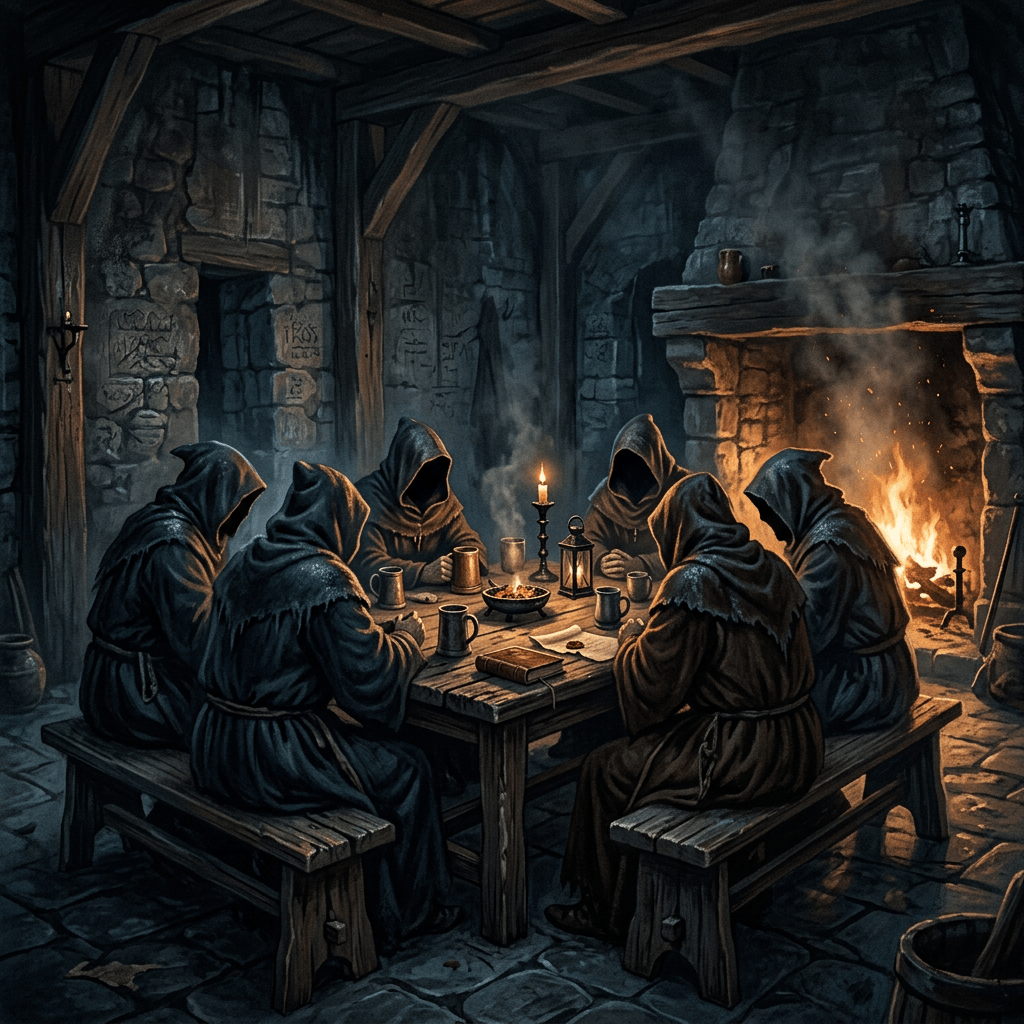
Six hooded figures gathered around a candlelit table in a stone chamber

The Coven smelled of damp wool and scorched incense.
Its familiar clutter of spellbooks, empty bottles, and ancient weapons seemed almost indecently comforting.
Coil emerged first, followed by Hull, whose boots struck the flagstones with a noise like a dropped safe.
Vixen stepped through last, adjusting her hair.
The black door shut behind them.
For several seconds nobody spoke.
Then footsteps sounded.

Demon stood beside the hearth, his lean face illuminated by green flames.
Grip occupied the divan, where he was methodically removing splinters from his left hand.

“You’re late,” said Demon.
“We took the scenic route,” Coil replied.
Grip grunted. “Through where?”
“An error.”
Hull sat heavily in an armchair.
It collapsed, recovered, and collapsed again, apparently uncertain which century it occupied.

Vixen surveyed her companions. “You escaped?”

“Eventually,” said Demon.
“We found ourselves in a kingdom where every promise became a physical object.
Grip promised to neutralize the pretender “

Grip displayed his wounds. “The pretender was a remarkable bastard.”

“We stole a boat,” Demon continued, “sailed through a sea of memories, and came ashore in a place where shadows were resided. Fortunately, I knew the Way”

Coil nodded appreciatively. “Professional work.”

“Then we followed a talking crow to a door.”

The shadowrunners looked towards the new door in the wall.

It possessed neither handle nor keyhole.
Upon its surface, silver letters slowly arranged themselves into a sentence:

THE COMPACT REMAINS IN FORCE.

Hull rose. “I’ll break it.”

“Certainly,” said Coil. “And when it opens into the inside of your skull, do try not to inconvenience us.”

Vixen approached the door, listening.
From somewhere beyond came the faint clink of armour.

She smiled.

“Gentlemen, I believe our landlord has arrived.”

Demon poured five drinks.

“Excellent,” he said. “We should discuss the rent.”

And somewhere beyond, something ancient began to laugh.

Ping:

Ghost-Echo Covenant with the Sidhe

Ghost-Echo Covenant with the Sidhe


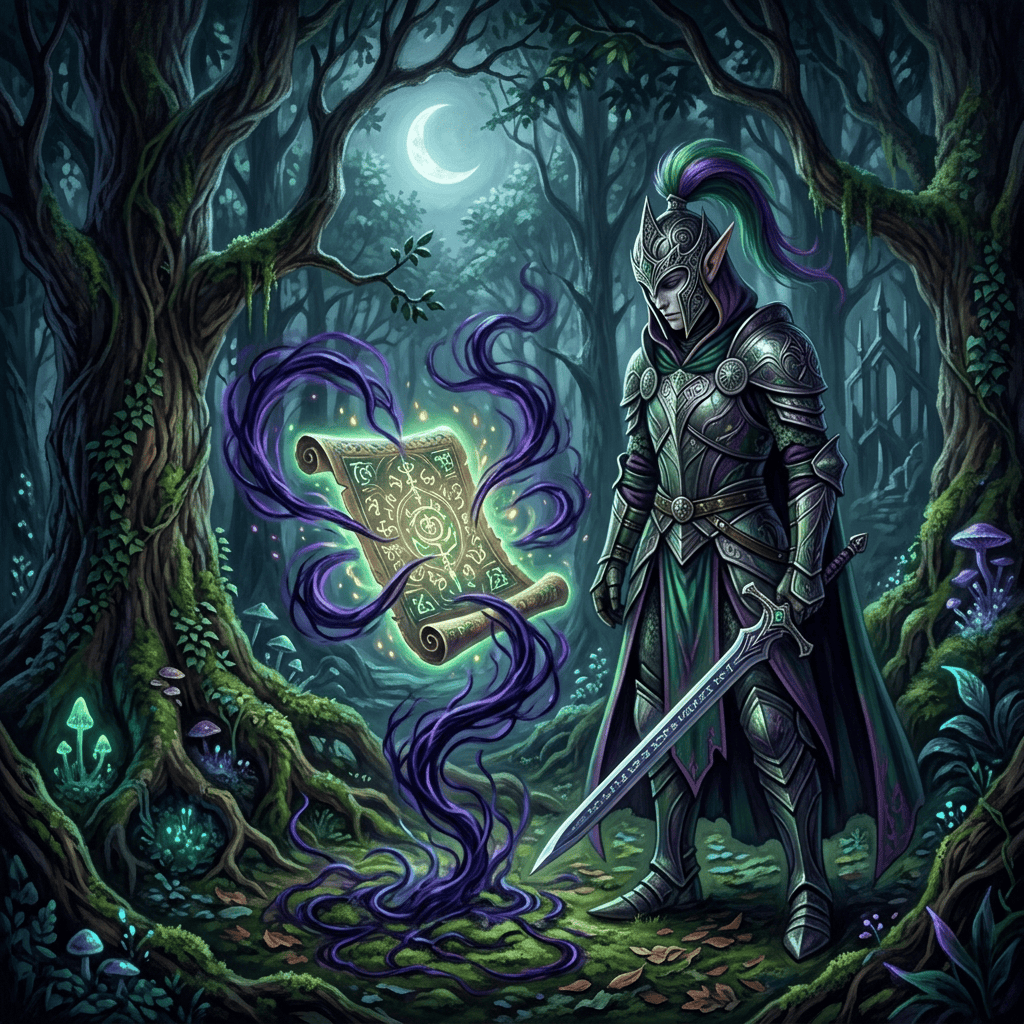
Armored elf holding a sword beside a glowing magical scroll in a forest
An armored elven guardian stands watch beside a glowing spell scroll in a moonlit enchanted forest.

The Sidhe Knight received the shadowrunners with the air of a magistrate accepting overdue taxes.
He raised his gauntleted hand, and the souls, bound in filaments of blue fire, vanished into the fissures of his armour.
“Your wishes,” he intoned, “have been granted according to the letter of our compact.”

One demanded a haven beyond the reach of their enemies.
The second required a conduit between the Tower and their Coven.
The third, who had little patience for metaphysics, merely wanted a door that opened.
The Knight inclined his helm. “You have all three.”
Then he laughed.
It was not a pleasant sound. The Tower shivered, the shattered battlements knitted themselves into unfamiliar geometries, and every window displayed a different sky.
The staircases descended into their own beginnings.
Doors opened upon rooms where the three shadowrunners stood, pale and bewildered, watching themselves arrive.

Hull kicked a door. It swallowed his boot and returned it three hours older.

Coil, who had made a career of discovering loopholes in contracts, examined the compact.
The Sidhe had stipulated that the Tower should be a haven for them, and that the link should join the Tower to their Coven. Nothing had been said about which side of the threshold they might inhabit.
“We’ve been comprehensively cheated,”
“Cheated?” said the Knight. “You have received precisely what you purchased.”

Vixen smiled. It was the sort of smile that had induced several respectable men to mortgage their estates and one bishop to resign his office.
She approached the Knight and whispered an offer involving his freedom, her gratitude, and certain pleasures unknown even to the oldest chronicles.

For a moment, the black visor reflected something resembling interest.

Coil seized the instant. He spoke the Knight’s forgotten name, extracted from stolen scrolls, and Vixen hurled her crystal ball against the floor.
The crystal ball shattered.
A doorway appeared.
Beyond it lay Midgard, rain-soaked and reassuringly vulgar.
The shadowrunners plunged through.
Behind them, the Black Knight thundered, “You have not escaped! The compact endures!”

The shadowrunners returned to their Coven, finding a new black door stood where the wall had been.

Ping:

Gotham and other city states

Gotham and other city states


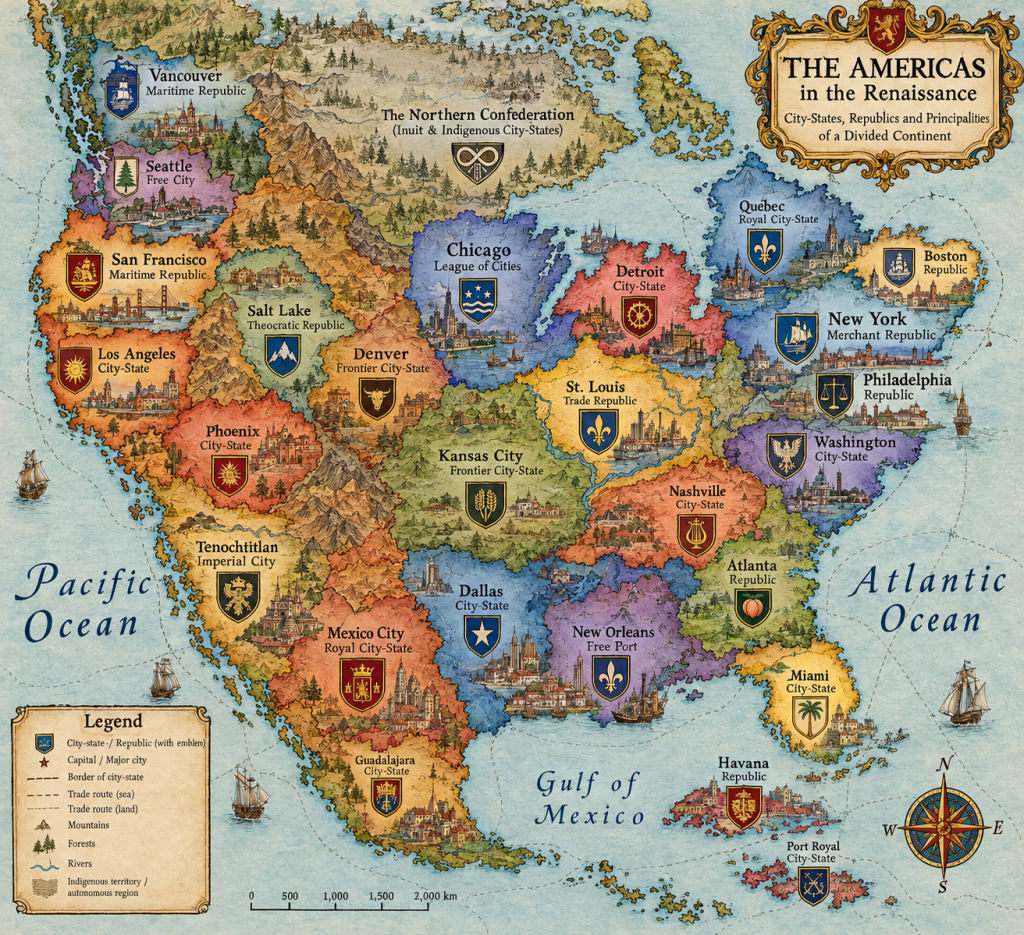
Imagine that America had never become united, but instead had developed like Renaissance Italy: a continent filled with rival city-states, powerful trading republics, principalities, and alliances.

New York, for example, becomes a powerful trading republic on the Atlantic coast, Chicago controls trade across the Great Lakes, and San Francisco emerges as a wealthy maritime city-state on the Pacific coast.

The political landscape might look something like this:

  • New York — a North American Venice, wealthy thanks to maritime trade, bankers, and diplomacy.
  • Boston — a republic of merchants, shipbuilders, and scholars.
  • Chicago — a strategic trading power controlling the connections between the Great Lakes and the interior.
  • San Francisco — a maritime republic with trade routes across the Pacific.
  • New Orleans — an important river city-state controlling access to the Mississippi.
  • Mexico City — a powerful southern empire with its own political and cultural traditions.

Just as in Renaissance Italy, these states would constantly form alliances, wage wars, hire mercenaries, and compete for control of trade routes.
Smaller cities might sometimes become particularly powerful by controlling a mountain pass, a river mouth, or an important harbor.

The fascinating consequence: the United States would not exist as a single country.
Instead, the continent would resemble an American patchwork of Florence, Venice, Genoa, and Milan, alongside larger kingdoms and Indigenous states pursuing their own struggles for power.