Tag: death

Mijn vader is overleden

Mijn vader is overleden


Donderdag 10 december werd ik omstreeks 1330 gebeld door mijn zus, omdat mijn vader gereanimeerd werd bij de VU.

Toen ik omstreeks 1430 aankwam, hoorde ik dat mijn vader was overleden.

Ik hoorde dat mijn vader omstreeks 1300 net met mijn moeder terug was van een controle bij de VU, en dat hij flauwviel nadat hij mijn moeder in de auto had gezet.
Binnen een paar minuten was de ambulance erbij en zijn ze een uur lang bezig geweest met reanimatie, maar mijn vader is niet meer bij bewustzijn gekomen; volgens de dokter had mijn vader een hartstilstand vanwege een groot infarct op het moment dat hij flauwviel.

Comments on my diary: China Journey 2007

Comments on my diary: China Journey 2007


Looking back at my journey:

For me, connecting with the ancestors is becoming a very important issue.
Not only the faraway mainland china connection, but also the more recent chinese diaspora to Java and Holland.

Often I feel on a gut-level during a meeting with somebody with these same roots: we are related, a few hunderd years ago…

The more I research on the shamanic roots of the chinese way of living, the more I discover:
chinese ancestor worship, gongfu (animal-styles, bagua), fengshui, divination (yi jing).

Fragments of my diary: China Journey august 2007:
At this moment I’m in Chongqing, the middle of china.
Already had a intense time in Shanghai-Yangtze river-Fengjie, later on I will visit Xian and Beijing.

Many things here remind me of Indonesia: the way people walk, the smells on the street, the shops, the slums.
I often have to explain that I do not speak chinese, but that my ancestors came from here.

Shanghai is weird: the contrast between sf and slum is great.

On the Yangtze I realised how this river is connected to chinese history. The great dam has already caused whole villages being displaced to outer provinces like Tibet and Xinjiang, imagine the suffering of the farmers of the displaced people but also on the receiving end in the outer provinces who have to cope with new invaders.
Many old ways are being destroyed in the name of progress.
At the dam I touched mother earth in a rock garden, it made me cry.

At Fengjie, city of ghosts, made for all the spirits from china, I realised how much has been destroyed by the cultural revolution.

Chongching is also very large and polluted, my stay here will be short.

I am looking forward to visit Xian, the tomb of the first emperor.
And of course in Beijing I will visit the great wall and TianAnMen square.

I hope to be back safe and well during Lammas…

…later…

Xi-an:

Terracotta army in the First Emperors’ tomb.
He was a real monster. Yeah, he ‘pacified’ China, but at the cost of many lives.

The Great Mosque of the Hui minority, fascinating to see all kinds of mythic creatures (like dragons etc) depicted despite the Muslim ban on depicting creatures.
Somewhere during the Tang-dynasty the Hui were invited in as mercenary troops to surpress peasant revolts, but now the Muslims are being distrusted as a possible source of terrorism.
Well, the Uighur in Xinjiang and Kazakhstan have cause to rebel against the pressure to be ‘assimilated’ as the Tibetans.

Beijing:

TianAnMen! Standing here, realising how the students’ movement was put down with tanks and guns,moves me to tears.
Weird to realize, that our guide (age 27) has never seen the pictures of that drama.
I brought a origami whitecrane all the way to Holland to here, originally to place it somewhere on this square to honour the fallen, but it was too crowded, so I gave it to our guide with the words: ‘in remembrance of the students that died, remember!’

Later on we had a tour through a Hutong, another ancient way of living that’s disappearing in the name of progress & profit: a network of old alleys & houses that form small downtown communities around a common well. The guide showed us a model-family (state-approved on show for tourists of course) who had many modern-day thingies like tv, refrigerator, dvd-player, piano; receiving tourists must be very profitable!.

Met some nice shopkeepers: one of them was very delighted to hear that my ancestors came from her home province Fujien, she was able to tell me that the dialect of my predecessors is still common in the area of the MinNan, another piece of the puzzle found!
….

Back home again: unpacking, cleaning myself & my stuff, opening my mailbox, calling friends.
Feels like I need to see some dear friends soon to reconnect to this land again!

When I was in china, I recoqnized many things I also saw in Java: the way people dress & move, the smells, the food, the housings. I never realised the great influence of the oversea chinese on the Javanese culture!”

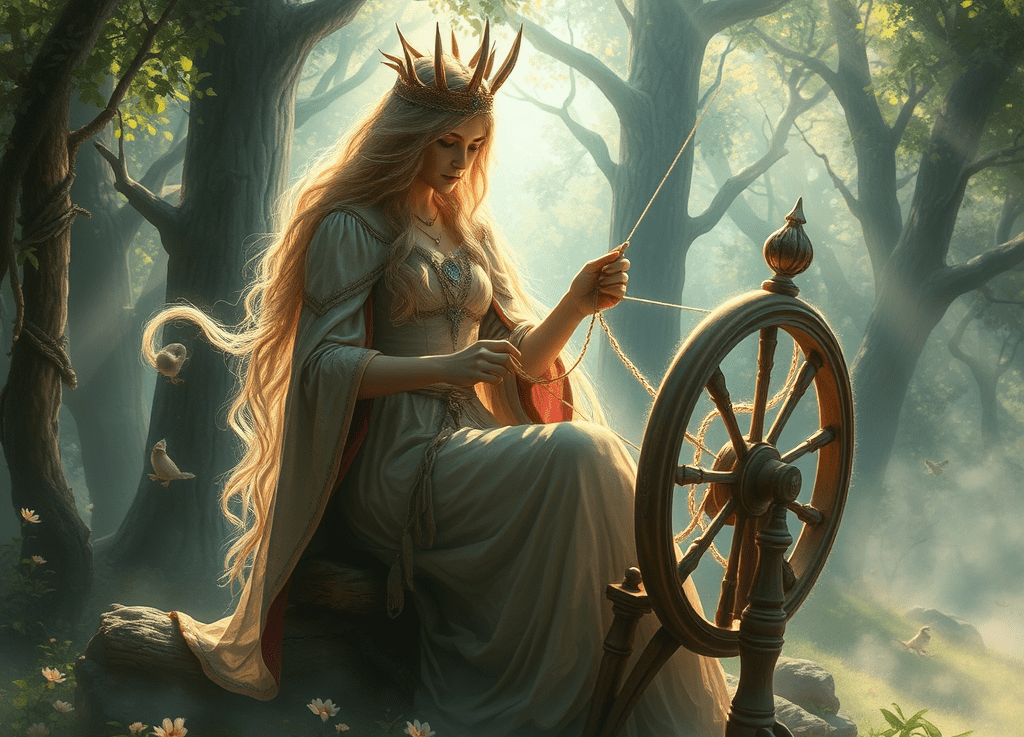
Doornroosje, sjamanistische trance

Doornroosje, sjamanistische trance


Grimm: “Die Königstochter soll sich in ihrem fünfzehnten Jahr an einer Spindel stechen und tot hinfallen.”
http://www.fln.vcu.edu/grimm/dorn_dual.html

Tiefwirtelspindeln (engl. Bottom- oder Down-Whorl), wenn der Wirtel sich unterhalb der Schaftmitte befindet.
In Europa war hauptsächlich diese Art von Spindel verbreitet.
http://de.wikipedia.org/wiki/Handspindel

Distaff:
The traditional form is a staff, held under one’s arm while using a spindle. It is about 3 feet long, held under the left arm, with the left hand drawing the fibers from it

http://en.wikipedia.org/wiki/Distaff

A spindle (sometimes called a drop spindle) is a wooden spike weighted at one end with a circular whorl; it may have an optional hook at either end of the spike. It is used for spinning wool and other fibers into thread.
http://en.wikipedia.org/wiki/Spindle_%28textiles%29

In het Engels is een spinrokken een distaff, en daar zit een staf in, een stok, en dis zou een oud woord zijn voor een streng vlas of wol.
http://blog.seniorennet.be/kareldhuyvetters/archief.php?ID=231

Doornroosje werkte dus met de spinrok-spintol combinatie, en prikte zich waarschijnlijk aan de spintol.

“Zodra het prinsesje de spintol wil proberen, prikt ze zichzelf en valt in slaap.”
http://www.meertens.knaw.nl/medewerkers/theo.meder/sprookje/doornroosje.html

De oudere versie van Perrault zegt:

“Le rang de la vieille Fée étant venu, elle dit en branlant la tête, encore plus de dépit que de vieillesse, que la princesse se percerait la main d’un fuseau, et qu’elle en mourrait.”
http://fr.wikisource.org/wiki/La_Belle_au_bois_dormant
Via google een aantal fuseau (spintollen) gevonden die heel erg scherp zijn!
http://images.google.com/images?sourceid=navclient&hl=nl&ie=UTF-8&rlz=1T4DANL_nl___NL203&q=fuseau&um=1&sa=N&tab=wi

Speculatief commentaar:
Wellicht valt het Doornroosje-verhaal te duiden als verwijzing naar een sjamanistische techniek om via spinnen met een spintol in trance te raken en de sjamanistische dood te ondergaan.

La Belle Dame Sans Merci

La Belle Dame Sans Merci


I

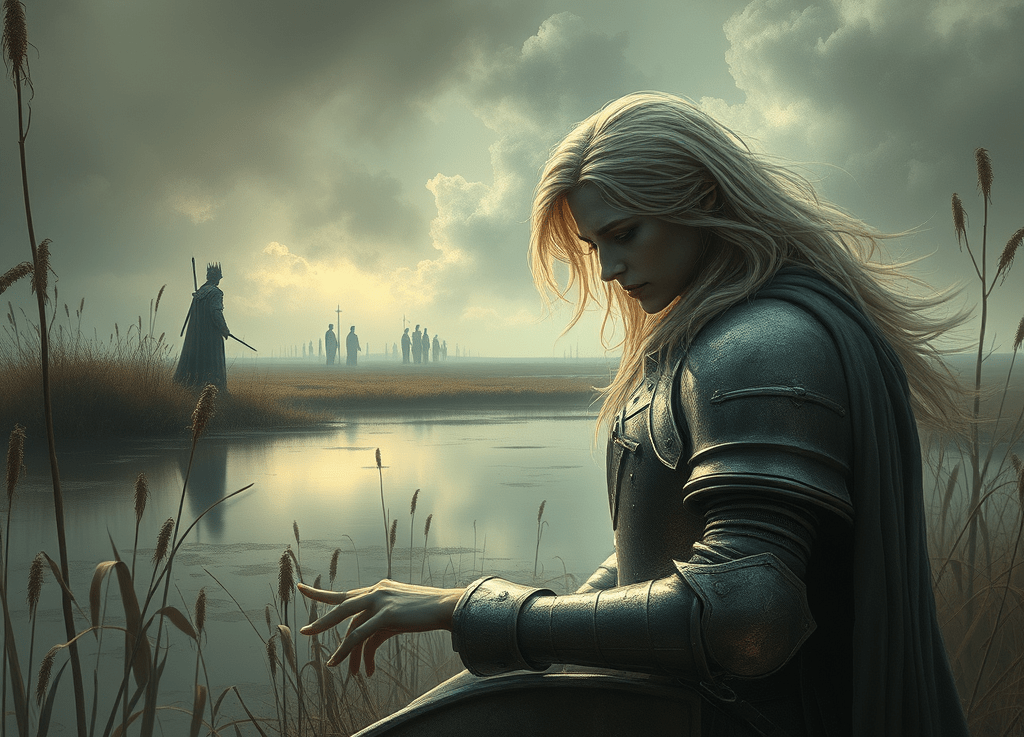
Oh what can ail thee, knight-at-arms,
Alone and palely loitering?
The sedge has withered from the lake,
And no birds sing.

                          II


Oh what can ail thee, knight-at-arms,
So haggard and so woe-begone?
The squirrel’s granary is full,
And the harvest’s done.

                          III


I see a lily on thy brow,
With anguish moist and fever-dew,
And on thy cheeks a fading rose
Fast withereth too.

                          IV


I met a lady in the meads,
Full beautiful – a faery’s child,
Her hair was long, her foot was light,
And her eyes were wild.

                          V


I made a garland for her head,
And bracelets too, and fragrant zone;
She looked at me as she did love,
And made sweet moan.

                          VI


I set her on my pacing steed,
And nothing else saw all day long,
For sidelong would she bend, and sing
A faery’s song.

                          VII

She found me roots of relish sweet,
And honey wild, and manna-dew,
And sure in language strange she said –
‘I love thee true’.

                          VIII


She took me to her elfin grot,
And there she wept and sighed full sore,
And there I shut her wild wild eyes
With kisses four.

                          IX


And there she lulled me asleep
And there I dreamed – Ah! woe betide! –
The latest dream I ever dreamt
On the cold hill side.

                          X


I saw pale kings and princes too,
Pale warriors, death-pale were they all;
They cried – ‘La Belle Dame sans Merci
Hath thee in thrall!’

                          XI


I saw their starved lips in the gloam,
With horrid warning gaped wide,
And I awoke and found me here,
On the cold hill’s side.

                          XII


And this is why I sojourn here
Alone and palely loitering,
Though the sedge is withered from the lake,
And no birds sing.

John Keats

Dedication to Hekate

Dedication to Hekate


Pre-Christian, pre-Olympian, pre-Titanic Hekate
World-Tree planted in Asia Minor,
gate-guard of the worlds,
keyholder to the 3 realms,
gross seated Mother, lions at your sides,
fostering nurse of all that’s young,
female heap of big fat attributes,
ruling through pre-rational ages
in cruelties of agricultural worship,
slain corn-kings, child sacrifice,
castrated temple-males.

You glid into Greece after Troy’s fall,
Hekate-Enodia riding down from Thessaly,
leading the angry horde of ghosts,
planted yourself at the crossroads;
your torch began to smoke then flared up,
making night noon –
World-Tree Hekate, your roots reached Hell’s
downmost altitude to suck the power
of the buried dead. Eater of Filth
Goddess of darkness, grimly silently
munching corpses, Hekate,
regaled with incense of goat-fat, baboon-shit,
garlic; honored with gutted puppies
and rubbish rites.

Hekate in your oakleaf crown shaking reptile dreadlocks,
around you hellhounds yowling sharp and shrill,
the meadows tremble, rivernymphs scream,
their waters rush backwards up the streambed
and dive affrighted down their own fountains.

With the witches I dance around you,
naked, snake-necklaced,
hair in the wind, gashing blood from arms:
sex-crazed hags with false teeth and hair,
young girls gloriously pornographic,
stir the cauldron of ugly oddities,
throw in magic salads gathered in the graveyard,
– a brew with power to draw babes screaming
into existence, or hurl them howling hence.
The witches lay hold of you, Hekate, World-tree,
shake, make tremble on your branches
the planets suspended like rare and fragile fruit.

Goddess good in struggles, finder of ways,
Hekate Rescuer, Greatest, Best,
accept this black libation of inkshed,
bring this book to birth,
adopt it for your child,
rearise through its pages in the realm of men.

– Jacob Rabinowitz