The council held together for exactly as long as Gotham remained in ruins.
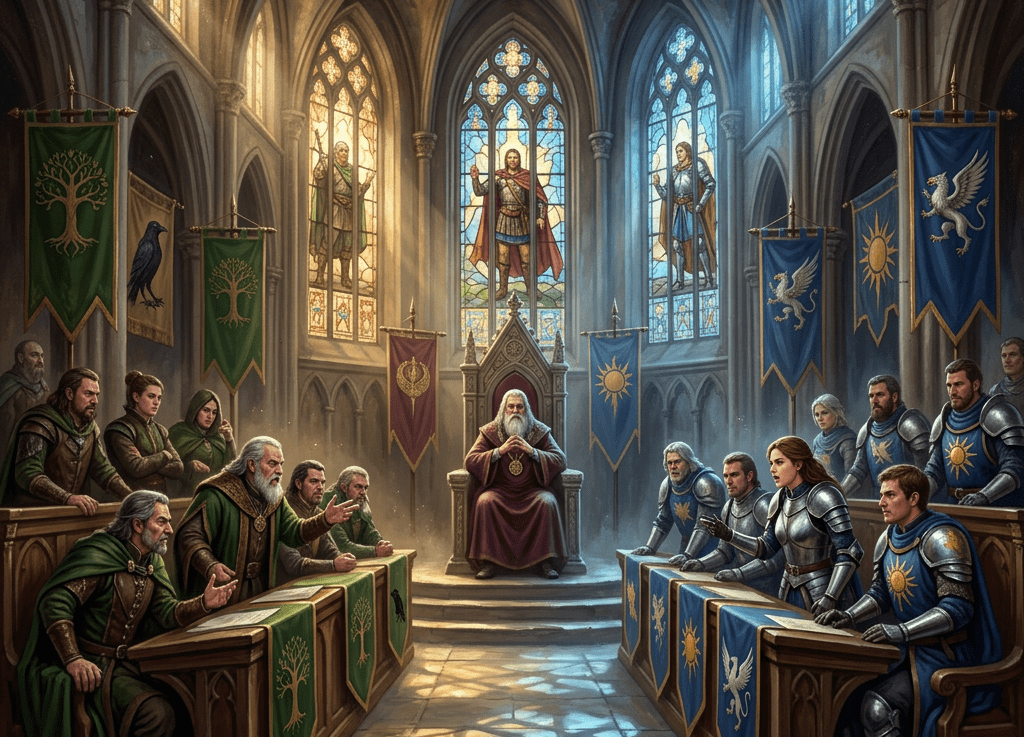
Lord Wayne brought order to the meetings. Lord Scurlock brought ledgers, contracts, and an unsettling knowledge of where every surviving coin had gone. Triad Elder Wang kept the markets moving when no one else could. Godfather Lionel made certain that food reached the districts that had once belonged to his enemies. Grandmother Bright listened to everyone, spoke little, and somehow knew which promises would be broken before they were made. Together, they were almost a government.
Then City Hall reopened. The first argument concerned taxes. The second concerned who had the authority to collect them.
By the third, Lord Wayne and Lord Scurlock were no longer speaking directly to one another.
Wang accused the nobles of rebuilding Gotham for themselves. Lionel accused Wang of using the shortages to strengthen the Triad. Scurlock produced figures proving that everyone was stealing from everyone else. Grandmother Bright merely sighed.
Outside, the citizens watched. They had fought a tyrant and discovered that tyranny was not the only thing that could make a city miserable. The council’s greatest weakness was also its greatest strength: none of its members trusted the others enough to surrender power.
And so they watched one another. Wayne watched Scurlock. Scurlock watched Wang. Wang watched Lionel. Lionel watched Wayne. Grandmother Bright watched them all.
For a time, this was enough.
Gotham recovered. The bridges reopened. Workshops filled with smoke. The hospitals gained roofs. Children returned to schools where teachers had begun replacing portraits of Highlord Macdonald with maps of the new republic.
Yet beneath the streets, something was changing. Workers repairing a sewer beneath the old South Quarter discovered that their tools were vibrating.
Then came the sound. Three slow turns of enormous gears. A pause. Three more. The foreman ordered the men out.
That night, beneath Gotham, the Dragonheart and Clockwork body moved.
And somewhere inside City Hall, Grandmother Bright suddenly woke from sleep. She had heard the same rhythm before.
Beneath Gotham, something moved. At first it was mistaken for settling stone: a faint grinding, a tremor beneath the broken foundations. Then came a sound no human throat could have produced—a wet metallic groan rising from somewhere below the oldest streets. The remnants of the dragon had not died. Its enormous body lay crushed beneath the Clockwork Golem, but the creature’s blackened heart still pulsed. Each beat sent a dull crimson light through the cracks in its scales. Worse still, the Golem’s broken mechanisms had begun turning again, driven by that alien rhythm. Dragon and machine were becoming one.
Engineer Leonardo understood before anyone else. “We must bury them deeper.”
But Lady Blackbird shook her head. “You cannot bury something that wants to dig upward.”
Meanwhile, the revolution had reached its decisive hour. Macdonald’s mercenaries, exhausted and surrounded, abandoned their barricades. The citizens poured into the streets. Yet victory proved less glorious than the revolutionaries had imagined. There was no perfect republic waiting beneath the rubble, only arguments, hunger, fear, and men suddenly discovering that power was easier to destroy than to govern.
For several bitter weeks, Gotham existed without a master. Then the rebuilding began. Not with towers. With sewers. With bridges. With hospitals and kitchens and workshops.
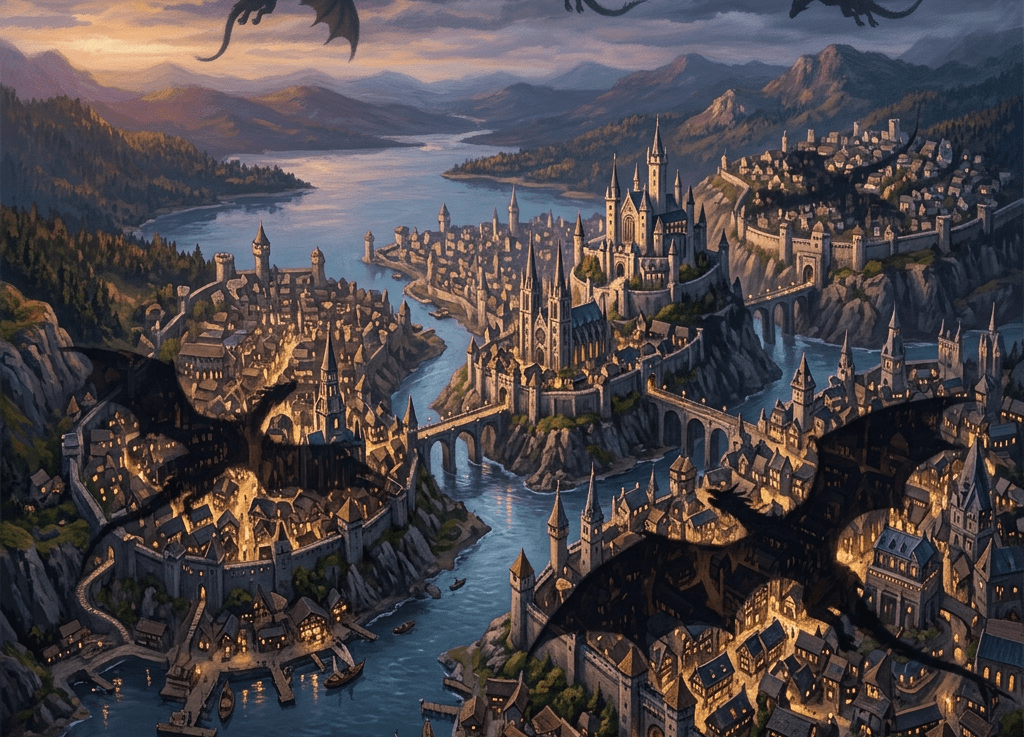
Stone by stone, the citizens reclaimed their city. The South Tower remained a jagged monument. The North Tower was left untouched, because every mason who approached it reported hearing gears turning beneath the earth. Gotham rebuilt itself, though never completely. New streets crossed the old foundations. New towers rose where ancient blood had soaked the soil. Children played in markets whose stones still bore the scars of dragon fire. And beneath them all, far below the city, two hearts continued their impossible rhythm. One organic. One mechanical. Together. Waiting.
Gotham had survived. But something beneath Gotham had survived with it.
The Owl lifted into the battle smoke. Dragon against Clockwork Golem. Teeth against gears. Magick against machinery. The sky had become a malfunctioning engine.
Lady Blackbird stood on the deck. “Nearest wormhole, Captain Avery. Now.”
Avery pulled the levers. Space buckled. The stars became white scratches on black glass. JUMP to Gotham.
They arrived scattered like bad thoughts. Each went to his preferred corner of the city.
Meanwhile Gotham was coming apart. Highlord Macdonald organized wrestling games while the streets burned with civil unrest. Mercenary guards fired into resurgent mobs. The city answered with broken windows, clubs, knives, slogans.
Above it all the Guardian Angels watched.
Then the Behemoth appeared. A shape against the horizon. Too large to be a shape. “Sound the alarm. Prepare the defence.”
South Tower. Four sent to watch the approach. Jeffrey the Sharpshooter. Julien the Medic. Morgan the Rogue. Peter the Messenger.
Julien closed his eyes. He listened with the part of the mind that listens beneath language. ‘Something evil this way comes’. Then: “A huge dragon.”
Peter launched the glider. From above, Gotham was a warzone. Rebels still rioting against mercenary troops. Vigilante martial artists converging on South Tower. Everyone moving. Nobody knowing where the exits were.
Peter returned with the report. Then North Tower.
Engineer Leonardo was waiting among wires, brass instruments and improbable machines. “According to legend,” Leonardo said, “the dragon has a weak spot. Hollow of the throat.” “We have an experimental flamethrower.” “You might try it.”
The Guardian Angels received a signal. HELP. Then another signal came screaming through the apparatus. ‘North Tower. A huge Clockwork Golem is approaching the city.’
Two monsters. One city.
Morgan went scavenging. Alchemical powder. Black residue. Things that should not be mixed. He built an experimental grenade.
The dragon came closer. Closer. Throw. The grenade met the dragon breath. FLASH. BOOM. “DUCK!”
Jeffrey did not duck quickly enough. He became toast.
Julien was already moving. Bandages. Salve. Medical intervention in the middle of the apocalypse.
Peter raised the flamethrower. Click. Nothing. Then: BOOM. Peter joined Jeffrey in the emergency ward. Julien sighed and went to work.
Morgan had better luck with the darts. One flew. Direct hit. The dragon’s eye erupted. “Yeah.”
Meanwhile Rudolf arrived. Jeffrey’s twin. He carried a meteor hammer. The weapon spun through the air, chain hissing, and wrapped itself around the dragon’s neck. Pull. The dragon pulled harder. Rudolf left the ground. For one second he was airborne, attached to a dragon. Then he let go. Iron bullets. Fire. One found the weak spot. The dragon screamed.
A blind dragon is a city-wide problem. It turned south. Then north. “The good news,” someone said, “is that it is leaving the South Tower.” Pause. “The bad news is that it is rampaging through the town center.”
North Tower. The wounded dragon charged. BANG. The tower shook. Again. BANG.
The dragon collapsed against the structure. For one impossible moment it seemed the city had survived. It had not.
Morgan took Peter’s glider. Up. Over the streets. Onto the Golem. Metal hands reaching. Clockwork heart turning. Cogs within cogs within cogs. Morgan found a panel. Opened it. Inside was a mechanical nightmare. Whirr. Click. Grind. He inserted his knife. The machinery stopped. The Golem stopped.
Then the North Tower gave way. The dragon’s weight had become too much. Stone cracked. Iron screamed. The tower folded into the street. And the Clockwork Golem came down with it. The Golem collapsed onto the dragon. Dragon beneath Golem. Golem beneath rubble.
Rubble all over Gotham. South to North, the city wore the scars of the battle like fresh wounds. Smoke. Broken towers. Burned streets. Twisted metal. Silence.
The heroes gathered among the wreckage. The worst scenario had been averted. This was considered a victory. In Gotham, you learn to celebrate the disasters that did not happen.
“Run!” There are moments in life when courage is indistinguishable from good sense, and this was one of them. Our heroes ran. Across the shattered hall, beneath falling stones, between statues that had survived three centuries only to perish in three seconds. “Where?” cried Engineer Leonardo.
“Up!”
“Up where?”
Lady Blackbird pointed. Above the palace, through a vast aperture torn in the roof, skyship the Owl
She hung above like a black-winged bird, her great propellers turning furiously, her brass hull shining through the smoke. Unfortunately, she was fifty feet above the roof.
“Excellent plan,” Leonardo said. “How do we reach it?”
A tremendous crash interrupted us. The golem had thrown the dragon through a wall. The wall came down. Captain Avery was already at the mooring platform. “Get aboard!”
“How?” He grinned. “By trusting a rope and regretting it afterward.”
A cable descended.
Below, the palace erupted. Windows burst outward. Towers leaned drunkenly.
The dragon emerged through a cloud of masonry, wings blazing, while the clockwork golem followed with the relentless dignity of a man who had never learned that buildings were supposed to remain standing.
“Cut the lines!” shouted Avery. The crew obeyed. The Owl lurched upward.
Then the dragon roared. It spread its wings. The golem seized one of its legs. Together they fell through the palace roof. A column of fire rose into the heavens. Leonardo stared downward. “Do you think they are dead?”
“No,” said Avery
“Why not?”
“Because,” he replied, looking toward the burning palace, “nothing in this cursed kingdom ever dies when it ought to.” And beneath us, something enormous moved in the flames.
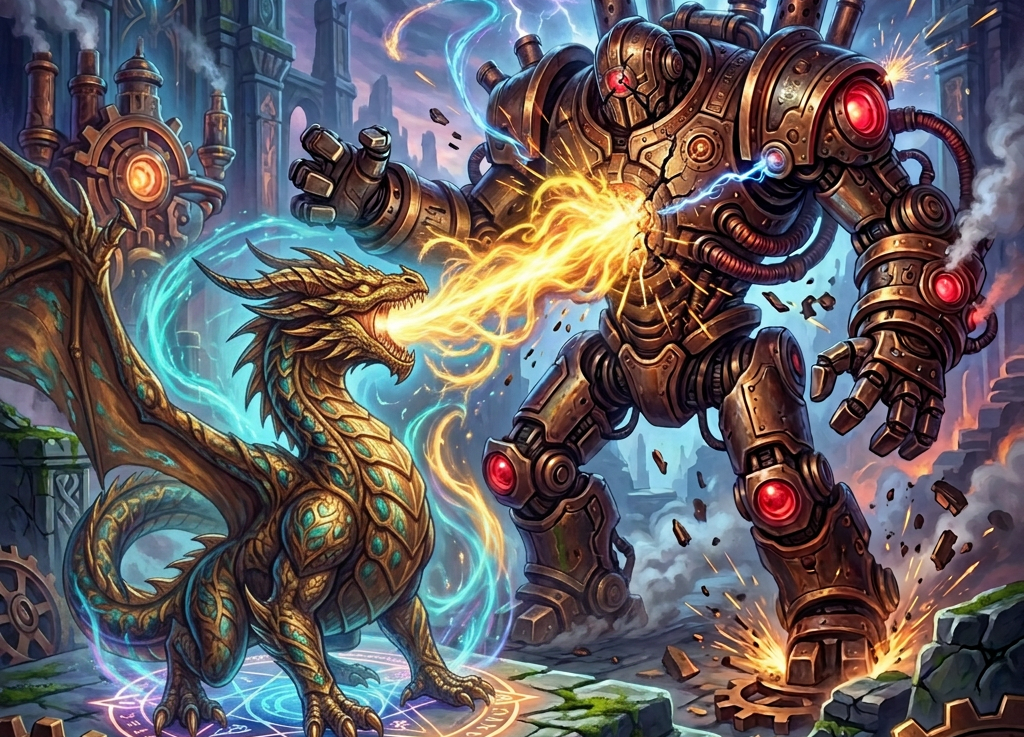
The palace shook. Dust poured from the ceiling. Then came a sound like a thousand iron teeth grinding together. The floor split open. Something enormous climbed out. It was a man. Or had once been one. Bronze plates covered its body. Pistons hammered beneath its chest. Its eyes burned with blue fire, and a great brass gear turned slowly behind its skull. The clockwork golem raised one iron fist. The dragon stared at it. The golem stared back.
The golem punched the dragon. The impact sounded like a cannon firing inside a cathedral. The dragon flew backward through three pillars. The dragon rose from the rubble. Its brass helmet was bent. Its pride was considerably more damaged. It spread its wings. Fire filled its throat.
“Everyone down!”
The dragon breathed. Flame swept across the hall.
The golem did not move. Its chest opened. Inside was a spinning furnace. The fire struck it. The machine glowed red. Then the golem laughed. It was not a pleasant sound. It seized the dragon by the throat.
The dragon clawed at its arms. The golem lifted it from the floor.
The entire palace groaned. Somewhere, a gear the size of a carriage began turning.
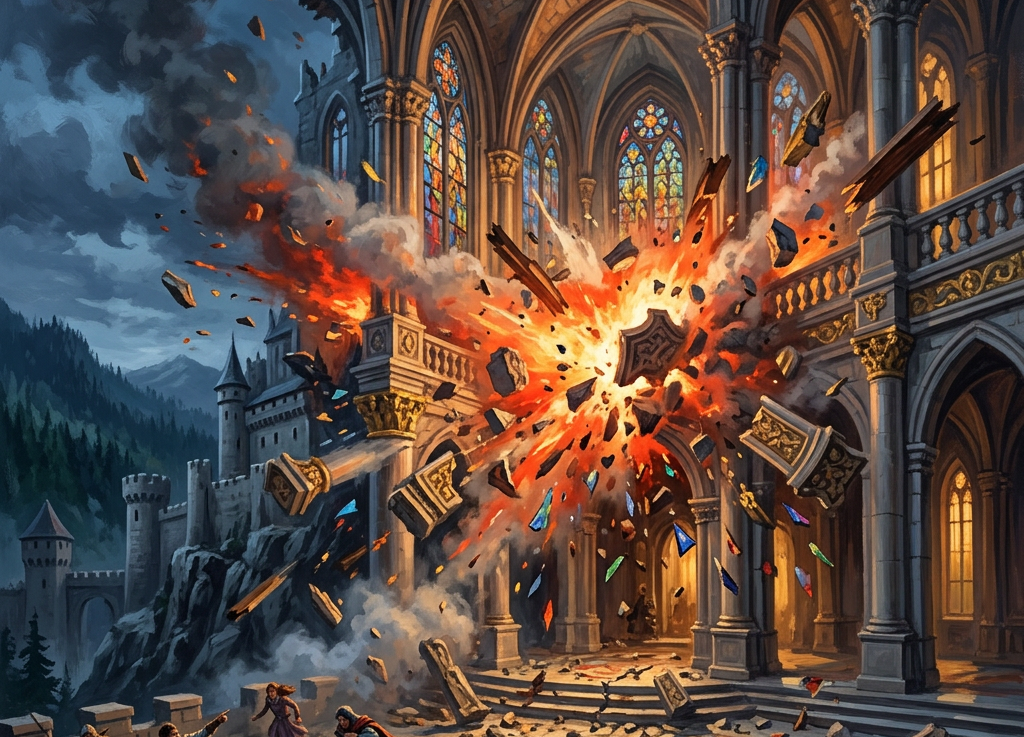
The ceiling exploded. Stone and dust thundered into the hall. Something vast crashed through the roof. It had claws. It had wings. It had far too many teeth. And it was wearing what appeared to be a brass helmet.
The creature roared. The windows shattered.
Scurlock drew his sword. Unlike Blackbird’s elegant rapier, his weapon was a long, wicked blade, black as midnight and twice as unpleasant.
“Right,” said Avery. “Who attacks first?”
Lady Blackbird grinned. “I do.”
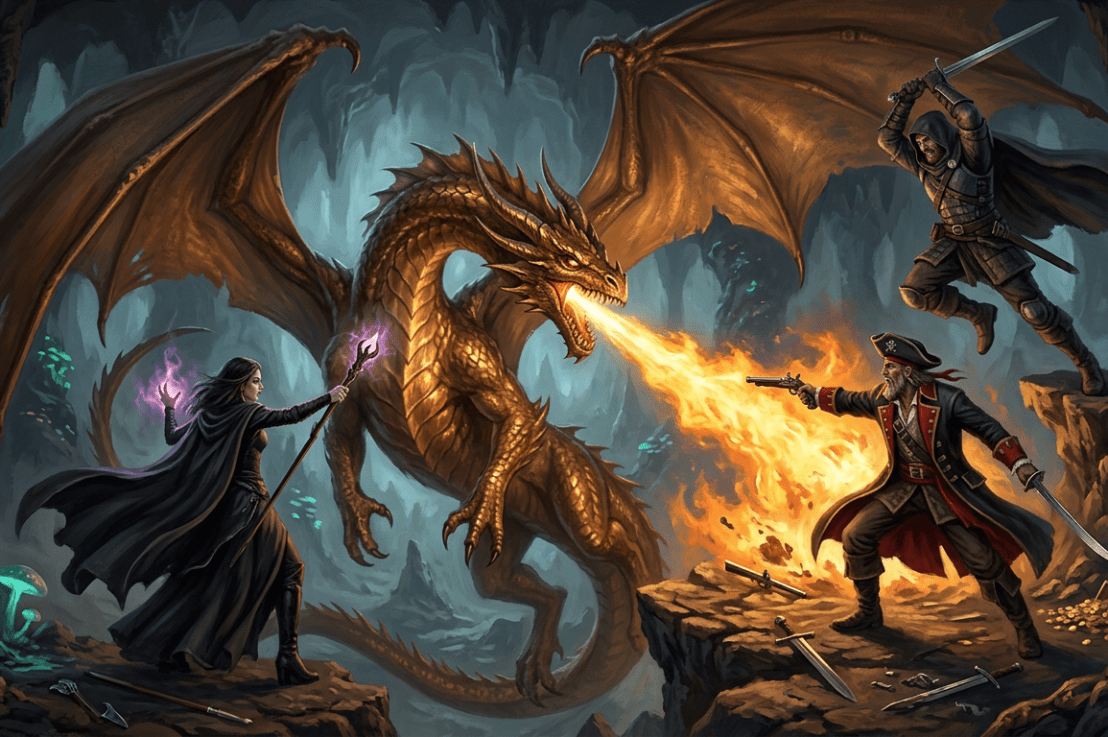
She sprang onto the back of a fallen statue, ran up its shoulder, and launched herself at the creature. Her sword flashed. She struck one of its horns. Sparks flew. The creature bellowed and swatted her aside. Avery caught her.
Scurlock leapt onto the creature’s claw. He drove his sword between two scales. The beast shrieked and shook its limb violently. Scurlock held on with one hand.
“Guardian!”
“Yes?”
“The lever!”
The Guardian went pale. “Which one?”
“All of them!”
“That seems unsafe!”
“Precisely!”
The Guardian hurled himself toward the machinery. Leonardo followed. “Wait for me!”
“You’re an engineer!”
“Exactly! I understand levers!”
Behind them, Lady Blackbird and Avery attacked together. Steel rang against brass. The creature snapped at Avery. He ducked.
Blackbird thrust. The blade vanished between its teeth. She stared. “Oh.”
Avery grabbed her by the collar. “Run!”
They fled as the beast bit down. The sword snapped.
Blackbird looked at the broken hilt in disbelief. “My sword!”
The Guardian pulled three levers. Somewhere beneath the palace, a machine awakened.
Lady Blackbird drew her sword and advanced to attack her advesary. “En garde, Lord Scurlock!”
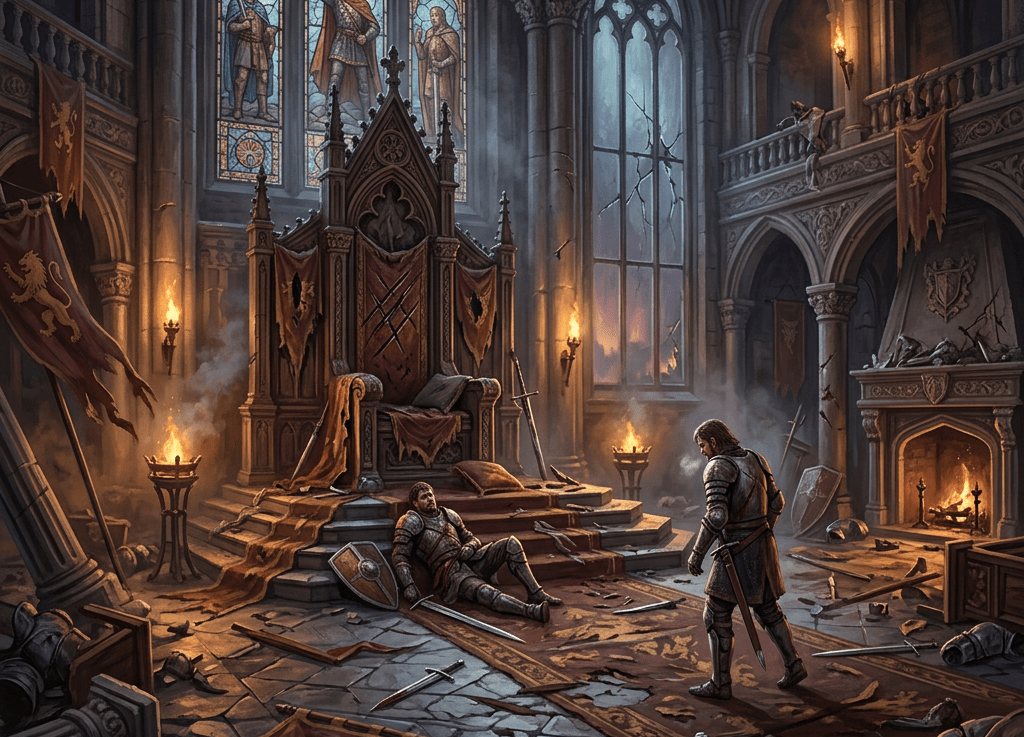
Lord Scurlock sighed. It was the kind of sigh a man makes when the evening has gone badly and somebody has just spilled gin on the carpet. He rose from the throne. He was tall, thin, and dressed in a black coat that looked as though it had been tailored by a funeral director with a grudge. A silver chain hung from his waist. At the end of it was a watch. The watch was ticking backward.
“Must we?” Scurlock asked.
Lady Blackbird lunged. Scurlock stepped aside.
She struck the throne. The throne screamed.
Lady Blackbird spun and attacked again. Scurlock parried with one finger. The blade stopped an inch from his chest. “Good sword,” he said.
“Good finger,” she replied.
He smiled. Then he flicked her sword across the hall.
It landed beside Captain Avery.
Avery picked it up. “I dislike him,” he said.
“You’re not alone,” said the Guardian. The Guardian was hiding behind engineer Leonardo.
Scurlock looked at him. The room became colder. “You,” he said.
The Guardian swallowed.
“Me?”
“You pulled the lever.”
“That was her.”
Scurlock walked toward them. Behind him, the golden throne folded itself into the shape of a chair.
“Lord Scurlock,” said Avery, raising the sword, “what exactly are you planning?”
Scurlock stopped. Through the enormous windows came the sound of something moving across the sky. Not flying. Dragging itself.
Scurlock glanced upward. “For once,” he said, “I’m not planning anything.”
The marble floor trembled.
“Then what is that?”
Scurlock looked at them. “That,” he said, “is the reason I built the door.”
Avery frowned. “The door exploded.”
“Yes.”
“Was that part of the plan?”
Scurlock considered this. “No.”
The ceiling cracked. Something enormous looked down through it.
Scurlock smiled without humor. “Now,” he said, “we may all attack together.”
Captain Avery had always believed that the universe, if approached with sufficient skepticism, would eventually admit it was making a mistake. The universe, regrettably, had developed a contrary disposition.
“Maintenance,” he repeated. “For the record, whenever an ancient civilization says maintenance, ordinary people usually end up fleeing something with entirely unreasonable numbers of legs.”
A masked figure inclined its head. “Statement statistically supported.”
Engineer Leonardo brightened with the unmistakable enthusiasm of a man discovering his worst fears had been peer-reviewed. “Oh dear.”
Lady Blackbird stepped toward the chest, where the lightning rod lay with the innocent composure peculiar to artifacts that had previously ended empires. It looked almost respectable now, which was deeply suspicious. espectability, she had long observed, was often merely catastrophe wearing polished boots.
“What,” she asked, “requires maintenance after a thousand years?”
All the masked custodians answered together. “Reality.”
Nobody spoke for several seconds. Even silence appeared uncertain whether it wished to continue.
Leonardo eventually cleared his throat with the care of a gentleman attempting not to offend the laws of existence. “I should like,” he said, “to hear the longer explanation.”
“There is no longer explanation.”
“I was afraid of that.”
The bronze beacon turned once, almost thoughtfully. Far below, another blue column flickered. Then another vanished.
The nearest custodian regarded the distant light without visible concern, which somehow made matters considerably worse. “Lighthouse Forty-Eight has failed.”
“What does it illuminate?” Avery asked.
The masked face turned toward him. “It prevents geography.”
There are professions that prepare one for alarming statements. Accounting occasionally brushes against them. Diplomacy rents them by the afternoon. Sailors become acquainted through prolonged exposure. None, however, adequately equip a person for learning that mountains, oceans and respectable peninsulas apparently required supervision lest they wander off like absent-minded sheep.
Somewhere beneath the clouds came a noise resembling continents reconsidering their arrangements.
Leonardo removed his spectacles, polished them carefully, replaced them, and sighed.
It simply continues existing, each note suspended in the air as though sound itself has forgotten how to fade. The clouds beneath the Chain Spires ripple in slow circles, not from wind but from pressure, as if the heavens have become the surface of a pond disturbed by an invisible stone.
Captain Avery instinctively reaches for the helm. “Tell me someone else hears that.”
Everyone aboard the Swift Skyship Owl nods. Even the ship seems to respond. The brass compass mounted beside the wheel rotates lazily through every direction before settling somewhere impossible—straight upward.
Engineer Leonardo studies it with narrowed eyes. “I distinctly designed that to disagree only with magnets.”
A second bell joins the first. Then a third.
None of them originate from the bronze lantern suspended between the towers. Instead they seem to emerge from different distances at once, as though enormous invisible churches have been hidden throughout the sky.
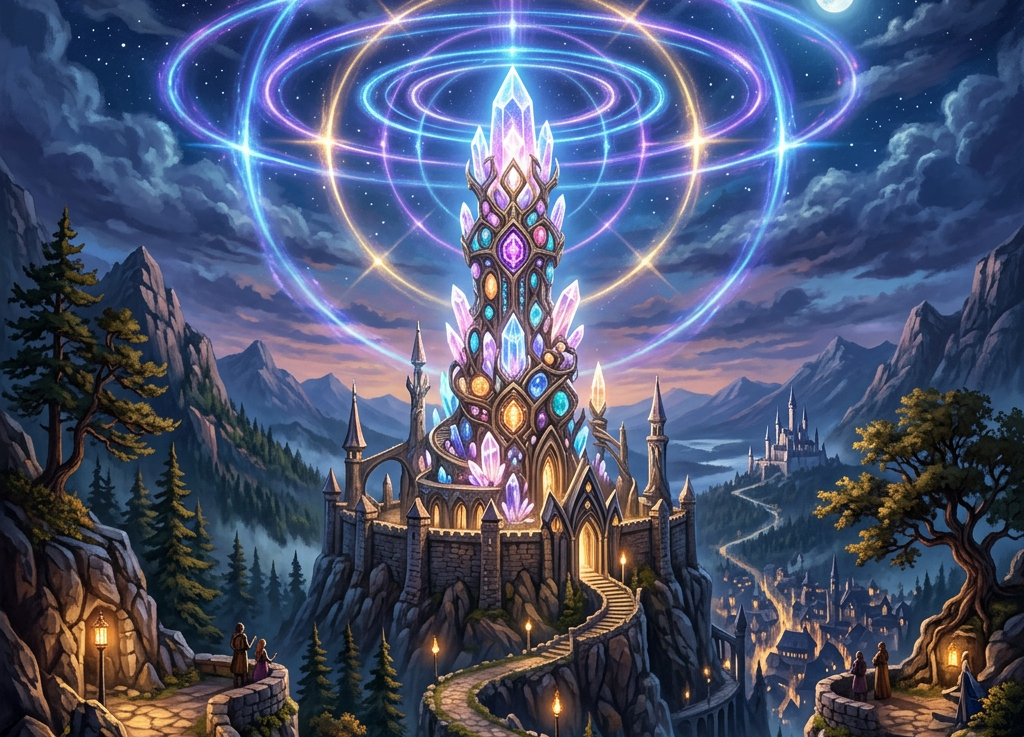
The beacon brightens. Its crystal heart rotates within its bronze cage. Blue light pours through engraved symbols circling the lantern’s frame. The runes are unlike any alphabet recorded in royal libraries. They resemble diagrams pretending to be letters, geometric thoughts carved into metal by minds that considered mathematics a native language.
The lightning rod, recovered by Lady Blackbird from the forgotten ruins, answers. It begins humming inside its storage chest. The lid rattles.
“Perhaps,” says Leonardo carefully, “we should not open that.”
The chest unlatches itself. The rod rises into the air with serene confidence, floating upright like a compass needle that has suddenly remembered true north. Thin threads of azure electricity stretch from its tip toward the distant beacon. No one aboard touches it.
No one wishes to volunteer for whatever conversation two ancient machines have decided to resume.
The Swift Skyship Owl lurches gently. Not from turbulence. From being pulled. The invisible force is subtle but undeniable, like the tide persuading a drifting boat that resistance is an unnecessary hobby.
Avery eases the helm against it. The ship answers for exactly three seconds before politely ignoring him. “I don’t appreciate vessels developing opinions,” he mutters.
Leonardo folds his arms. “I have built many remarkable devices.”
He watches the wheel turn of its own accord. “I do not recall constructing one with ambition.”
Ahead, the Chain Spires grow larger. Each tower is carved from a single pillar of dark stone streaked with veins of silver that shimmer beneath the bronze beacon’s glow. Iron chains disappear into the clouds below, so vast that entire villages could have stood upon a single link. The copper vanes atop every tower spin faster.
Still there is no wind. As the Owl drifts closer, figures appear upon the nearest platform. Not statues. People. Or something close enough to invite dangerous assumptions.
They wear long coats woven with threads of tarnished copper, their faces hidden behind polished masks shaped like expressionless owls. None carry weapons. Instead each holds a staff crowned with a crystal that burns with the same pale blue fire as the beacon. They watch the approaching skyship without waving. Without moving.
One raises a gloved hand. The bronze lantern answers.
A circle of light blossoms beneath the Swift Skyship Owl, spreading wider until it surrounds the entire vessel. The humming rod descends gently back into its chest, as though satisfied it has introduced two old acquaintances.
The bells cease.
Silence returns with such completeness that the creak of a single rope sounds startlingly loud. Then the nearest masked figure speaks. Its voice arrives from every direction equally. “Identification acknowledged.”
The pause that follows feels less like hesitation than the turning of a page in a very old book. “Courier Vessel Designation: Owl.”
Another pause. “Custodian Key recognized.”
Every masked head turns toward the chest containing the lightning rod. “Protocol Seven has resumed.”
Leonardo blinks. “I was unaware there were six previous protocols.”
The masked figure continues as though no interruption has occurred. “The Lighthouse Network requests maintenance.”
The words hang in the still air. Not a plea. Not an order. Simply the recitation of a duty left unfinished for centuries.
Far below, hidden beneath the endless blanket of cloud, something immense answers. One by one, faint columns of blue light begin rising through the overcast in distant parts of the world. There are dozens. Then hundreds. Ancient beacons—silent since kingdoms were young—are awakening.
And somewhere beyond every known chart, where forgotten seas concealed cities that memory itself struggled to locate, one final light burns brighter than all the others before disappearing beneath the horizon once more.
Atlantis, it seems, had never stopped listening. It had merely been waiting for someone to ring the bell.












You must be logged in to post a comment.