

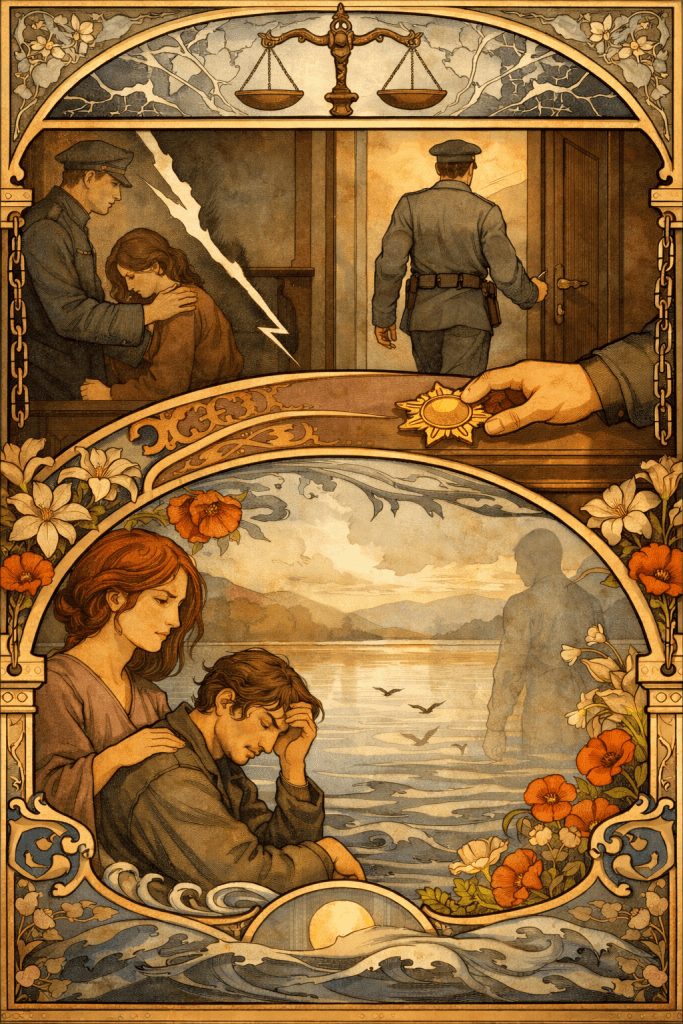
I belonged to a unit that called itself orderly, though order there was a brittle thing, like frost on a window that vanishes at a breath.
We wore the same colors, spoke the same clipped phrases, and trusted—so we said—the same chain of command.
But one morning our leader turned his gaze upon a colleague of mine, a quiet woman who kept her counsel and did her work with a steady hand.
He judged her in haste, and his words were a blade without temper.
I felt the cut as if it had found my own skin.
In that moment I understood how a structure may stand and yet be hollow.
Justice, we had been taught, was the spine of our work.
Without it, we were only shadows moving in formation.
I placed my badge upon the desk, a small sun gone cold, and stepped out of that narrow world.
No one stopped me.
The door closed with a sound like a verdict, though I could not say upon whom it fell.
…
The dream shifted, as dreams do, into a softer country.
I was among friends—no uniforms, no ranks—only the fragile, luminous ties we make of laughter and shared hours.
We walked beside water that held the sky like a second, deeper truth.
There was someone there who mattered to me in ways I had never named, as one does not name the air until it is gone.
Then a friend approached, her face already carrying the news before her lips shaped it.
The words were simple, and because they were simple they were absolute: he was gone.
The world did not break; it thinned.
Sound grew distant, as if I stood beneath the surface of the water we had walked beside.
Grief came not as a storm but as a tide—inevitable, patient.
It filled the spaces where certainty had been.
I learned then that leaving and losing are kin, each a doorway we do not choose, each remaking the shape of the self that passes through.


You must be logged in to post a comment.