

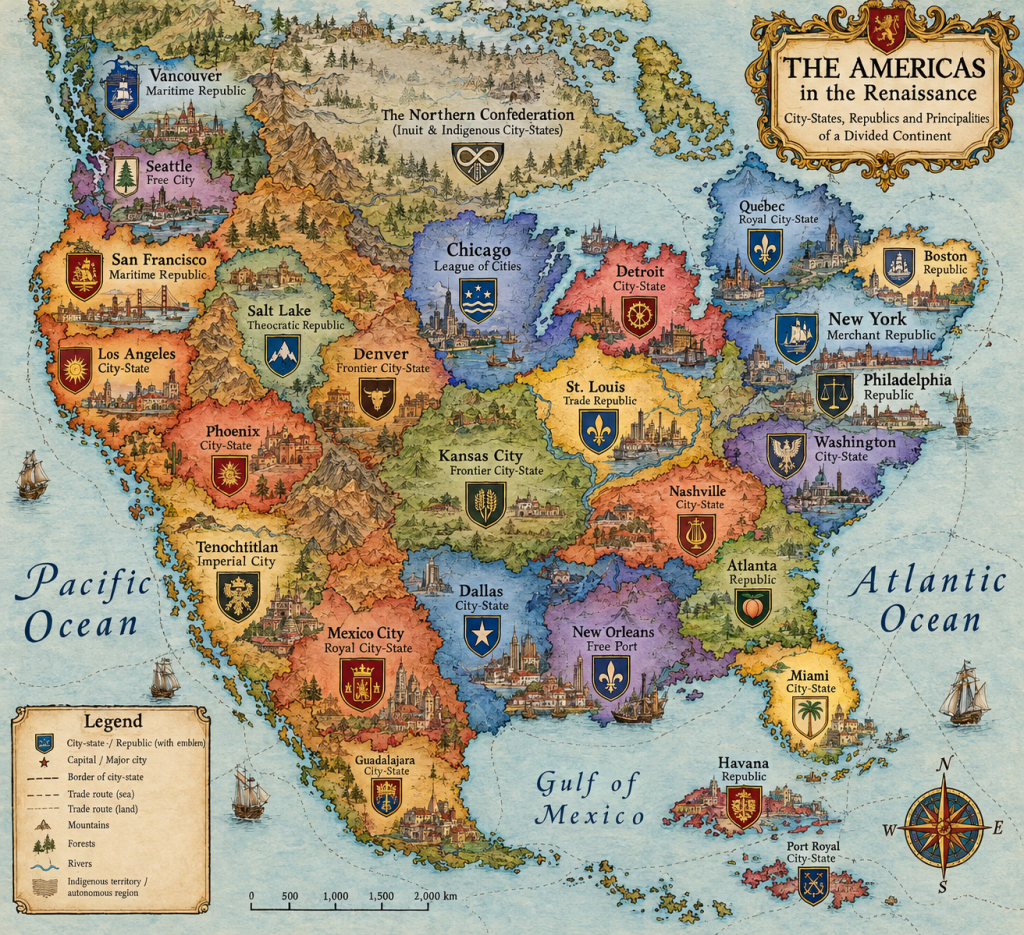
Imagine that America had never become united, but instead had developed like Renaissance Italy: a continent filled with rival city-states, powerful trading republics, principalities, and alliances.
New York, for example, becomes a powerful trading republic on the Atlantic coast, Chicago controls trade across the Great Lakes, and San Francisco emerges as a wealthy maritime city-state on the Pacific coast.
The political landscape might look something like this:
- New York — a North American Venice, wealthy thanks to maritime trade, bankers, and diplomacy.
- Boston — a republic of merchants, shipbuilders, and scholars.
- Chicago — a strategic trading power controlling the connections between the Great Lakes and the interior.
- San Francisco — a maritime republic with trade routes across the Pacific.
- New Orleans — an important river city-state controlling access to the Mississippi.
- Mexico City — a powerful southern empire with its own political and cultural traditions.
Just as in Renaissance Italy, these states would constantly form alliances, wage wars, hire mercenaries, and compete for control of trade routes.
Smaller cities might sometimes become particularly powerful by controlling a mountain pass, a river mouth, or an important harbor.
The fascinating consequence: the United States would not exist as a single country.
Instead, the continent would resemble an American patchwork of Florence, Venice, Genoa, and Milan, alongside larger kingdoms and Indigenous states pursuing their own struggles for power.


You must be logged in to post a comment.