
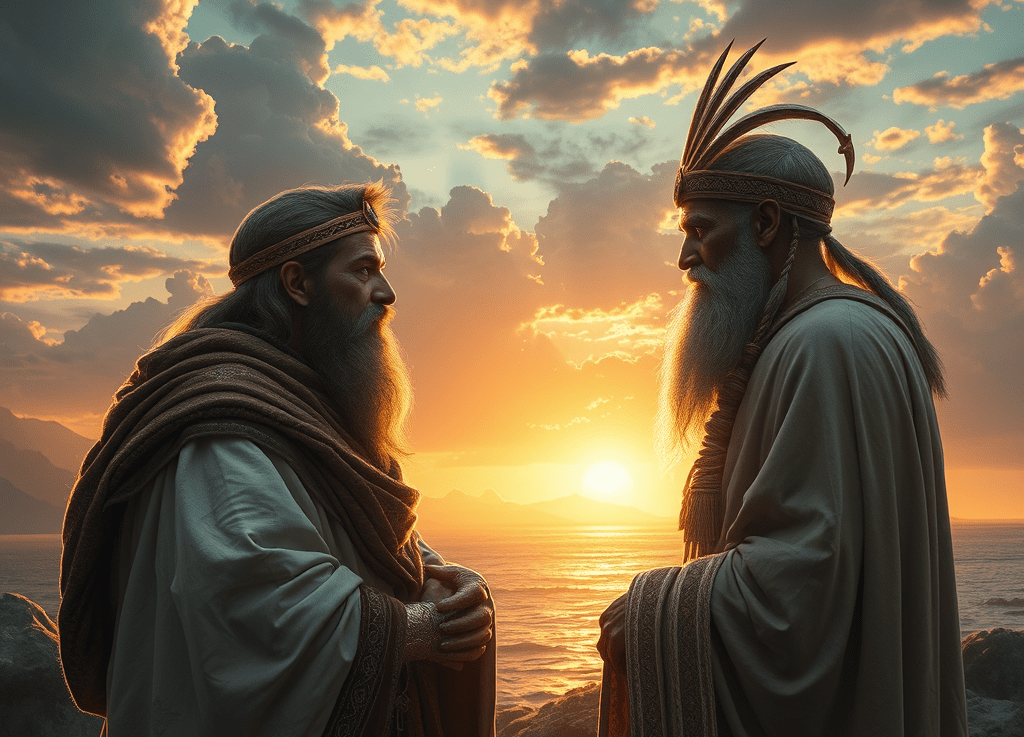
Gilgamesh spoke to Utanapishtim, the Faraway:
“I have been looking at you,
but your appearance is not strange–you are like me!
You yourself are not different–you are like me!
My mind was resolved to fight with you,
(but instead?) my arm lies useless over you.
Tell me, how is it that you stand in the Assembly of the Gods,
and have found life!”
Utanapishtim spoke to Gilgamesh, saying:
“I will reveal to you, Gilgamesh, a thing that is hidden,
a secret of the gods I will tell you!
Shuruppak, a city that you surely know,
situated on the banks of the Euphrates,
that city was very old, and there were gods inside it.
The hearts of the Great Gods moved them to inflict the Flood.
Their Father Anu uttered the oath (of secrecy),
Valiant Enlil was their Adviser,
Ninurta was their Chamberlain,
Ennugi was their Minister of Canals.
Ea, the Clever Prince(?), was under oath with them
so he repeated their talk to the reed house:
‘Reed house, reed house! Wall, wall!
O man of Shuruppak, son of Ubartutu:
Tear down the house and build a boat!
Abandon wealth and seek living beings!
Spurn possessions and keep alive living beings!
Make all living beings go up into the boat.
The boat which you are to build,
its dimensions must measure equal to each other:
its length must correspond to its width.
Roof it over like the Apsu.
I understood and spoke to my lord, Ea:
‘My lord, thus is the command which you have uttered
I will heed and will do it.
But what shall I answer the city, the populace, and the
Elders!’
Ea spoke, commanding me, his servant:
‘You, well then, this is what you must say to them:
“It appears that Enlil is rejecting me
so I cannot reside in your city (?),
nor set foot on Enlil’s earth.
I will go down to the Apsu to live with my lord, Ea,
and upon you he will rain down abundance,
a profusion of fowl, myriad(!) fishes.
He will bring to you a harvest of wealth,
in the morning he will let loaves of bread shower down,
and in the evening a rain of wheat!”‘
Just as dawn began to glow
the land assembled around me-
the carpenter carried his hatchet,
the reed worker carried his (flattening) stone,
… the men …
The child carried the pitch,
the weak brought whatever else was needed.
On the fifth day I laid out her exterior.
It was a field in area,
its walls were each 10 times 12 cubits in height,
the sides of its top were of equal length, 10 times It cubits each.
I laid out its (interior) structure and drew a picture of it (?).
I provided it with six decks,
thus dividing it into seven (levels).
The inside of it I divided into nine (compartments).
I drove plugs (to keep out) water in its middle part.
I saw to the punting poles and laid in what was necessary.
Three times 3,600 (units) of raw bitumen I poured into the
bitumen kiln,
three times 3,600 (units of) pitch …into it,
there were three times 3,600 porters of casks who carried (vege-
table) oil,
apart from the 3,600 (units of) oil which they consumed (!)
and two times 3,600 (units of) oil which the boatman stored
away.
I butchered oxen for the meat(!),
and day upon day I slaughtered sheep.
I gave the workmen(?) ale, beer, oil, and wine, as if it were
river water,
so they could make a party like the New Year’s Festival.
… and I set my hand to the oiling(!).
The boat was finished by sunset.
The launching was very difficult.
They had to keep carrying a runway of poles front to back,
until two-thirds of it had gone into the water(?).
Whatever I had I loaded on it:
whatever silver I had I loaded on it,
whatever gold I had I loaded on it.
All the living beings that I had I loaded on it,
I had all my kith and kin go up into the boat,
all the beasts and animals of the field and the craftsmen I
had go up.
Shamash had set a stated time:
‘In the morning I will let loaves of bread shower down,
and in the evening a rain of wheat!
Go inside the boat, seal the entry!’
That stated time had arrived.
In the morning he let loaves of bread shower down,
and in the evening a rain of wheat.
I watched the appearance of the weather–
the weather was frightful to behold!
I went into the boat and sealed the entry.
For the caulking of the boat, to Puzuramurri, the boatman,
I gave the palace together with its contents.
Just as dawn began to glow
there arose from the horizon a black cloud.
Adad rumbled inside of it,
before him went Shullat and Hanish,
heralds going over mountain and land.
Erragal pulled out the mooring poles,
forth went Ninurta and made the dikes overflow.
The Anunnaki lifted up the torches,
setting the land ablaze with their flare.
Stunned shock over Adad’s deeds overtook the heavens,
and turned to blackness all that had been light.
The… land shattered like a… pot.
All day long the South Wind blew …,
blowing fast, submerging the mountain in water,
overwhelming the people like an attack.
No one could see his fellow,
they could not recognize each other in the torrent.
The gods were frightened by the Flood,
and retreated, ascending to the heaven of Anu.
The gods were cowering like dogs, crouching by the outer wall.
Ishtar shrieked like a woman in childbirth,
the sweet-voiced Mistress of the Gods wailed:
‘The olden days have alas turned to clay,
because I said evil things in the Assembly of the Gods!
How could I say evil things in the Assembly of the Gods,
ordering a catastrophe to destroy my people!!
No sooner have I given birth to my dear people
than they fill the sea like so many fish!’
The gods–those of the Anunnaki–were weeping with her,
the gods humbly sat weeping, sobbing with grief(?),
their lips burning, parched with thirst.
Six days and seven nights
came the wind and flood, the storm flattening the land.
When the seventh day arrived, the storm was pounding,
the flood was a war–struggling with itself like a woman
writhing (in labor).
The sea calmed, fell still, the whirlwind (and) flood stopped up.
I looked around all day long–quiet had set in
and all the human beings had turned to clay!
The terrain was as flat as a roof.
I opened a vent and fresh air (daylight!) fell upon the side of
my nose.
I fell to my knees and sat weeping,
tears streaming down the side of my nose.
I looked around for coastlines in the expanse of the sea,
and at twelve leagues there emerged a region (of land).
On Mt. Nimush the boat lodged firm,
Mt. Nimush held the boat, allowing no sway.
One day and a second Mt. Nimush held the boat, allowing
no sway.
A third day, a fourth, Mt. Nimush held the boat, allowing
no sway.
A fifth day, a sixth, Mt. Nimush held the boat, allowing
no sway.
When a seventh day arrived
I sent forth a dove and released it.
The dove went off, but came back to me;
no perch was visible so it circled back to me.
I sent forth a swallow and released it.
The swallow went off, but came back to me;
no perch was visible so it circled back to me.
I sent forth a raven and released it.
The raven went off, and saw the waters slither back.
It eats, it scratches, it bobs, but does not circle back to me.
Then I sent out everything in all directions and sacrificed
(a sheep).
I offered incense in front of the mountain-ziggurat.
Seven and seven cult vessels I put in place,
and (into the fire) underneath (or: into their bowls) I poured
reeds, cedar, and myrtle.
The gods smelled the savor,
the gods smelled the sweet savor,
and collected like flies over a (sheep) sacrifice.
Just then Beletili arrived.
She lifted up the large flies (beads) which Anu had made for
his enjoyment(!):
‘You gods, as surely as I shall not forget this lapis lazuli
around my neck,
may I be mindful of these days, and never forget them!
The gods may come to the incense offering,
but Enlil may not come to the incense offering,
because without considering he brought about the Flood
and consigned my people to annihilation.’
Just then Enlil arrived.
He saw the boat and became furious,
he was filled with rage at the Igigi gods:
‘Where did a living being escape?
No man was to survive the annihilation!’
Ninurta spoke to Valiant Enlil, saying:
‘Who else but Ea could devise such a thing?
It is Ea who knows every machination!’
La spoke to Valiant Enlil, saying:
‘It is yours, O Valiant One, who is the Sage of the Gods.
How, how could you bring about a Flood without consideration
Charge the violation to the violator,
charge the offense to the offender,
but be compassionate lest (mankind) be cut off,
be patient lest they be killed.
Instead of your bringing on the Flood,
would that a lion had appeared to diminish the people!
Instead of your bringing on the Flood,
would that a wolf had appeared to diminish the people!
Instead of your bringing on the Flood,
would that famine had occurred to slay the land!
Instead of your bringing on the Flood,
would that (Pestilent) Erra had appeared to ravage the land!
It was not I who revealed the secret of the Great Gods,
I (only) made a dream appear to Atrahasis, and (thus) he
heard the secret of the gods.
Now then! The deliberation should be about him!’
Enlil went up inside the boat
and, grasping my hand, made me go up.
He had my wife go up and kneel by my side.
He touched our forehead and, standing between us, he
blessed us:
‘Previously Utanapishtim was a human being.
But now let Utanapishtim and his wife become like us,
the gods!
Let Utanapishtim reside far away, at the Mouth of the Rivers.’
They took us far away and settled us at the Mouth of the Rivers.”
“Now then, who will convene the gods on your behalf,
that you may find the life that you are seeking!
Wait! You must not lie down for six days and seven nights.”
soon as he sat down (with his head) between his legs
sleep, like a fog, blew upon him.
Utanapishtim said to his wife:
“Look there! The man, the youth who wanted (eternal) life!
Sleep, like a fog, blew over him.”
his wife said to Utanapishtim the Faraway:
“Touch him, let the man awaken.
Let him return safely by the way he came.
Let him return to his land by the gate through which he left.”
Utanapishtim said to his wife:
“Mankind is deceptive, and will deceive you.
Come, bake loaves for him and keep setting them by his head
and draw on the wall each day that he lay down.”
She baked his loaves and placed them by his head
and marked on the wall the day that he lay down.
The first loaf was dessicated,
the second stale, the third moist(?), the fourth turned white,
its …,
the fifth sprouted gray (mold), the sixth is still fresh.
the seventh–suddenly he touched him and the man awoke.
Gilgamesh said to Utanapishtim:
“The very moment sleep was pouring over me
you touched me and alerted me!”
Utanapishtim spoke to Gilgamesh, saying:
“Look over here, Gilgamesh, count your loaves!
You should be aware of what is marked on the wall!
Your first loaf is dessicated,
the second stale, the third moist, your fourth turned white,
its …
the fifth sprouted gray (mold), the sixth is still fresh.
The seventh–suddenly he touched him and the man awoke.
Gilgamesh said to Utanapishtim:
“The very moment sleep was pouring over me
you touched me and alerted me!”
Utanapishtim spoke to Gilgamesh, saying:
“Look over here, Gilgamesh, count your loaves!
You should be aware of what is marked on the wall!
Your first loaf is dessicated,
the second stale, the third moist, your fourth turned white,
its …
the fifth sprouted gray (mold), the sixth is still fresh.
The seventh–at that instant you awoke!”
Gilgamesh said to Utanapishtim the Faraway:
“O woe! What shall I do, Utanapishtim, where shall I go!
The Snatcher has taken hold of my flesh,
in my bedroom Death dwells,
and wherever I set foot there too is Death!”
Home Empty-Handed
Utanapishtim said to Urshanabi, the ferryman:
“May the harbor reject you, may the ferry landing reject you!
May you who used to walk its shores be denied its shores!
The man in front of whom you walk, matted hair chains
his body,
animal skins have ruined his beautiful skin.
Take him away, Urshanabi, bring him to the washing place.
Let him wash his matted hair in water like ellu.
Let him cast away his animal skin and have the sea carry it off,
let his body be moistened with fine oil,
let the wrap around his head be made new,
let him wear royal robes worthy of him!
Until he goes off to his city,
until he sets off on his way,
let his royal robe not become spotted, let it be perfectly new!”
Urshanabi took him away and brought him to the washing place.
He washed his matted hair with water like ellu.
He cast off his animal skin and the sea carried it oh.
He moistened his body with fine oil,
and made a new wrap for his head.
He put on a royal robe worthy of him.
Until he went away to his city,
until he set off on his way,
his royal robe remained unspotted, it was perfectly clean.
Gilgamesh and Urshanabi bearded the boat,
they cast off the magillu-boat, and sailed away.
The wife of Utanapishtim the Faraway said to him:
“Gilgamesh came here exhausted and worn out.
What can you give him so that he can return to his land (with
honor) !”
Then Gilgamesh raised a punting pole
and drew the boat to shore.
Utanapishtim spoke to Gilgamesh, saying:
“Gilgamesh, you came here exhausted and worn out.
What can I give you so you can return to your land?
I will disclose to you a thing that is hidden, Gilgamesh,
a… I will tell you.
There is a plant… like a boxthorn,
whose thorns will prick your hand like a rose.
If your hands reach that plant you will become a young
man again.”
Hearing this, Gilgamesh opened a conduit(!) (to the Apsu)
and attached heavy stones to his feet.
They dragged him down, to the Apsu they pulled him.
He took the plant, though it pricked his hand,
and cut the heavy stones from his feet,
letting the waves(?) throw him onto its shores.
Gilgamesh spoke to Urshanabi, the ferryman, saying:
“Urshanabi, this plant is a plant against decay(!)
by which a man can attain his survival(!).
I will bring it to Uruk-Haven,
and have an old man eat the plant to test it.
The plant’s name is ‘The Old Man Becomes a Young Man.'”
Then I will eat it and return to the condition of my youth.”
At twenty leagues they broke for some food,
at thirty leagues they stopped for the night.
Seeing a spring and how cool its waters were,
Gilgamesh went down and was bathing in the water.
A snake smelled the fragrance of the plant,
silently came up and carried off the plant.
While going back it sloughed off its casing.’
At that point Gilgamesh sat down, weeping,
his tears streaming over the side of his nose.
“Counsel me, O ferryman Urshanabi!
For whom have my arms labored, Urshanabi!
For whom has my heart’s blood roiled!
I have not secured any good deed for myself,
but done a good deed for the ‘lion of the ground’!”
Now the high waters are coursing twenty leagues distant,’
as I was opening the conduit(?) I turned my equipment over
into it (!).
What can I find (to serve) as a marker(?) for me!
I will turn back (from the journey by sea) and leave the boat by
the shore!”
At twenty leagues they broke for some food,
at thirty leagues they stopped for the night.
They arrived in Uruk-Haven.
Gilgamesh said to Urshanabi, the ferryman:
“Go up, Urshanabi, onto the wall of Uruk and walk around.
Examine its foundation, inspect its brickwork thoroughly–
is not (even the core of) the brick structure of kiln-fired brick,
and did not the Seven Sages themselves lay out its plan!
One league city, one league palm gardens, one league lowlands, the open area(?) of the Ishtar Temple,
three leagues and the open area(?) of Uruk it encloses.
Ping: https://www.ancienttexts.org/library/mesopotamian/gilgamesh/tab11.htm




 Dreamquest