| YOU may talk o’ gin an’ beer |
|
| When you’re quartered safe out ‘ere, |
|
| An’ you’re sent to penny-fights an’ Aldershot it; |
|
| But if it comes to slaughter |
|
| You will do your work on water, |
5 |
| An’ you’ll lick the bloomin’ boots of ‘im that’s got it. |
|
| Now in Injia’s sunny clime, |
|
| Where I used to spend my time |
|
| A-servin’ of ‘Er Majesty the Queen, |
|
| Of all them black-faced crew |
10 |
| The finest man I knew |
|
| Was our regimental bhisti, Gunga Din. |
|
|
| It was “Din! Din! Din! |
|
| You limping lump o’ brick-dust, Gunga Din! |
|
| Hi! slippy hitherao! |
15 |
| Water, get it! Panee lao! |
|
| You squidgy-nosed old idol, Gunga Din!” |
|
|
| The uniform ‘e wore |
|
| Was nothin’ much before, |
|
| An’ rather less than ‘arf o’ that be’ind, |
20 |
| For a twisty piece o’ rag |
|
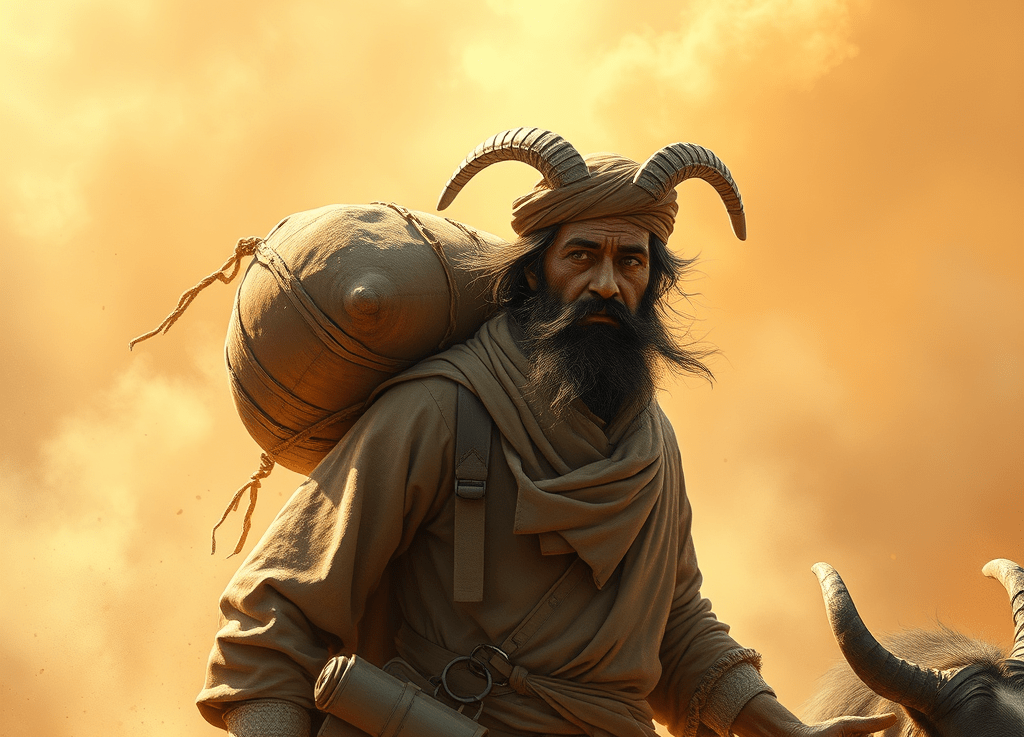
| An’ a goatskin water-bag |
|
| Was all the field-equipment ‘e could find. |
|
| When the sweatin’ troop-train lay |
|
| In a sidin’ through the day, |
25 |
| Where the ‘eat would make your bloomin’ eyebrows crawl, |
|
| We shouted “Harry By!” |
|
| Till our throats were bricky-dry, |
|
| Then we wopped ‘im ’cause ‘e couldn’t serve us all. |
|
|
| It was “Din! Din! Din! |
30 |
| You ‘eathen, where the mischief ‘ave you been? |
|
| You put some juldee in it, |
|
| Or I’ll marrow you this minute, |
|
| If you don’t fill up my helmet, Gunga Din!” |
|
|
| ‘E would dot an’ carry one |
35 |
| Till the longest day was done, |
|
| An’ ‘e didn’t seem to know the use o’ fear. |
|
| If we charged or broke or cut, |
|
| You could bet your bloomin’ nut, |
|
| ‘E’d be waitin’ fifty paces right flank rear. |
40 |
| With ‘is mussick on ‘is back, |
|
| ‘E would skip with our attack, |
|
| An’ watch us till the bugles made “Retire.” |
|
| An’ for all ‘is dirty ‘ide, |
|
| ‘E was white, clear white, inside |
45 |
| When ‘e went to tend the wounded under fire! |
|
|
| It was “Din! Din! Din!” |
|
| With the bullets kickin’ dust-spots on the green. |
|
| When the cartridges ran out, |
|
| You could ‘ear the front-files shout: |
50 |
| “Hi! ammunition-mules an’ Gunga Din!” |
|
|
| I sha’n’t forgit the night |
|
| When I dropped be’ind the fight |
|
| With a bullet where my belt-plate should ‘a’ been. |
|
| I was chokin’ mad with thirst, |
55 |
| An’ the man that spied me first |
|
| Was our good old grinnin’, gruntin’ Gunga Din. |
|
|
| ‘E lifted up my ‘ead, |
|
| An’ ‘e plugged me where I bled, |
|
| An’ ‘e guv me ‘arf-a-pint o’ water—green; |
60 |
| It was crawlin’ an’ it stunk, |
|
| But of all the drinks I’ve drunk, |
|
| I’m gratefullest to one from Gunga Din. |
|
|
| It was “Din! Din! Din! |
|
| ‘Ere’s a beggar with a bullet through ‘is spleen; |
65 |
| ‘E’s chawin’ up the ground an’ ‘e’s kickin’ all around: |
|
| For Gawd’s sake, git the water, Gunga Din!” |
|


 Dreamquest
Tering Jantje, wat een lap tekst. Het spijt me, ik heb het niet allemaal gelezen…
LikeLike
Hoi hoi! Ik heb je log even grondig gelezen. Ik vind het prachtig wat je schrijft. Alleen deze, vind ik een beetje te moeilijk…………. Wat ik eruit haal is een soldaat die teveel heeft meegemaakt en nu aan de drank is???????
En, wat is Din?? Klinkt mischien stupid, maar leg maar uit.
Liefs, en tot logs….Only
LikeLike
Gunga Din is de naam van een van de vele Indiase waterdragers van de Engelse troepen in het koloniale India, in dit gedicht wordt beschreven hoe Gunga Din ondanks neerbuigende behandeling door de soldaten zijn leven waagt voor een gewonde Engelse soldaat en daarbij het leven laat.
In feite geeft Kipling met dit gedicht posthuum ode aan de ondersteunende hulptroepen van Indiase afkomst, die in het Engelse koloniale leger beschouwd werden als derderangs.
LikeLike