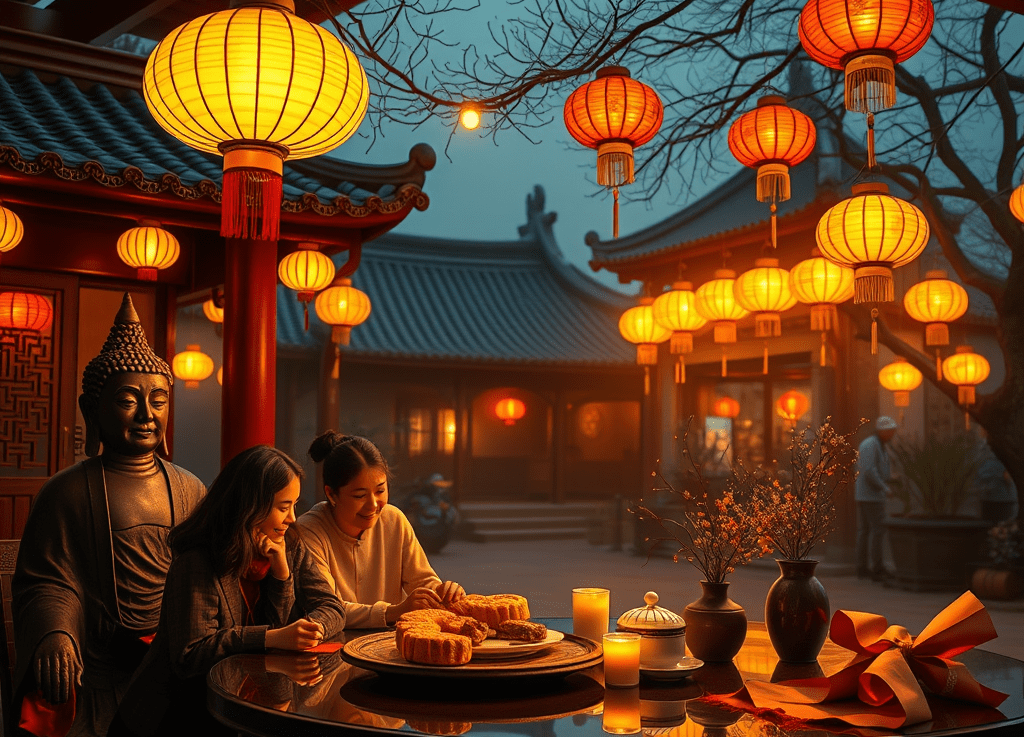
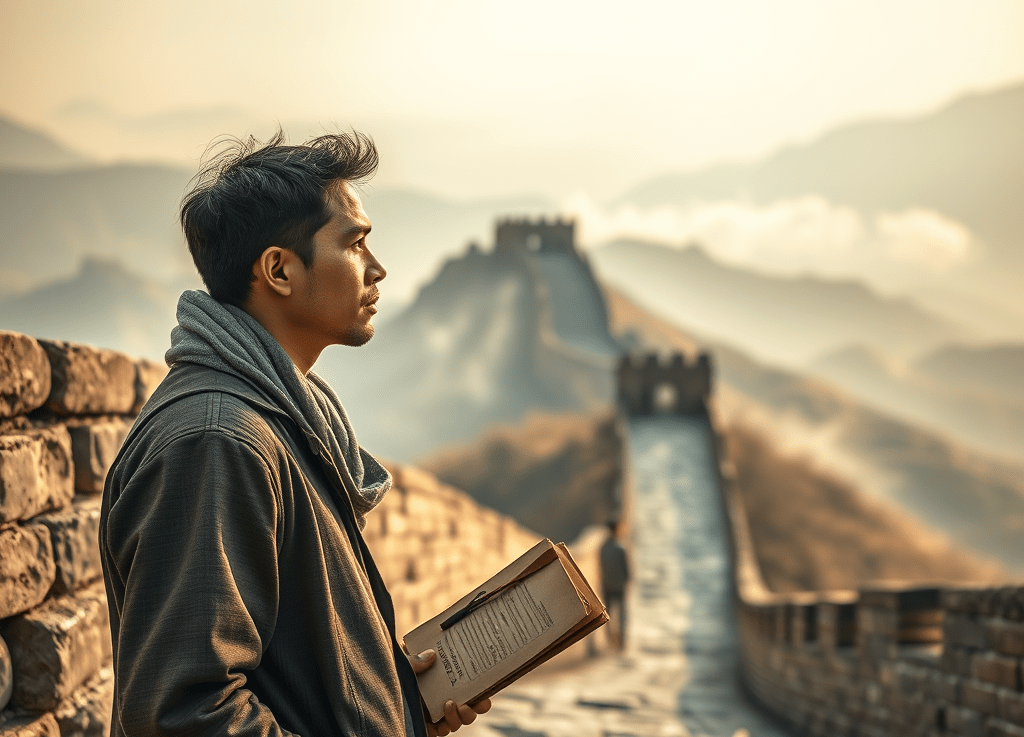
Voor de viering van de chinese herfstmaan had ik met een aantal dierbare vrienden afgesproken om naar de Chinese tempel te Amsterdam te gaan.
De afspraak begon wat onrustig: nummer een liep ik helemaal mis bij het station (daar maakte ik me wel zorgen om), nummer twee kwam daar verlaat aan, nummer drie kwam pas aan toen we al in de tempel waren.
Om tot rust te komen, eerst maar met z’n tweetjes theedrinken in theehuis Himalaya, tijd nemen voor omschakelen van hectiek naar rust in een fijne omgeving.
Gezellig gebabbeld met mijn metgezel, we hadden het nog over de traditie dat je een boeddha-beeldje kado moet krijgen.
In een kalm tempo naar de tempel gegaan, net op tijd om nog een aantal leuke optredens mee te maken van Chinese zang, Hui-dansen, Xing-yi gongfu.
Terwijl ik helemaal tot rust kwam in de tempel, gingen mijn gedachten ook uit naar de dierbaren die er niet bij konden zijn, waarvoor ik steun en hulp vroeg aan Guanyin.
Tussen de bedrijven door werd een loterij gehouden, het kwam zo uit dat mijn metgezel een boeddhabeeldje ontving (waar ze natuurlijk heel erg blij verrast van was); zelf ontving ik een zijden sjaal (die verpakt was in kadopapier met mijn naam )
Deze fijne middag afgesloten met z’n drietjes, koffie verkeerd gedronken in theehuis Himalaya, impressies uitwisselen.
Toen ik eenmaal thuiskwam, zag ik voor mijn stoep de vermiste gast, dus alles was weer helemaal goed!
Tag: China
Pre-Communist Tibet: Embodying the myth of Shangri-la?
Of course, ancient Tibet was no paradise, but the People’s Republic ‘liberation’ of Tibet is not creating a new Marxist dream for the common man…
“If China is the great success story of speedy free market development, and is to be the model and inspiration for Tibet’s future, then old feudal Tibet indeed may start looking a lot better than it actually was.”
Friendly Fuedalism – The Tibet Myth
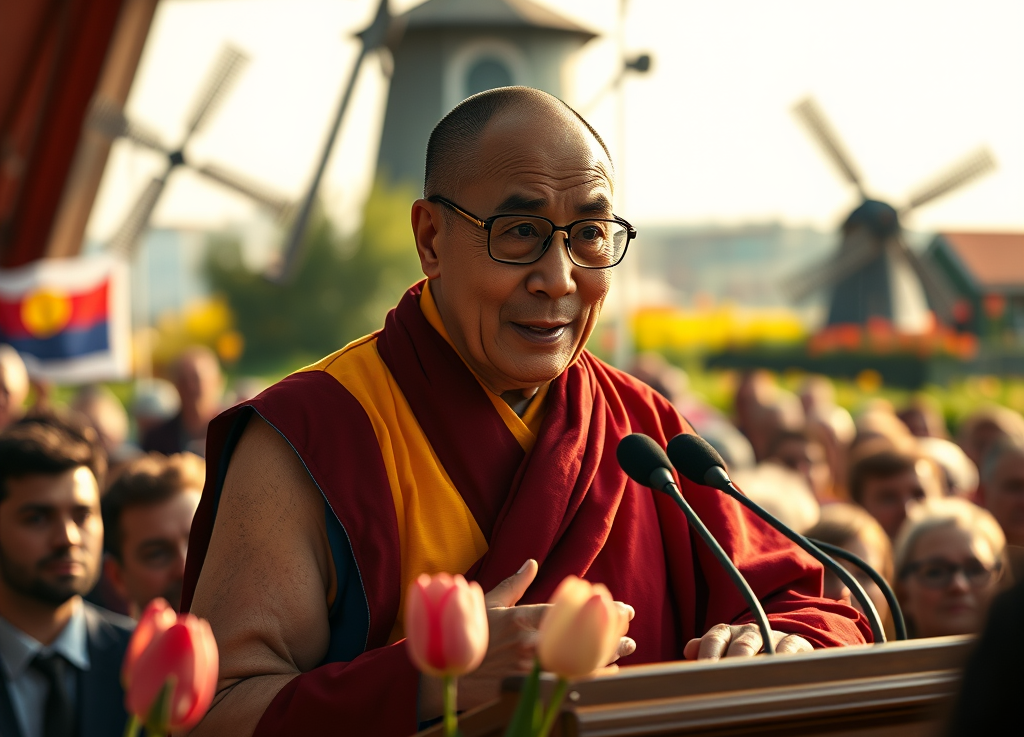
the Dalai Lama will visit Holland 4 & 5 JUNE 2009
While the whole world almost forgets TianAnMen 04-06-1989, the Dalai Lama will visit Holland.
Is the Dutch Government courageous enough to honour these historical important happenings?
http://www.dalailamanederland.nl/
Tian An Men 04-06-1989
A song was heard in China In the city of Beijing.
In the spring of 1989
You could hear the people sing.
And it was the song of freedom
That was ringing in the square,
The world could feel the passion of
The people gathered there.Oh children, blood is on the square.
For many nights and many days,
Waiting in the square.
“To build a better nation”
Was the song that echoed there.
“For we are China’s children,
We love our native land,
For brotherhood and freedom
We are joining hand in hand.”Oh children, blood is on the square.
Then came the People’s army
With trucks and tanks and guns.
The government was frightened
Of their daughters and their sons.
But in the square was courage and
A vision true and fair,
The Army of the People would not harm
The young ones there.Oh children, blood is on the square.
On June the 3rd in China,
In the spring of ’89,
An order came from high above
And passed on down the line.
The soldiers opened fire,
Young people bled and died,
The blood of thousands on the square
That lies can never hide.Oh children, blood is on the square.
For four more days of fury
The people faced the guns.
How many thousands slaughtered
When their grisly work was done?
They quickly burned the bodies
To hide their coward’s shame,
But blood is thick upon their hands and
Darkness on their names.Oh children, blood is on the square.
There are tears that flow in China
For her children that are gone.
There is fear and there is hiding,
For the killing still goes on.
And the iron hand of terror can
Buy silence for today,
But the blood that lies upon the square
Cannot be washed away.Oh children, blood is on the squar
Ai = love
Wie zijn Wei Tuo en Qie Lan?
Onlangs op bezoek geweest in de chinese tempel te amsterdam, waar ik zag hoe Guanyin geflankeerd werd door twee beschermers waarover weinig te vinden was in de folder en website van de tempel:
“Guan Yin Bodhisattva wordt geflankeerd door twee beelden van Wei Tuo en Qie-Lan, de legendarische beschermers van de boeddhistische leer en de tempel.” (Bron: FGS He Hua Amsterdam Zeedijk Tempel – Over Ons)
Wei Tuo is in het chinese buddhisme de Opperbevelhebber van de hemelse legers en wordt afgebeeld als een geharnaste jonge krijger, die leunt op een vajra-donderstaf,
In het buddhisme heet hij Skanda en beschermt hij de Dharma, in deze hoedanigheid wordt Skanda ook geassocieerd met Vajrapani (drager van de donderstaf) die dezelfde functie heeft in het Hellenistisch Buddhisme na Alexander.
Wellicht werd Sikander geassocieerd met Skanda?
Tevens is er de associatie met de Hindugod Skanda aka Kartikeya, opperbevelhebber van de hemelse legers.
Zie ook: http://en.wikipedia.org/wiki/Wei_Tuo
Qie-lan is de buddhistische naam van de vergoddelijkte hertog Guan, de veldheer die tijdens de Drie Koninkrijken bekend werd; door de buddhisten wordt hij, net als Wei Tuo, gezien als beschermer van de Dharma.
Hij wordt vereerd door Confucianisten om zijn loyaliteit en rechtvaardigheid, en door Taoisten in zijn functie van demonendoder.
Zie ook: http://en.wikipedia.org/wiki/Guan_Yu
Persoonlijke noot: gevoelsmatig spreekt GuanYu me meer aan dan WeiTuo, ook in de chinese tempel wist men mij meer te vertellen over GuanYu dan over WeiTuo.
De schok
Hexagram 51, de donder:
“de schok maakt honderd mijl aan het schrikken
en hij laat niet offerlepel en kelk vallen”
Op weg naar vrienden, afgebeld door een wederzijdse vriendin, omdat ze de avond daarvoor een ongeluk hadden gekregen.
Een auto, had hun auto in de flank gegrepen, ze eindigden bijna tegen een boom: twee zwaar gekneusd, de derde moest losgezaagd worden en naar het ziekenhuis gebracht worden.
De rest van de dag heeft dit me bezig gehouden, vragen komen naar boven: waarom juist zij, vooral de jongste die nog zo sprankelt van leven en lente-energie?
In de loop van de nacht, in halfslaap/trance, in de Droomtijd gezocht naar haar aanwezigheid in de werelden:
Uiteindelijk verscheen voor mijn geestesoog, hoe ze mocht verblijven in het rustoord van Holda.
Moge het zo zijn, dat dit verblijf tijdelijk is, en dat ze erna opnieuw gesterkt met nieuwe inspiratie onder ons mag terugkomen op midden-aarde.
Mijn hart is bij haar en degenen die haar nabij zijn.
Zie ook: het ongeluk
Comments on my diary: China Journey 2007
Looking back at my journey:
For me, connecting with the ancestors is becoming a very important issue.
Not only the faraway mainland china connection, but also the more recent chinese diaspora to Java and Holland.
Often I feel on a gut-level during a meeting with somebody with these same roots: we are related, a few hunderd years ago…
The more I research on the shamanic roots of the chinese way of living, the more I discover:
chinese ancestor worship, gongfu (animal-styles, bagua), fengshui, divination (yi jing).
Fragments of my diary: China Journey august 2007:
At this moment I’m in Chongqing, the middle of china.
Already had a intense time in Shanghai-Yangtze river-Fengjie, later on I will visit Xian and Beijing.Many things here remind me of Indonesia: the way people walk, the smells on the street, the shops, the slums.
I often have to explain that I do not speak chinese, but that my ancestors came from here.Shanghai is weird: the contrast between sf and slum is great.
On the Yangtze I realised how this river is connected to chinese history. The great dam has already caused whole villages being displaced to outer provinces like Tibet and Xinjiang, imagine the suffering of the farmers of the displaced people but also on the receiving end in the outer provinces who have to cope with new invaders.
Many old ways are being destroyed in the name of progress.
At the dam I touched mother earth in a rock garden, it made me cry.At Fengjie, city of ghosts, made for all the spirits from china, I realised how much has been destroyed by the cultural revolution.
Chongching is also very large and polluted, my stay here will be short.
I am looking forward to visit Xian, the tomb of the first emperor.
And of course in Beijing I will visit the great wall and TianAnMen square.I hope to be back safe and well during Lammas…
…later…
Xi-an:
Terracotta army in the First Emperors’ tomb.
He was a real monster. Yeah, he ‘pacified’ China, but at the cost of many lives.The Great Mosque of the Hui minority, fascinating to see all kinds of mythic creatures (like dragons etc) depicted despite the Muslim ban on depicting creatures.
Somewhere during the Tang-dynasty the Hui were invited in as mercenary troops to surpress peasant revolts, but now the Muslims are being distrusted as a possible source of terrorism.
Well, the Uighur in Xinjiang and Kazakhstan have cause to rebel against the pressure to be ‘assimilated’ as the Tibetans.Beijing:
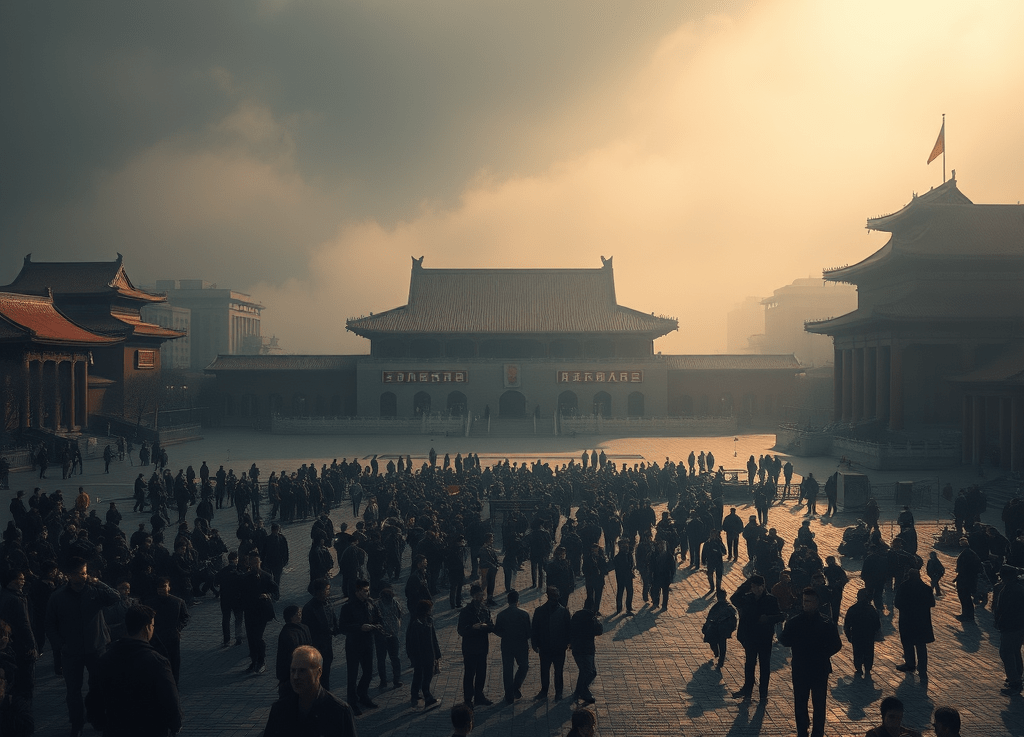
TianAnMen! Standing here, realising how the students’ movement was put down with tanks and guns,moves me to tears.
Weird to realize, that our guide (age 27) has never seen the pictures of that drama.
I brought a origami whitecrane all the way to Holland to here, originally to place it somewhere on this square to honour the fallen, but it was too crowded, so I gave it to our guide with the words: ‘in remembrance of the students that died, remember!’
…
Later on we had a tour through a Hutong, another ancient way of living that’s disappearing in the name of progress & profit: a network of old alleys & houses that form small downtown communities around a common well. The guide showed us a model-family (state-approved on show for tourists of course) who had many modern-day thingies like tv, refrigerator, dvd-player, piano; receiving tourists must be very profitable!.
…
Met some nice shopkeepers: one of them was very delighted to hear that my ancestors came from her home province Fujien, she was able to tell me that the dialect of my predecessors is still common in the area of the MinNan, another piece of the puzzle found!
….Back home again: unpacking, cleaning myself & my stuff, opening my mailbox, calling friends.
Feels like I need to see some dear friends soon to reconnect to this land again!When I was in china, I recoqnized many things I also saw in Java: the way people dress & move, the smells, the food, the housings. I never realised the great influence of the oversea chinese on the Javanese culture!”
We make ‘em tougher here in China…
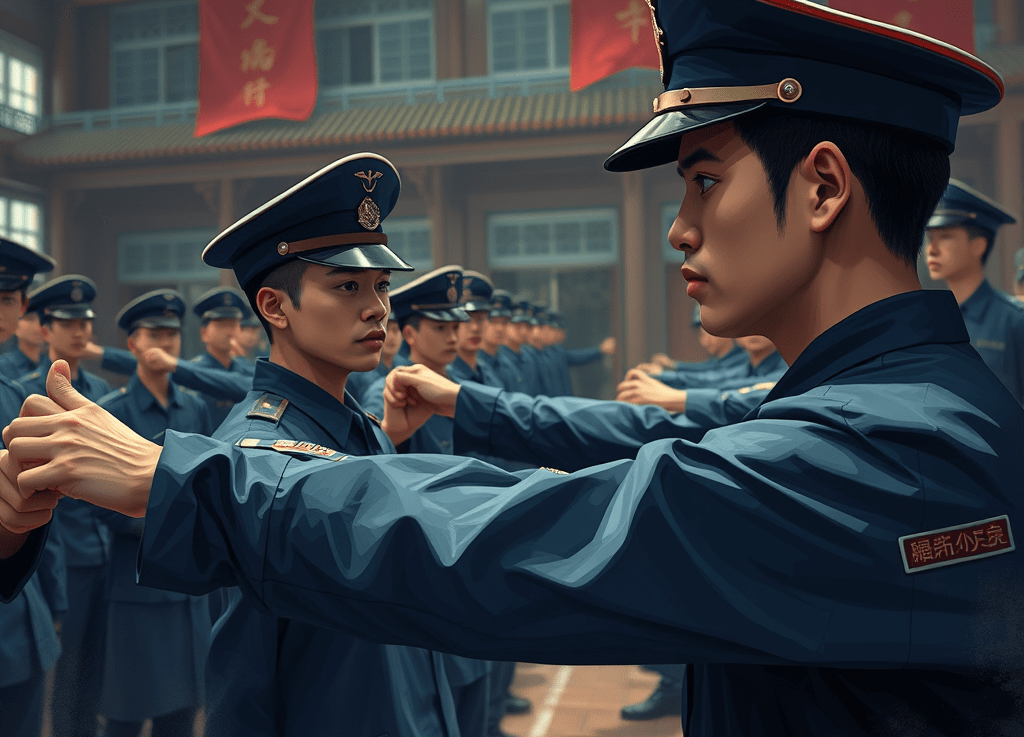
Jacobesis proposes to use militairy training at college to instill a sense of discipline in students.
I say:
seen this, done that…during my teenage time at school we had some marching drills and bajonet-fighting with bamboo-sticks, a perfect way to create war-childs.
I would say yes to teaching self-defense at a young age, but militairy drill is going much too far, it is a way to create fighting robots.
Dragon blog
Arie says:
Somehow I felt that the international healing magick should be done with
the aid of Dragons.
Wikipedia says:
The origin of Chinese dragon is not certain, but many scholars agree that
it originated from totems of different tribes in China .
…
Chinese dragons are strongly associated with water in popular belief.
They are believed to be the rulers of moving bodies of water, such as
waterfalls, rivers, or seas.
…
At the end of his reign, the first legendary Emperor Huang Di was
said to have been immortalized into a dragon that resembled his emblem, and
ascended to Heaven. Since the Chinese consider Huang Di as their ancestor, they
sometimes refer to themselves as “the descendants of the dragon”. This legend
also contributed towards the use of the Chinese dragon as a symbol of imperial power.
…
The four Dragon Kings (龍王; pinyin: Lóng Wáng) are, in Chinese mythology, the divine rulers of the four seas (each sea corresponds to one of the cardinal directions)
Comment:
Connecting with the Dragon Kings means connecting with elementary powers.
Proceed with caution!


You must be logged in to post a comment.