Tag: shaman

Chief Seattle’s Reply (january 1857)

Chief Seattle’s Reply (january 1857)


Yonder sky that has wept tears of compassion upon my people for centuries untold, and which to us appears changeless and eternal, may change.
Today is fair.
Tomorrow it may be overcast with clouds.
My words are like the stars that never change.

Whatever Seattle says, the great chief at Washington can rely upon with as much certainty as he can upon the return of the sun or the seasons.
The white chief says that Big Chief at Washington sends us greetings of friendship and goodwill.
This is kind of him for we know he has little need of our friendship in return.
His people are many.
They are like the grass that covers vast prairies.
My people are few.
They resemble the scattering trees of a storm-swept plain.

The great, and I presume — good, White Chief sends us word that he wishes to buy our land but is willing to allow us enough to live comfortably.
This indeed appears just, even generous, for the Red Man no longer has rights that he need respect, and the offer may be wise, also, as we are no longer in need of an extensive country.

There was a time when our people covered the land as the waves of a wind-ruffled sea cover its shell-paved floor, but that time long since passed away with the greatness of tribes that are now but a mournful memory.
I will not dwell on, nor mourn over, our untimely decay, nor reproach my paleface brothers with hastening it, as we too may have been somewhat to blame.

Youth is impulsive.
When our young men grow angry at some real or imaginary wrong, and disfigure their faces with black paint, it denotes that their hearts are black, and that they are often cruel and relentless, and our old men and old women are unable to restrain them.
Thus it has ever been.
Thus it was when the white man began to push our forefathers ever westward.
But let us hope that the hostilities between us may never return.
We would have everything to lose and nothing to gain.
Revenge by young men is considered gain, even at the cost of their own lives, but old men who stay at home in times of war, and mothers who have sons to lose, know better.

Our good father in Washington–for I presume he is now our father as well as yours, since King George has moved his boundaries further north–our great and good father, I say, sends us word that if we do as he desires he will protect us.
His brave warriors will be to us a bristling wall of strength, and his wonderful ships of war will fill our harbors, so that our ancient enemies far to the northward — the Haidas and Tsimshians — will cease to frighten our women, children, and old men.
Then in reality he will be our father and we his children.
But can that ever be?

Your God is not our God!
Your God loves your people and hates mine!
He folds his strong protecting arms lovingly about the paleface and leads him by the hand as a father leads an infant son.
But, He has forsaken His Red children, if they really are His.
Our God, the Great Spirit, seems also to have forsaken us. Y
our God makes your people wax stronger every day.
Soon they will fill all the land.
Our people are ebbing away like a rapidly receding tide that will never return.
The white man’s God cannot love our people or He would protect them.
They seem to be orphans who can look nowhere for help.
How then can we be brothers?
How can your God become our God and renew our prosperity and awaken in us dreams of returning greatness?
If we have a common Heavenly Father He must be partial, for He came to His paleface children.
We never saw Him.
He gave you laws but had no word for His red children whose teeming multitudes once filled this vast continent as stars fill the firmament.
No; we are two distinct races with separate origins and separate destinies.
There is little in common between us.

To us the ashes of our ancestors are sacred and their resting place is hallowed ground.
You wander far from the graves of your ancestors and seemingly without regret.
Your religion was written upon tablets of stone by the iron finger of your God so that you could not forget.
The Red Man could never comprehend or remember it. Our religion is the traditions of our ancestors — the dreams of our old men, given them in solemn hours of the night by the Great Spirit; and the visions of our sachems, and is written in the hearts of our people.

Your dead cease to love you and the land of their nativity as soon as they pass the portals of the tomb and wander away beyond the stars.
They are soon forgotten and never return. Our dead never forget this beautiful world that gave them being.
They still love its verdant valleys, its murmuring rivers, its magnificent mountains, sequestered vales and verdant lined lakes and bays, and ever yearn in tender fond affection over the lonely hearted living, and often return from the happy hunting ground to visit, guide, console, and comfort them.

Day and night cannot dwell together.
The Red Man has ever fled the approach of the White Man, as the morning mist flees before the morning sun.
However, your proposition seems fair and I think that my people will accept it and will retire to the reservation you offer them.
Then we will dwell apart in peace, for the words of the Great White Chief seem to be the words of nature speaking to my people out of dense darkness.

It matters little where we pass the remnant of our days.
They will not be many.
The Indian’s night promises to be dark.
Not a single star of hope hovers above his horizon.
Sad-voiced winds moan in the distance.
Grim fate seems to be on the Red Man’s trail, and wherever he will hear the approaching footsteps of his fell destroyer and prepare stolidly to meet his doom, as does the wounded doe that hears the approaching footsteps of the hunter.

A few more moons, a few more winters, and not one of the descendants of the mighty hosts that once moved over this broad land or lived in happy homes, protected by the Great Spirit, will remain to mourn over the graves of a people once more powerful and hopeful than yours.
But why should I mourn at the untimely fate of my people?
Tribe follows tribe, and nation follows nation, like the waves of the sea.
It is the order of nature, and regret is useless.
Your time of decay may be distant, but it will surely come, for even the White Man whose God walked and talked with him as friend to friend, cannot be exempt from the common destiny.
We may be brothers after all.
We will see.

We will ponder your proposition and when we decide we will let you know.
But should we accept it, I here and now make this condition that we will not be denied the privilege without molestation of visiting at any time the tombs of our ancestors, friends, and children.
Every part of this soil is sacred in the estimation of my people.
Every hillside, every valley, every plain and grove, has been hallowed by some sad or happy event in days long vanished.
Even the rocks, which seem to be dumb and dead as the swelter in the sun along the silent shore, thrill with memories of stirring events connected with the lives of my people, and the very dust upon which you now stand responds more lovingly to their footsteps than yours, because it is rich with the blood of our ancestors, and our bare feet are conscious of the sympathetic touch.
Our departed braves, fond mothers, glad, happy hearted maidens, and even the little children who lived here and rejoiced here for a brief season, will love these somber solitudes and at eventide they greet shadowy returning spirits.

And when the last Red Man shall have perished, and the memory of my tribe shall have become a myth among the White Men, these shores will swarm with the invisible dead of my tribe, and when your children’s children think themselves alone in the field, the store, the shop, upon the highway, or in the silence of the pathless woods, they will not be alone. In all the earth there is no place dedicated to solitude.
At night when the streets of your cities and villages are silent and you think them deserted, they will throng with the returning hosts that once filled them and still love this beautiful land.
The White Man will never be alone.

Let him be just and deal kindly with my people, for the dead are not powerless.
Dead, did I say? There is no death, only a change of worlds.

Ping: https://en.wikipedia.org/wiki/Chief_Seattle’s_speech

De weg van de Krijger-Sjamaan

De weg van de Krijger-Sjamaan


In mijn visie beschouw ik de esoterische vechtkunsten (Taiji, Bagua, Xingyi) als methodes om door middel van vechtkunsten tot geestelijke bewustwording te komen.
Als je bezig bent met vechtkunst, kom je de volgende leerpunten tegen: Angst en agressie in jezelf en in je opponent.
Een algemene ethische regel bij de vechtkunst is, dat fysiek geweld pas in allerlaatste instantie als oplossing wordt aangeboden.
In eerste instantie gaat het er om, een situatie waarin geweld zou kunnen ontstaan, te herkennen en te vermijden; wanneer de situatie onvermijdelijk zou zijn, is het streven om met een minimum aan geweld de aanvaller onschadelijk te maken.
Naast de toepassing van de vechtkunst in een daadwerkelijk gevecht, word je ook getraind in een specifieke geesteshouding, die ook van toepassing zou moeten zijn in het dagelijkse leven: een houding van alertheid, het vermogen om stress-situaties te onderkennen en te neutraliseren.
Nog verder gaat de esoterische training van de geest: Het fysieke beoefenen van vechtkunst kan je in geestelijke zin ook gebruiken als metafoor in het omgaan met geestelijke problemen.

Wat zijn geesten?

Wat zijn geesten?


Dikke van Dale

quote:
geest (de ~ (m.), ~en, ~en)
1 datgene in de mens wat denkt, voelt en wil => psyche; <=> lichaam
2 de scheppende, bezielende kracht die van iem. of iets uit gaat
3 strekking, bedoeling
4 onstoffelijk wezen
5 iem., beschouwd als een sterke, vooral intellectuele, persoonlijkheid

Waarover praten wij, als we het woord ‘geest’ gebruiken?
geest-psyche: psyche komt uit het grieks en betekent ziel of vlinder, dan hebben we het over de geest als ziel.

geest-onstoffelijk: etymologisch gezien is er een verband tussen geest en gas, geest als onstoffelijk ‘iets’, zoals ‘spirit’ etymologisch verbonden is aan ‘spiritus’.

In de Joodse traditie wordt onderscheid gemaakt tussen ruach (goddelijke, hogere) geest en nephesh (dierlijke, instinctieve, lagere) geest, die beiden aspecten vormen van de menselijke geest.

In de Arabische traditie word gesproken over jinni, een soort van elementale geesten.
Over Salomo word gezegd dat hij heerser was over de jinni.
In de Koran is sura 72 (al-jinni) gewijd aan de jinni.

In de Egyptische traditie worden nog meer onderverdelingen van ‘geest’ gemaakt:
ba, de bewuste identiteit & persoonlijkheid
ka, het etherisch dubbellichaam
sekhem, de aangeboren magische energie
sah, het astraallichaam
khaibit, de schaduw, de aura

De vraag blijft dus:
Waarover spreken wij, als we het woord ‘geest’ gebruiken?
Over ‘iets’ dat in beginsel bij de mens hoort?
Zo ja, welk aspect van dat ‘iets’ benoemen we dan?
Of over ‘iets’ dat ook niet-menselijk van oorsprong kan zijn?

Seizoensfeesten

Seizoensfeesten


De Lente-equinox (omstreeks 21 maart)
Equinox: de dag is net zo lang als de nacht.
Lente: Vanaf dit punt worden de dagen langer dan de nachten
We vieren de definitieve doorbraak van het licht.
Thema: nieuwe bloei van het leven.

De Zomerzonnewende (omstreeks 21 juni)
De zon staat op het hoogste punt, dit is de langste dag, de warmste periode, maar hierna gaat het zonlicht weer afnemen.
We vieren het hoogtepunt van het licht.

De Herfstequinox (omstreeks 21 september)
Equinox: de dag is net zo lang als de nacht.
Herfst: Vanaf dit punt worden de nachten langer dan de dagen.
We vieren het afscheid van het licht.
Thema: oogsten, loslaten.

De Winterzonnewende (omstreeks 21 december)
De zon staat op haar laagste punt, dit is de langste nacht, de koudste periode, maar hierna gaat het zonlicht weer toenemen.
We vieren de wedergeboorte van het licht.
Thema: nieuwe hoop

Ishtar in the underworld

Ishtar in the underworld


To Kurnugi, land of [no return],
Ishtar daughter of Sin was [determined] to go;
The daughter of Sin was determined to go
To the dark house, dwelling of Erkalla’s god,
To the house which those who enter cannot leave,
On the road where travelling is one-way only,
To the house where those who enter are deprived of light,
Where dust is their food, clay their bread.
They see no light, they dwell in darkness,
They are clothed like birds, with feathers.
Over the door and the bolt, dust has settled.
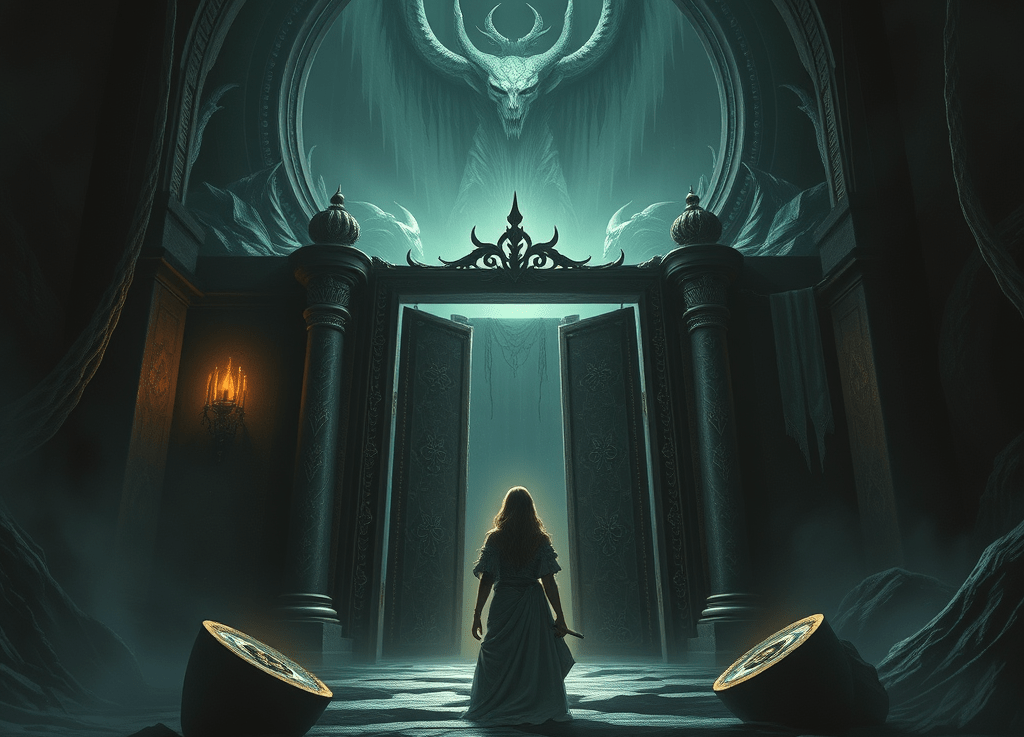
Ishtar, when she arrived at the gate of Kurnugi,
Addressed her words to the keeper of the gate,
“Here gatekeeper, open your gate for me,
Open your gate for me to come in!
If you do not open the gate for me to come in!
If you do not open the gate for me to come in,
I shall smash the door and shatter the bolt,
I shall smash the doorpost and overturn the doors,
I shall raise up the dead and they shall eat the living:
The dead shall outnumber the living!”
The gatekeeper made his voice heard and spoke,
He said to great Inanna,
“Stop, lady, do not break it down!
Let me go and report your words to queen Ereshkigal.”
The gatekeeper went in and spoke to [Ereshkigal],
“Here she is, your sister Inanna [. . .]
Who holds the great keppu’toy,
Stirs up the Abzu in Ea’s presence [. . .]?”

When Ereshkigal heard this,
Her face grew livid as cut tamarisk,
Her lips grew dark as the rim of a kuninu-vessel.
“What brings her to me? What has incited her against me?
Surely not because I drink water with the Anunnaki,
I eat clay for bread,I drink muddy water for beer?
I have to weep for young men forced to abandon their sweethearts.
I have to weep for girls wrenched from their lover’s laps.
For the infant child I have to weep, expelled before its time.
Go,gatekeeper, open your gate to her.
Treat her asccording to the ancient rites.”
The gatekeeper went.
He opened the gate to her.
“Enter, my lady: may Kutha give you joy,
May the palace of Kurnugi be glad to see you”

He let her in through the first door, but stripped off (and) took away the great crown on her head,
“Gatekeeper, why have you taken away the great crown on my head?”
“Go in, my lady. Such are the rites of the Mistress of Earth.”
He let her in through the second door, but stripped off (and) took away the rings in her ears.
“Gatekeeper, why have you taken away the rings in my ears?”
“Go in, my lady. Such are the rites of the Mistress of Earth.”
He let her in through the third door, but stripped off (and) away the beads around her neck.
“Gatekeeper, why have you taken away the beads around my neck?”
“Go in, my lady. Such are the rites of the Mistress of Earth.”
He let her in through the fourth door, but stripped off (and) took away the toggle pins at her breast.
“Gatekeeper, why have you taken away the toggle pins at my breast?”
“Go in, my lady. Such are the rites of the Mistress of Earth.”
He let her in through the fifth door, but stripped off (and) took away the girdle of birth-stones around her waist.
“Gatekeeper, why have you taken the girdle of birth stones around my waist?”
“Go in, my lady. Such are the rites of the Mistress of Earth.”
He let her in through the sixth door, but stripped off (and) took away the bangles on her wrists and ankles.
“Gatekeeper, why have you taken away the bangles from my wrists and ankles?”
“Go in my lady. Such are the rites of the Mistress of Earth.”
He let her in through the seventh door, but stripped off (and) took away the proud garment of her body.
“Gatekeeper, why have you taken away the proud garment of my body?”
“Go in, my lady. Such are the rites of the Mistress of Earth.”
As soon as Inanna went down to Kurnugi,
Ereshkigal loked at her and trembled before her.
Inanna did not deliberate (?), but leant over her.
Ereshkigal made her voice heard and spoke,
Addressed her words to Namtar her vizier,
“Go Namtar [ ] of my [ ]
Send out against her sixty diseases
[ ] Inanna:
Disease of the eyes to her [eyes]
Disease of the arms to her [arms]
Disease of the feet to her [feet]
Disease of the heart to her [heart]
Disease of the head [to her head]
To every part of her and to [ ].”
After Inanna the Mistress of (?) [had gone to Kernugi]
No bull mounted a cow, [no donkey impregnated a jenny]
No young man impregnated a girl [in thr street(?)]
The young man slept in his private room,
The girl slept in the company of her friends.
Then Papsukkal, vizier of the great gods, hung his head, his face [became gloomy];
He wore mourning clothes, his hair unkempt.
Dejected(?), he went and wept before Sin his father,
His tears flowed freely before king Ea.
“Inanna has gone down to The Earth and has not come up again.
As soon as Inanna went down to Kurnugi
No bull mounted a cow, no donkey impregnated a jenny,
No young man impregnated a girl on the street
The young man slept in his private room,
The girl slept in the company of her friends.”
Ea, in the wisdom of his heart, created a person.
He created Good-looks the playboy.
“Come,Good-looks,set your face towards the gate of Kurnugi.
The seven gates of Kurnugi shall be opened before you.
Ereshkigal shall look at you and be glad to see you.
When she is relaxed, her mood will lighten.
Get her to swear the oath by the great gods.
Raise your head, pay attention to the waterskin,
Saying, ‘Hey my lady,let them give me the waterskin, that I may drink water from it.'”

(and so it happened. But)
When Ereshkigal heard this,
She struck her thigh and bit her finger.
“You have made a request of me that should not have been made!
Come, Good-looks, I shall curse you with a great curse.
I shall decree for you a fate that shall never be forgotten.
Bread (gleaned(?)) from the city’s ploughs shall be your food,
The city drains shall be your only drinking place,
Threshold steps your only sitting place,
The drunkard and the thirsty shall slap your cheek.”
Ereshkigal made her voice heard and spoke:
She adressd her words to Namtar her vizier,
“Go Namtar, knock (?) at Egalina,
Decorate the threshold steps with coral,
Bring the Annunaki out and seat (them) on golden thrones,
Sprinkle Inanna with the waters of life and conduct her into my presence.”
Namtar went, knocked at Egalina,
Decorated the threshold steps with coral,
Brought out the Annunaki, seated them on golden thrones,
Sprinkled Inanna with the waters of life and brought her out to her (sister).
He let her out through the the first door, and gave her back to her the proud garment of her body.
He let her out through the second door, and gave back to her the bangles of her wrists and ankles.
He let her out through the third door, and gave back to her the girdle of birthstones around her waist.
He let her out through the fourth door, and gave back to her the toggle-pins at her breast.
He let her out through the fifth door, and gave back to her the beads around her neck.
He let her out through the sixth door, and gave back to her the rings for her ears.
He let her out through the seventh door, and gave back the great crown for her head.
“Swear that (?) she has paid you for her ransom,and give her back (in exchange) for him,
For Dmuzi,the lover of her youth,
Wash (him) with pure water,anoint him with sweet oil,
Clothe him in a red robe, let the lapis lazuli pipe play(?)
Let party-girls raise a loud lament(?)”
Then Belili tore off (?) her jewellery,
Her lap was filled with eyestones.
Belili heard the lament for her brother, she struck the jewellery [from her body],
The eyestones with which the front of the wild cow was filled.
“You shall not rob me (forever) of my only brother!
On the day when Dmuzi comes back up, (and) the lapis pipe and the carnelian ring come up with him,
(When) male and female mourners come up with him,
The dead shall come up and smell the smoke offering”